van den Tillaar Roland, Saeterbakken Atle Hole
Department of Sports Science and Physical Education, Nord University, Levanger, Norway.
Department of Teacher Education and Sports, Western Norwy University of Applied Sciences, Sogndal, Norway.
J Hum Kinet. 2018 Jun 13;62:43-53. doi: 10.1515/hukin-2017-0176. eCollection 2018 Jun.
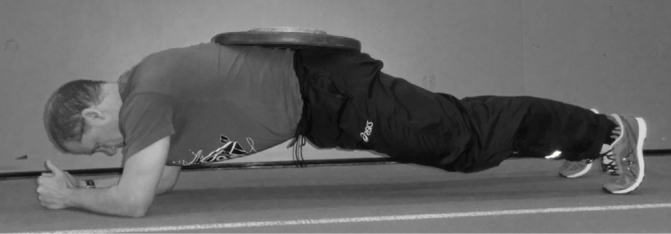
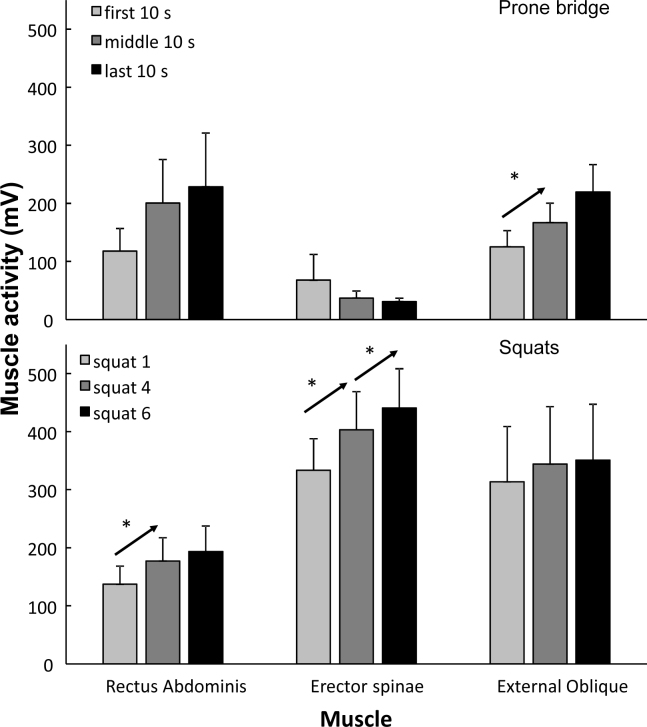
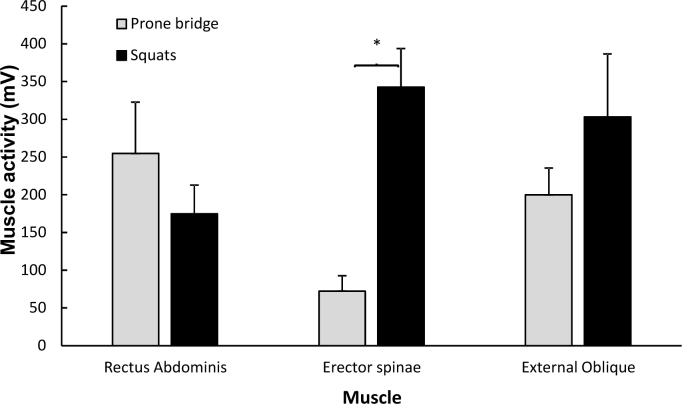
The purpose of this study was to compare core muscle activation during a prone bridge (plank) until failure and 6-RM back squats. Twelve resistance-trained males (age 23.5 ± 2.6 years, body mass 87.8 ± 21.3 kg, body height 1.81 ± 0.08 m) participated in this study. Total exercise time and EMG activity of the rectus abdominis, external abdominal oblique and erector spinae were measured during 6-RM back squats and a prone bridge with a weight of 20% of participants' body mass on their lower back. The main findings showed non-significant differences between the exercises in the rectus abdominis or external oblique, but greater erector spinae activation in squatting. Furthermore, in contrast to the prone bridge, the erector spinae and rectus abdominis demonstrated increasing muscle activation throughout the repetitions while squatting, whereas the prone bride demonstrated increasing external oblique activation between the beginning and the middle of the set. It was concluded that since squatting resulted in greater erector spine activation, but similar rectus abdominis and oblique external activation as the prone bridge, high-intensity squats rather than isometric low intensity core exercises for athletes would be recommended.
本研究的目的是比较俯卧桥(平板支撑)直至力竭和6次重复最大重量的深蹲过程中核心肌肉的激活情况。12名经过抗阻训练的男性(年龄23.5±2.6岁,体重87.8±21.3千克,身高1.81±0.08米)参与了本研究。在6次重复最大重量的深蹲以及在参与者下背部负重其体重20%的俯卧桥过程中,测量了总运动时间以及腹直肌、腹外斜肌和竖脊肌的肌电图活动。主要研究结果表明,在腹直肌或腹外斜肌方面,两种运动之间无显著差异,但深蹲时竖脊肌的激活程度更高。此外,与俯卧桥不同,深蹲时竖脊肌和腹直肌在整个重复过程中肌肉激活程度不断增加,而俯卧桥在组间开始和中间阶段腹外斜肌的激活程度增加。研究得出结论,由于深蹲导致竖脊肌的激活程度更高,但腹直肌和腹外斜肌的激活程度与俯卧桥相似,因此建议运动员进行高强度深蹲而非等长低强度核心训练。