Gonçalves Bruno, Folgado Hugo, Coutinho Diogo, Marcelino Rui, Wong Del, Leite Nuno, Sampaio Jaime
Research Center in Sports Sciences, Health Sciences and Human Development, CIDESD, CreativeLab Research Community, Évora, Portugal.
Sport Sciences Department, Universidade de Trás-os-Montes e Alto Douro, Vila Real, Portugal.
J Hum Kinet. 2018 Jun 13;62:145-155. doi: 10.1515/hukin-2017-0166. eCollection 2018 Jun.
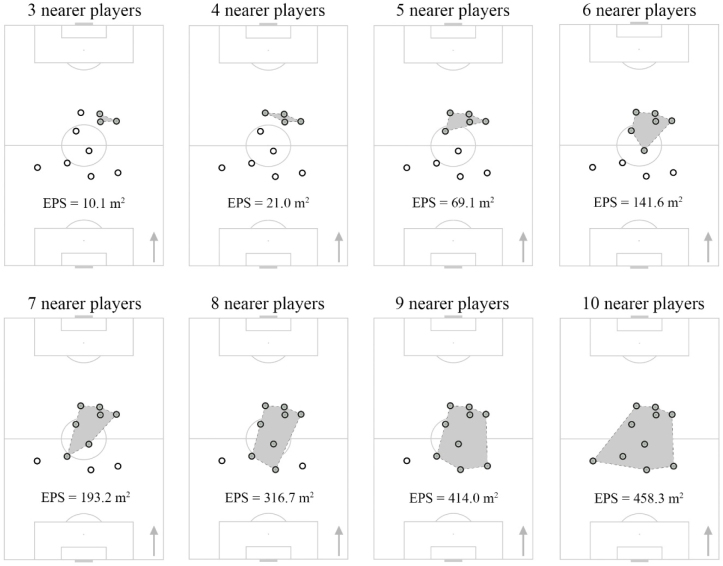
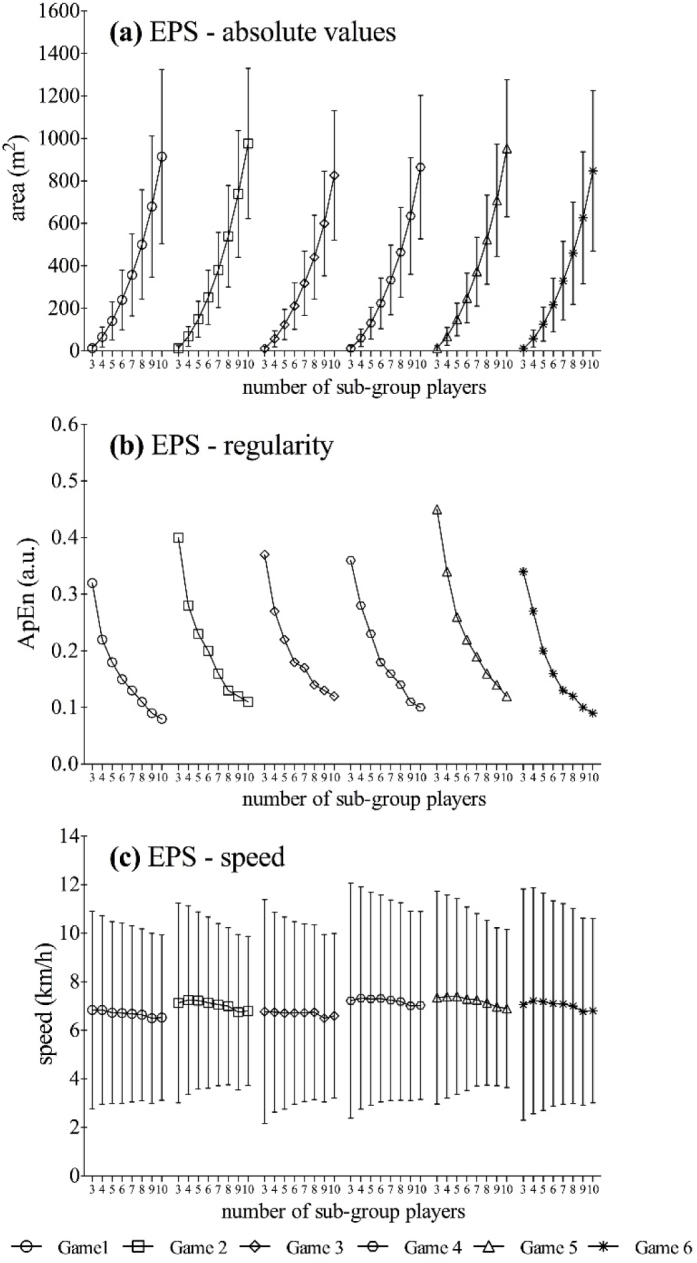
Success in soccer is much dependent on how players and teams create and restrict space and time. In match situations, players constitute small sub-groups to improve their collective synchronization and achievement of specific goals. This study aimed to identify changes in the effective playing space (EPS, defined as the smallest polygonal area delimited by the peripheral outfield players) when considering sub-groups of 3 to 10 players. Twenty outfield professional players participated in this study. The EPS, its regularity pattern (measured by the approximate entropy), coefficient of variation and players' mean speed were calculated for sub-groups of 3, 4, 5, 6, 7, 8, 9 and 10 players, considering the smallest inter-player distance as the criterion. The EPS presented a most likely increase with a higher number of players, especially considering the transition from 3 to 4 players (~440% of variation, very large). As the EPS increased with the number of players, the correspondent regularity presented a trend of a most likely increase (from EPS3 vs. EPS4: ~25%, very large; to EPS9 vs. EPS10: ~11%, moderate). The mean speed results suggest that players may achieve different states of collective coordination, mainly between ~6 to 8 km.h-1. Overall, three different match scenarios should require additional attention when aiming to design more match transferable tasks: i) transition from EPS3 to EPS4; ii) transition from EPS4 up to EPS8; and iii) transition from EPS8 to EPS9. These results help to understand match self-organized behaviours and, consequently, allow to optimize task characteristics in practice sessions.
足球比赛的成功很大程度上取决于球员和球队如何创造和限制空间与时间。在比赛情境中,球员会组成小的子群体以提高他们的集体同步性并实现特定目标。本研究旨在确定当考虑3至10名球员的子群体时有效比赛空间(EPS,定义为由外围外场球员划定的最小多边形区域)的变化。20名外场职业球员参与了本研究。以球员之间的最小距离为标准,计算了3、4、5、6、7、8、9和10名球员子群体的EPS、其规律性模式(通过近似熵测量)、变异系数和球员平均速度。随着球员数量增加,EPS极有可能增大,尤其是考虑从3名球员到4名球员的转变时(变异约440%,非常大)。随着EPS随球员数量增加,相应的规律性呈现出极有可能增加的趋势(从EPS3与EPS4对比:约25%,非常大;到EPS9与EPS10对比:约11%,中等)。平均速度结果表明,球员可能会达到不同的集体协调状态,主要在约6至8公里/小时之间。总体而言,在旨在设计更具比赛可转移性的任务时,三种不同的比赛场景应格外关注:i)从EPS3到EPS4的转变;ii)从EPS4到EPS8的转变;iii)从EPS8到EPS9的转变。这些结果有助于理解比赛中的自组织行为,从而在训练课中优化任务特征。