Department of Biology, University of Central Florida, Orlando, FL.
Division of Invertebrate Zoology, American Museum of Natural History, New York, NY.
Mol Biol Evol. 2018 Sep 1;35(9):2097-2109. doi: 10.1093/molbev/msy124.
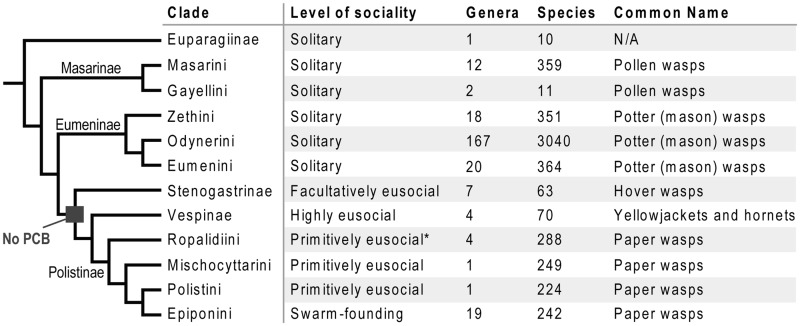
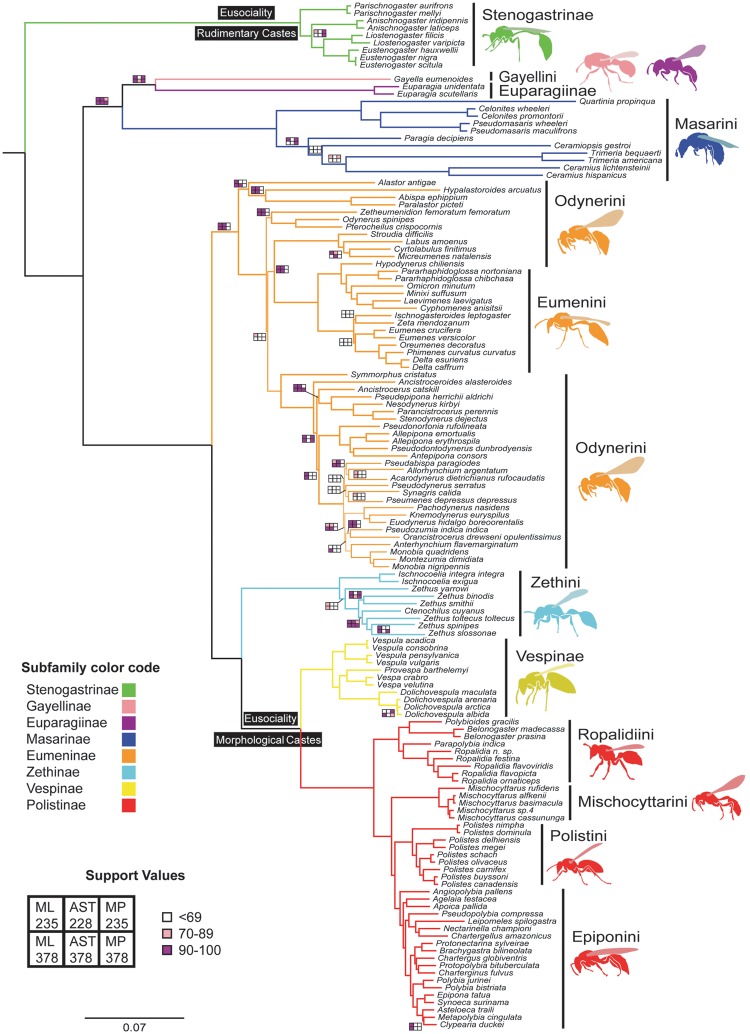
The hypothesis that eusociality originated once in Vespidae has shaped interpretation of social evolution for decades and has driven the supposition that preimaginal morphophysiological differences between castes were absent at the outset of eusociality. Many researchers also consider casteless nest-sharing an antecedent to eusociality. Together, these ideas endorse a stepwise progression of social evolution in wasps (solitary → casteless nest-sharing → eusociality with rudimentary behavioral castes → eusociality with preimaginal caste-biasing (PCB) → morphologically differentiated castes). Here, we infer the phylogeny of Vespidae using sequence data generated via anchored hybrid enrichment from 378 loci across 136 vespid species and perform ancestral state reconstructions to test whether rudimentary and monomorphic castes characterized the initial stages of eusocial evolution. Our results reject the single origin of eusociality hypothesis, contest the supposition that eusociality emerged from a casteless nest-sharing ancestor, and suggest that eusociality in Polistinae + Vespinae began with castes having morphological differences. An abrupt appearance of castes with ontogenetically established morphophysiological differences conflicts with the current conception of stepwise social evolution and suggests that the climb up the ladder of sociality does not occur through sequential mutation. Phenotypic plasticity and standing genetic variation could explain how cooperative brood care evolved in concert with nest-sharing and how morphologically dissimilar castes arose without a rudimentary intermediate. Furthermore, PCB at the outset of eusociality implicates a subsocial route to eusociality in Polistinae + Vespinae, emphasizing the role of mother-daughter interactions and subfertility (i.e. the cost component of kin selection) in the origin of workers.
真社会性起源于 Vespidae 的假说已经影响了几十年来对社会进化的解释,并推动了这样一种假设,即在真社会性起源之初,不同等级之间的预蛹形态生理差异并不存在。许多研究人员还认为无等级的巢共享是真社会性的前身。这些观点共同支持黄蜂中社会进化的逐步发展(独居→无等级的巢共享→具有基本行为等级的真社会性→具有预蛹等级偏倚(PCB)的真社会性→形态分化的等级)。在这里,我们使用通过 136 种黄蜂物种的 378 个基因座的锚定混合富集生成的序列数据推断 Vespidae 的系统发育,并进行祖先状态重建,以检验基本的和单态的等级是否具有真社会性进化的初始阶段的特征。我们的结果否定了真社会性起源于单一起源的假说,挑战了真社会性起源于无等级的巢共享祖先的假设,并表明 Polistinae+Vespinae 的真社会性始于具有形态差异的等级。具有胚胎发生上建立的形态生理差异的等级的突然出现与逐步社会进化的当前概念相冲突,表明社会等级的攀升不是通过连续突变发生的。表型可塑性和遗传变异的稳定性可以解释为什么合作的育雏护理与巢共享一起进化,以及形态上不同的等级是如何在没有基本中间阶段的情况下出现的。此外,在真社会性起源之初的 PCB 表明 Polistinae+Vespinae 中的亚社会性是真社会性的一种途径,强调了母女相互作用和亚不育(即亲属选择的成本成分)在工蜂起源中的作用。