Department of Environmental Technology, Kaunas University of Technology, Kaunas, Lithuania.
Empa (Swiss Federal Laboratories for Materials Science and Technology), Laboratory for Advanced Analytical Technologies, Dübendorf, Switzerland.
Nicotine Tob Res. 2019 Sep 19;21(10):1371-1377. doi: 10.1093/ntr/nty121.
There are fundamental differences between electronic cigarettes (e-cigarettes) and conventional cigarette product categories with regards to potential environmental exposures, notably that e-cigarettes do not contain tobacco or generate side-stream emissions. Here we assess the spatial and temporal patterns of exhaled e-cigarette aerosol at a bystander's position, and compare it with conventional cigarette smoke emissions.
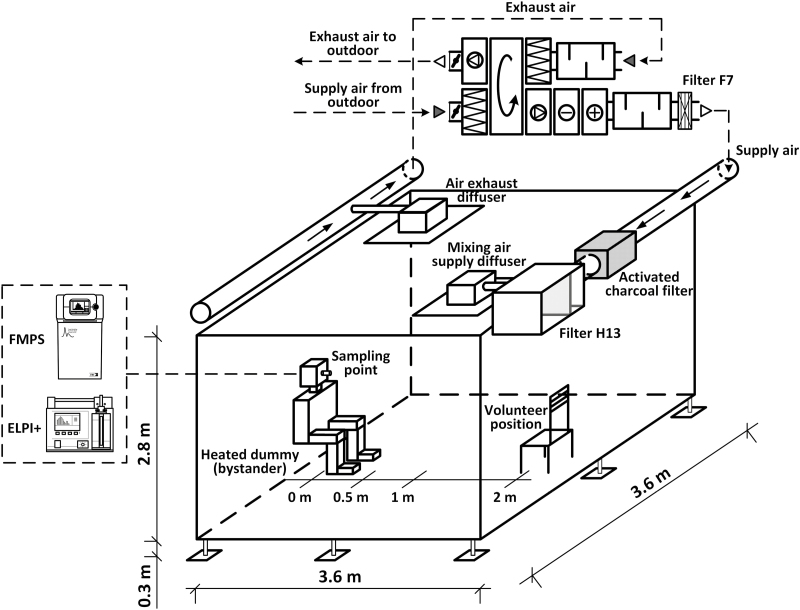
Smokers were asked to use e-cigarettes or smoke conventional cigarettes in a room-simulating chamber. Volunteers used the products at different distances from a heated mannequin, representing a bystander, and under different room ventilation rates. Aerosol particle concentrations and size distributions at the bystander's position were measured.
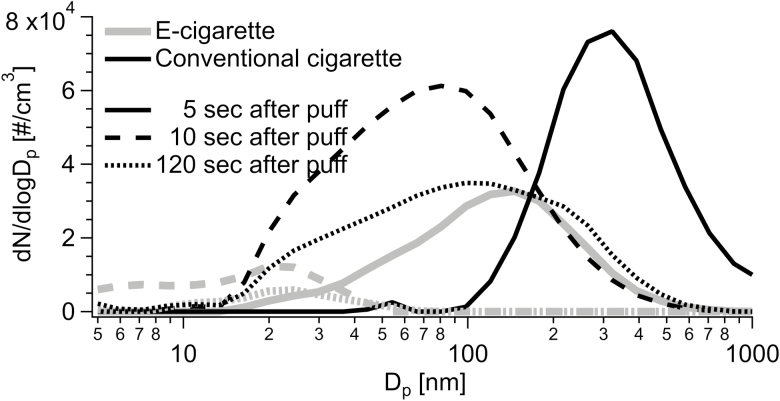
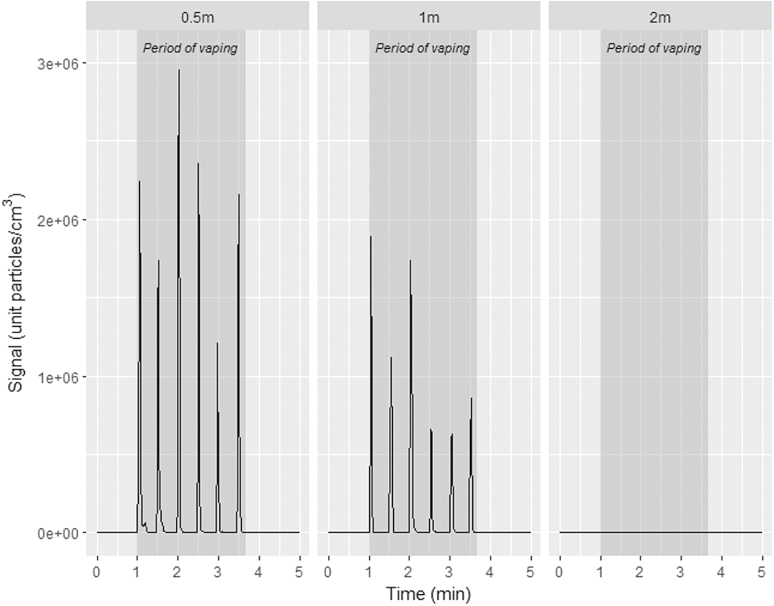
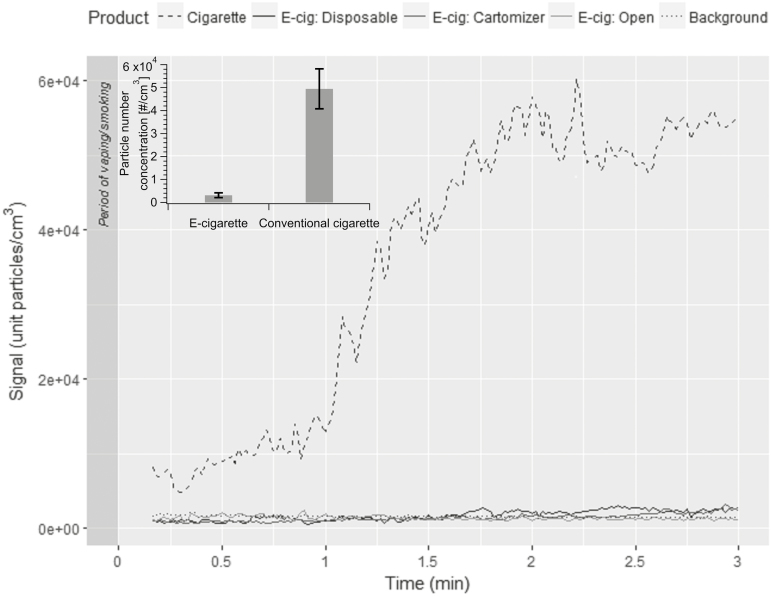
For both product categories, the particle concentrations registered following each puff were in the same order of magnitude. However, for e-cigarettes the particle concentration returned rapidly to background values within seconds; for conventional cigarettes it increased with successive puffs, returning to background levels after 30-45 minutes. Unlike for the e-cigarette devices tested, such temporal variation was dependent on the room ventilation rate. Particle size measurements showed that exhaled e-cigarette particles were smaller than those emitted during smoking conventional cigarettes and evaporated almost immediately after exhalation, thus affecting the removal of particles through evaporation rather than displacement by ventilation.
Significant differences between emissions from the tested e- and conventional cigarettes are reported. Exhaled e-cigarette particles are liquid droplets evaporating rapidly; conventional cigarette smoke particles are far more stable and linger.
• Several factors potentially influencing particle behavior after exhalation of e-cigarette aerosols or emitted during smoking conventional cigarettes were studied.• Differences in particle size between those exhaled following use of e-cigarettes and those emitted during smoking of conventional cigarettes were observed.• E-cigarette particle concentrations decreased rapidly following exhalation due to evaporation.• The removal of particles following smoking conventional cigarettes was much slower and was dependent on the room ventilation rate.
电子烟和传统香烟产品在潜在环境暴露方面存在根本差异,特别是电子烟不含烟草或产生侧流排放物。在这里,我们评估了在旁观者位置呼出的电子烟气溶胶的时空分布,并将其与传统香烟烟雾排放进行了比较。
要求吸烟者在一个模拟房间的房间里使用电子烟或吸食传统香烟。志愿者在不同距离的加热人体模型(代表旁观者)和不同的房间通风率下使用这些产品。在旁观者的位置测量气溶胶粒子浓度和粒径分布。
对于这两种产品类别,每次抽吸后记录的粒子浓度处于同一数量级。然而,对于电子烟,粒子浓度在几秒钟内迅速回到背景值;对于传统香烟,随着连续抽吸,它会增加,在 30-45 分钟后回到背景水平。与测试的电子烟设备不同,这种时间变化取决于房间的通风率。粒径测量表明,呼出的电子烟颗粒比吸烟传统香烟时排放的颗粒小,并且几乎在呼出后立即蒸发,从而通过蒸发而不是通风来影响颗粒的去除。
报告了测试的电子烟和传统香烟之间排放的显著差异。呼出的电子烟颗粒是迅速蒸发的液滴;传统香烟烟雾颗粒则稳定得多,持续时间更长。
• 研究了可能影响电子烟气溶胶呼出后或吸烟传统香烟时颗粒行为的几个因素。• 观察到呼出后使用电子烟和吸烟传统香烟时排放的颗粒在粒径上存在差异。• 由于蒸发,电子烟颗粒浓度在呼出后迅速下降。• 吸烟传统香烟后颗粒的去除速度要慢得多,并且取决于房间的通风率。