Department of Health Promotion, Education, and Behavior, Arnold School of Public Health, University of South Carolina, Columbia, SC, USA.
Womens Health (Lond). 2022 Jan-Dec;18:17455057221133830. doi: 10.1177/17455057221133830.
The high rate of maternal mortality among Black women in the United States continues to gain attention; yet research has not yet fully illuminated the precursors to these events, most impactful among them being "maternal near misses." A maternal near miss occurs when a woman nearly dies but survives a complication that occurred during pregnancy, childbirth, or within 42 days of termination of pregnancy. Researchers have focused on reviewing patient medical records after sentinel maternal events to help determine major contributors to them; however, qualitative studies with near-miss survivors, especially among Black women, may be a more useful approach.
Using a qualitative methodology, we conducted semi-structured interviews with 12 Black women to explore how they perceived the care provided to them during their near-miss experiences. Our study also employed a phenomenology framework to understand the lived experience of Black women who had a maternal near miss in the context of a hospital setting.
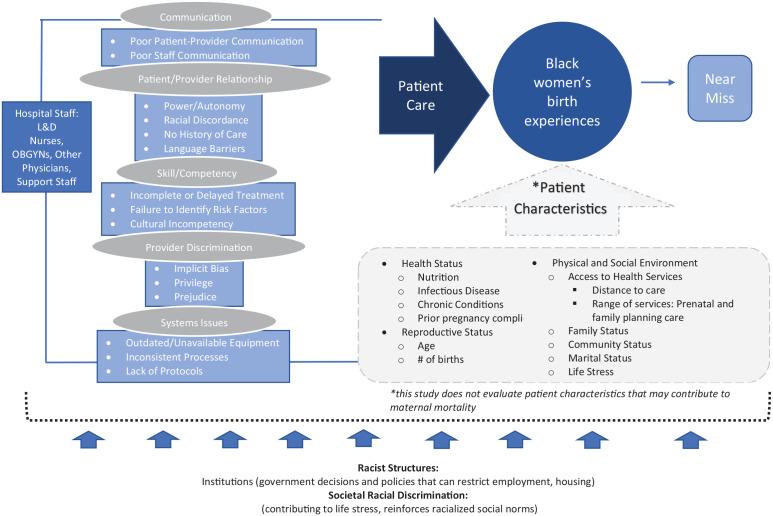
We interviewed 12 women between October 2020 and March 2021. All participants had a maternal near miss between the years 2010 and 2020 and were aged between 19 and 41 years when they had their near-miss experience. These women identified communication, patient-provider relationship, skills/competency of staff, provider discrimination, systems issues, and emotional distress as major contributors to their experiences.
Maternal near misses serve as a precursor to maternal mortality events. By listening to patients and their families recount their perspectives on what leads up to these near misses, we can unearth valuable lessons that can aid in the development of strategies and interventions to decrease the numbers of pregnancy-related deaths; especially among Black women who suffer disproportionately from maternal morbidity and mortality. Based on these findings, we recommend that hospitals and OB-GYN practices consider the unique predispositions of their Black patients; account for their own personal biases, revisit the near-miss experiences of past patients to keep patients central to care and build rapport between patients and hospital birthing support staff; and center discussions about improvements in care around racist structures and systems.
美国黑人女性的高孕产妇死亡率持续受到关注;然而,研究尚未充分阐明这些事件的前兆,其中最具影响力的是“孕产妇接近死亡病例”。孕产妇接近死亡病例是指一名妇女因妊娠、分娩或妊娠终止后 42 天内的并发症而几乎死亡但幸存下来。研究人员专注于审查发生重大孕产妇事件后的患者病历,以帮助确定主要促成因素;然而,对接近死亡病例幸存者进行定性研究,尤其是对黑人女性进行定性研究,可能是一种更有用的方法。
我们采用定性方法,对 12 名黑人女性进行了半结构化访谈,以探讨她们如何看待自己在接近死亡病例经历中所接受的护理。我们的研究还采用了现象学框架,以了解在医院环境中经历过孕产妇接近死亡病例的黑人女性的生活体验。
我们于 2020 年 10 月至 2021 年 3 月期间采访了 12 名女性。所有参与者在 2010 年至 2020 年期间都经历过孕产妇接近死亡病例,且在经历接近死亡病例时年龄在 19 至 41 岁之间。这些女性认为沟通、医患关系、医护人员的技能/能力、医护人员的歧视、系统问题和情绪困扰是导致她们经历的主要因素。
孕产妇接近死亡病例是孕产妇死亡事件的前兆。通过倾听患者及其家属讲述导致这些接近死亡病例的原因,我们可以发现有价值的经验教训,这有助于制定策略和干预措施,以减少与妊娠相关的死亡人数;特别是在黑人女性中,她们不成比例地遭受孕产妇发病率和死亡率的影响。基于这些发现,我们建议医院和妇产科诊所考虑其黑人患者的独特倾向;考虑到自己的个人偏见,回顾过去患者的接近死亡病例经历,将患者置于护理中心,并在患者和医院分娩支持人员之间建立融洽关系;并将关于改善护理的讨论围绕种族主义结构和系统展开。