Wang Heng, Bi Chongliang, Wang Yinjie, Sun Jun, Meng Xia, Li Jianji
College of Veterinary Medicine, Yangzhou University, Yangzhou, 225009, Jiangsu, China.
Jiangsu Co-innovation Center for Prevention and Control of Important Animal Infectious Diseases and Zoonoses, Yangzhou, 225009, Jiangsu, China.
BMC Vet Res. 2018 Jun 20;14(1):197. doi: 10.1186/s12917-018-1508-y.
Staphylococcus aureus (S. aureus) internalization into bovine mammary epithelial cells (bMECs) is considered an important pathogenic mechanism for the establishment of mastitis. Given the interesting link between selenium (Se) status and mastitis, our objective was to prove that Se was essential to suppress pro-inflammatory mediators, in part, by modulation of Toll-like receptor2 (TLR2), nuclear factor kappaB (NF-κB) and mitogen activated protein kinase (MAPK) signal transduction pathway in bMECs.
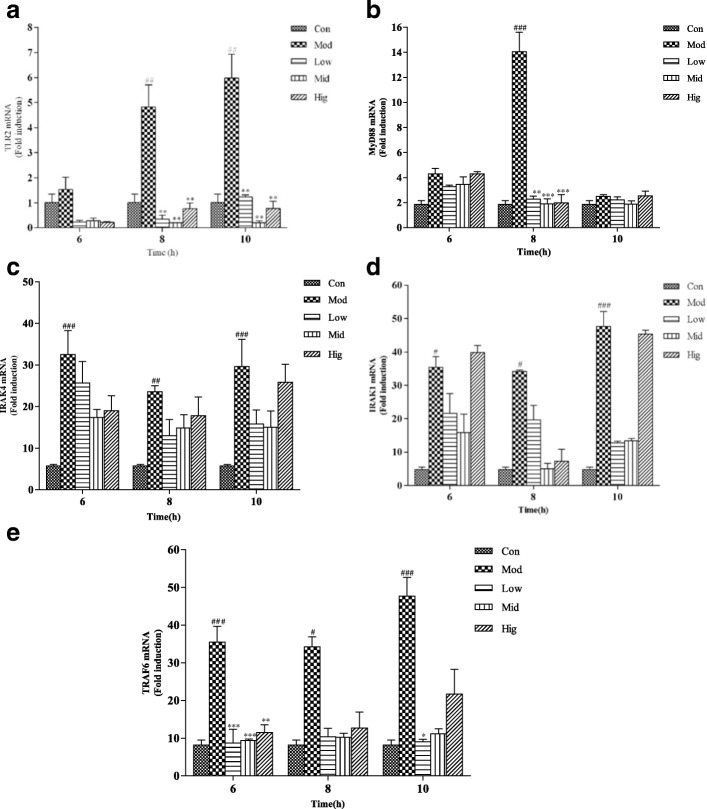
Results showed that Se (0~ 16 μM) did not affect the growth of bMECs. The mRNA expression of TLR2, Myeloid differentiation factor 88 (Myd88), Interleukin-1 receptor-associated kinase4 (Irak4), Interleukin-1 receptor-associated kinase1 (Irak1) and TNF receptor-associated factor6 (Traf6) in TLR2 signal pathway were increased or significantly increased by S. aureus. Se played an important role in regulating the genes expression of TLR2, Myd88, Traf6 but not in controlling the expression of Irak4 and Irak1. In addition, Se exerted strong inhibitory effects on the genes expression of tumor necrosis factor-alpha (TNF-α), interleukin-1β (IL-1β) and interleukin-6 (IL-6) induced by S. aureus. To further investigate the possible signaling mechanisms involved in the processes, we analyzed the role of MAPK and NF-κB signaling pathway in inflammation response in S. aureus-stimulated bMECs in vitro. Results showed that the phosphorylation of inhibitory kappaB alpha (IκBα), p65, p38 and extracellular regulated protein kinase (Erk) were significantly increased in S. aureus-stimulated bMECs. It indicated that S. aureus activated NF-κB and MAPK signaling pathway. We also examined the effects of Se on the phosphorylation of IκBα, p65, p38 and Erk in NF-κB and MAPK signaling pathway, which have well been proved to control the synthesis and release of pro-inflammatory mediators during inflammation. The findings are exciting, that pretreatment with Se (4, 8 μM) significantly suppressed the phosphorylation of IκBα, p65, p38 and Erk.
These results suggest that Se down-regulates inflammatory mediators TNF-α, IL-1β and IL-6 gene expressions via TLR2, NF-κB and MAPK signaling pathway in S. aureus-stimulated bMECs, which may be responsible for the anti-inflammatory effect of Se.
金黄色葡萄球菌内化进入牛乳腺上皮细胞(bMECs)被认为是引发乳腺炎的一种重要致病机制。鉴于硒(Se)状态与乳腺炎之间存在有趣的联系,我们的目标是证明硒对于抑制促炎介质至关重要,部分原因是通过调节bMECs中的Toll样受体2(TLR2)、核因子κB(NF-κB)和丝裂原活化蛋白激酶(MAPK)信号转导通路。
结果表明,硒(0~16 μM)不影响bMECs的生长。金黄色葡萄球菌使TLR2信号通路中TLR2、髓样分化因子88(Myd88)、白细胞介素-1受体相关激酶4(Irak4)、白细胞介素-1受体相关激酶1(Irak1)和肿瘤坏死因子受体相关因子6(Traf6)的mRNA表达增加或显著增加。硒在调节TLR2、Myd88、Traf6的基因表达中起重要作用,但对Irak4和Irak1的表达没有调控作用。此外,硒对金黄色葡萄球菌诱导的肿瘤坏死因子-α(TNF-α)、白细胞介素-1β(IL-1β)和白细胞介素-6(IL-6)的基因表达具有强烈的抑制作用。为了进一步研究这些过程中可能涉及的信号机制,我们分析了MAPK和NF-κB信号通路在体外金黄色葡萄球菌刺激的bMECs炎症反应中的作用。结果表明,在金黄色葡萄球菌刺激的bMECs中,抑制性κBα(IκBα)、p65、p38和细胞外调节蛋白激酶(Erk)的磷酸化显著增加。这表明金黄色葡萄球菌激活了NF-κB和MAPK信号通路。我们还研究了硒对NF-κB和MAPK信号通路中IκBα、p65、p38和Erk磷酸化的影响,这些通路已被充分证明在炎症过程中控制促炎介质的合成和释放。令人兴奋的是,用硒(4、8 μM)预处理可显著抑制IκBα、p65、p38和Erk的磷酸化。
这些结果表明,硒通过TLR2、NF-κB和MAPK信号通路下调金黄色葡萄球菌刺激的bMECs中炎症介质TNF-α、IL-1β和IL-6的基因表达,这可能是硒具有抗炎作用的原因。