Department of Orthopaedics, College of Medicine, Taibah University, Universities Road, Taibah, Madinah Al-Munawwarah, 42353, Saudi Arabia.
Centre of Excellence in Nanotechnology, Asian Institute of Technology, PO Box 4, Klong Luang, Pathumthani, 12120, Thailand.
Sci Rep. 2018 Jun 20;8(1):9417. doi: 10.1038/s41598-018-27752-z.
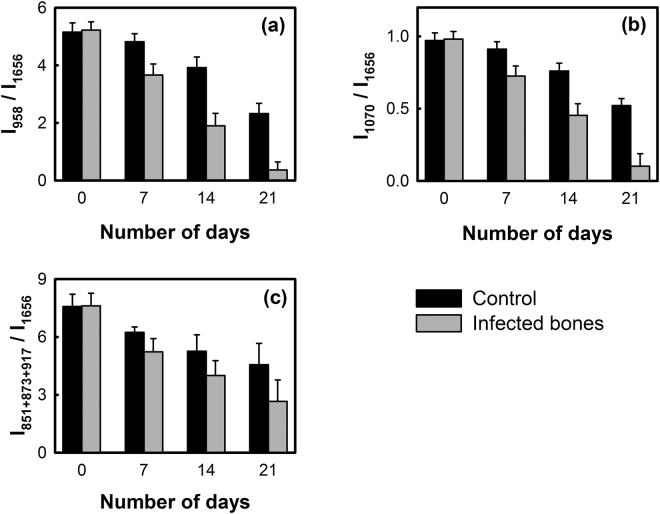
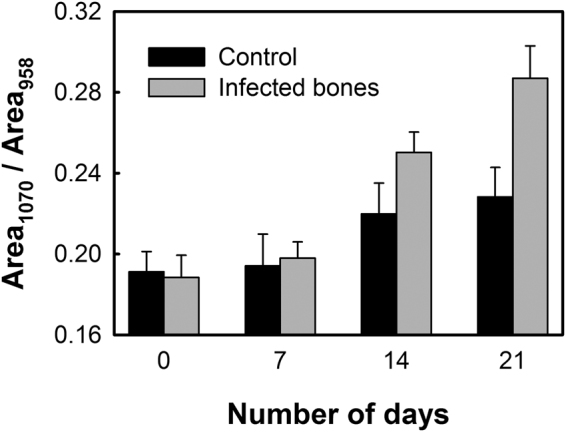
Diagnosis of osteomyelitis presents a formidable challenge. Lack of pathognomonic clinical sign(s) and diagnostic tests that can diagnose osteomyelitis at an early stage contribute to this difficulty. If the diagnosis is not made early, the disease becomes very difficult to eradicate and can lead to limb threatening and potentially life-threatening complications. Staphylococcus aureus is the most common organism causing osteomyelitis. Raman Spectroscopy provides information about molecular vibration that could potentially be harnessed as a spectral signature for cellular changes in specific pathologic conditions. In this study we describe a technique using Raman spectroscopy that could potentially be used to diagnose staphylococcal osteomyelitis. Human bone samples were co-cultured with Staphylococcus aureus (S. aureus) and the effects of bacterial growth on bone quality were then monitored using Raman spectroscopy. A major drop in the bone mineral quality and crystallinity was observed in the infected bones compared to the controls. S. aureus infection was also found to alter the collagen cross-linking. Our study shows that specific spectral signatures are present for the cause as well as the effect of staphylococcal osteomyelitis, opening the possibility of developing a useful diagnostic modality for early and rapid diagnosis of this condition.
骨髓炎的诊断极具挑战性。缺乏特征性的临床症状和诊断性检查,导致早期诊断骨髓炎变得困难。如果不能早期诊断,疾病很难根治,可能导致威胁肢体甚至危及生命的并发症。金黄色葡萄球菌是引起骨髓炎最常见的病原体。拉曼光谱提供了有关分子振动的信息,这些信息可能被用作特定病理条件下细胞变化的光谱特征。在这项研究中,我们描述了一种使用拉曼光谱的技术,该技术可能用于诊断金黄色葡萄球菌骨髓炎。将人骨样本与人源金黄色葡萄球菌(S. aureus)共同培养,然后使用拉曼光谱监测细菌生长对骨质量的影响。与对照组相比,感染骨中的骨矿物质质量和结晶度明显下降。金黄色葡萄球菌感染还改变了胶原的交联。我们的研究表明,针对金黄色葡萄球菌骨髓炎的病因和影响存在特定的光谱特征,这为开发一种有用的诊断方法以快速早期诊断这种疾病提供了可能。