Kim Eun Jin, Jung Chi Young, Kim Kyung Chan
Department of Internal Medicine, Daegu Catholic University Medical Center, Daegu Catholic University School of Medicine, Daegu, Korea.
Tuberc Respir Dis (Seoul). 2018 Oct;81(4):319-329. doi: 10.4046/trd.2017.0122. Epub 2018 Jun 19.
Bronchoalveolar lavage (BAL) is a necessary procedure for diagnosis of various lung diseases. High-flow nasal cannula (HFNC) oxygen delivery was recently introduced. This study aimed to investigate the safety and effectiveness of HFNC oxygen supply during BAL procedure in patients with acute respiratory failure (ARF).
Patients who underwent BAL while using HFNC at a partial pressure of oxygen in arterial blood/fraction of inspired oxygen (PaO₂/FiO₂; PF) ratio of 300 or below among patients who had been admitted from March 2013 to May 2017 were retrospectively investigated.
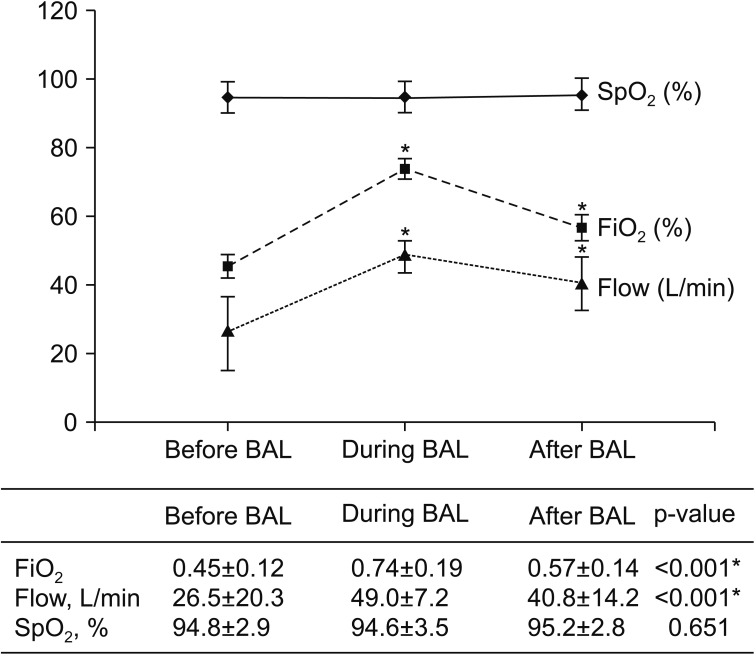
Thirty-three BAL procedures were confirmed. Their baseline PF ratio was 166.1±46.7. FiO₂ values before, during, and after BAL were 0.45±0.12, 0.74±0.19, and 0.57±0.14, respectively. Flow (L/min) values before, during, and after BAL were 26.5±20.3, 49.0±7.2, and 40.8±14.2, respectively. Both FiO₂ and flow during and after the procedure were significantly different from those before the procedure (both p<0.001). Oxygen saturation levels before, during, and after BAL measured by pulse oximeter were 94.8±2.9, 94.6±3.5, and 95.2±2.8%, respectively. There were no significant differences in oxygen saturation among the three groups. Complications of BAL procedure included transient hypoxemia, hypotension, and fever. However, there was no endotracheal intubation within 24 hours. Baseline PF ratio in "without HFNC" group was significantly higher than that in "with HFNC" group. There were no differences in complications between the two groups.
The use of HFNC during BAL procedure in ARF patients was effective and safe. However, there were no significant differences in oxygen saturation level and complications comparing "without HFNC" group in mild ARF. More studies are needed for moderate to severe ARF patients.
支气管肺泡灌洗(BAL)是诊断各种肺部疾病的必要手段。高流量鼻导管(HFNC)给氧方式最近被引入。本研究旨在探讨急性呼吸衰竭(ARF)患者在BAL操作过程中使用HFNC给氧的安全性和有效性。
回顾性研究2013年3月至2017年5月期间收治的动脉血氧分压/吸入氧分数(PaO₂/FiO₂;PF)比值在300或以下且在使用HFNC时接受BAL的患者。
确认进行了33次BAL操作。其基线PF比值为166.1±46.7。BAL前、中、后的FiO₂值分别为0.45±0.12、0.74±0.19和0.57±0.14。BAL前、中、后的流量(L/min)值分别为26.5±20.3、49.0±7.2和40.8±14.2。操作期间和操作后的FiO₂和流量与操作前均有显著差异(均p<0.001)。通过脉搏血氧仪测量的BAL前、中、后的氧饱和度水平分别为94.8±2.9%、94.6±3.5%和95.2±2.8%。三组之间的氧饱和度无显著差异。BAL操作的并发症包括短暂性低氧血症、低血压和发热。然而,24小时内未进行气管插管。“未使用HFNC”组的基线PF比值显著高于“使用HFNC”组。两组之间的并发症无差异。
ARF患者在BAL操作过程中使用HFNC是有效且安全的。然而,与轻度ARF的“未使用HFNC”组相比,氧饱和度水平和并发症无显著差异。对于中度至重度ARF患者,需要更多的研究。