Department of Orthopaedics and Traumatology, Nanfang Hospital, Southern Medical University, Guangzhou, China.
Division of Orthopaedic Surgery, Children's Hospital of Philadelphia, Philadelphia, Pennsylvania, USA.
Am J Sports Med. 2018 Jul;46(9):2222-2231. doi: 10.1177/0363546518778789. Epub 2018 Jun 21.
Tendon injuries are common problems among athletes. Complete recovery of the mechanical structure and function of ruptured tendons is challenging. It has been demonstrated that upregulation of glycolysis and lactate production occurs in wounds, inflammation sites, and cancerous tumors, and these metabolic changes also control growth and differentiation of stem and progenitor cells. Similar metabolic changes have been reported in human healing tendons. In addition, lactate production has increased in progenitors isolated from injured tendons after treatment with IL-1β. It is thought that the metabolic changes play a role in tendon healing after injury.
Glucose metabolism is altered during tendon injury and healing, and modulation of this altered metabolism improves tendon repair.
Controlled laboratory study.
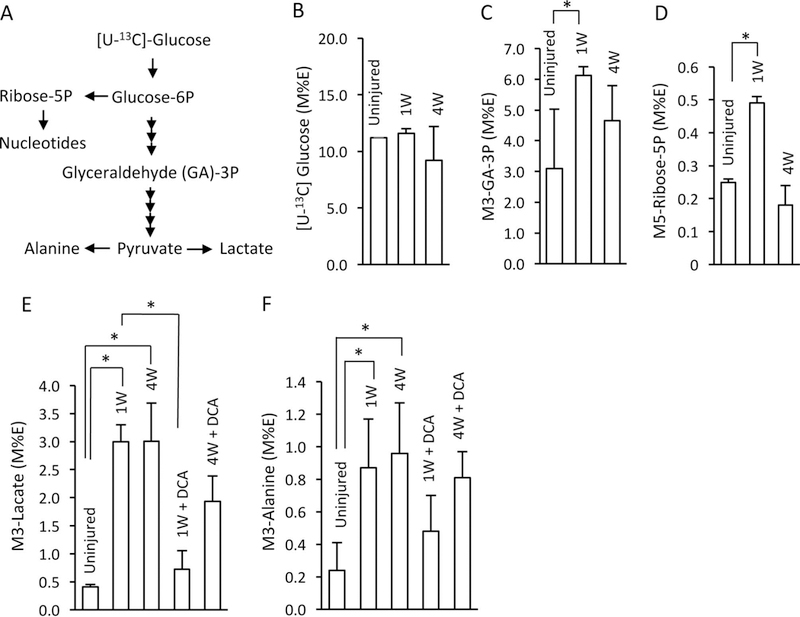
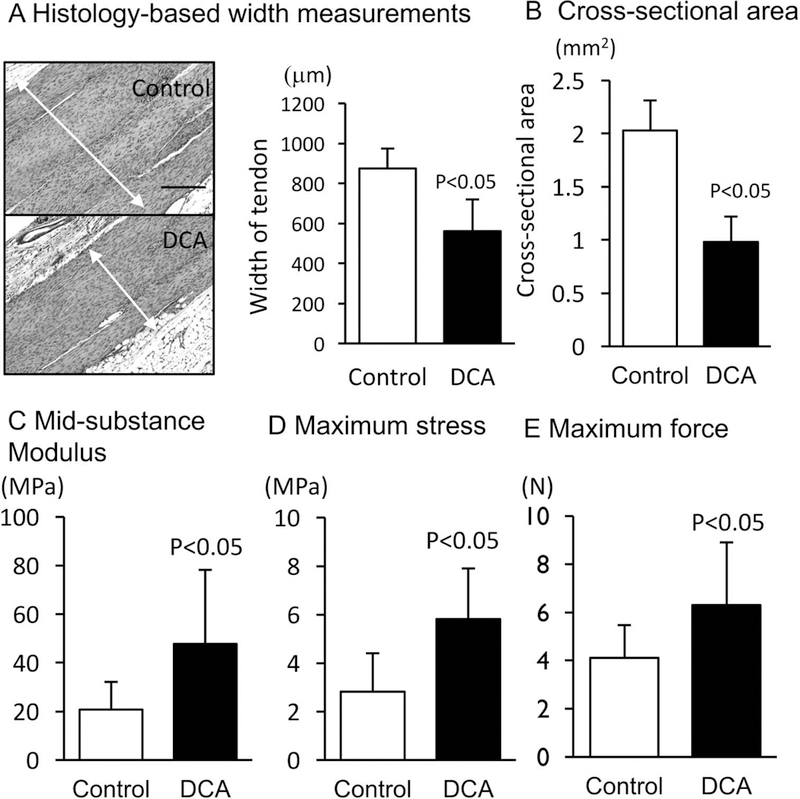
The authors used the tendon injury model involving a complete incision of the Achilles tendon in C57BL/6J female mice and studied alterations of glucose metabolism in injured tendons with [U-C]glucose and metabolomics analysis 1 and 4 weeks after surgery. They also examined the effects of dichloroacetate (DCA; an indirect lactate synthesis inhibitor) treatment on the recovery of structure and mechanical properties of injured tendons 4 weeks after surgery in the same mouse model.
Significant changes in glucose metabolism in tendons after injury surgery were detected. C enrichment of metabolites and intermediates, flux through glycolysis, and lactate synthesis, as well as tricarboxylic acid cycle activity, were acutely increased 1 week after injury. Increased glycolysis and lactate generation were also found 4 weeks after injury. DCA-treated injured tendons showed decreased cross-sectional area and higher values of modulus, maximum stress, and maximum force when compared with vehicle-treated injured tendons. Improved alignment of the collagen fibers was also observed in the DCA group. Furthermore, DCA treatment reduced mucoid accumulation and ectopic calcification in injured tendons.
The findings indicate that injured tendons acutely increase glycolysis and lactate synthesis after injury and that the inhibition of lactate synthesis by DCA is beneficial for tendon healing.
Changing metabolism in injured tendons may be a therapeutic target for tendon repair.
肌腱损伤是运动员常见的问题。断裂肌腱的机械结构和功能的完全恢复具有挑战性。已经证明,糖酵解和乳酸生成在上皮伤口、炎症部位和癌性肿瘤中上调,这些代谢变化还控制着干细胞和祖细胞的生长和分化。在人类愈合的肌腱中也报道了类似的代谢变化。此外,在接受白细胞介素-1β(IL-1β)治疗后,从受伤肌腱中分离出的祖细胞的乳酸产量增加。人们认为,代谢变化在损伤后肌腱愈合中起作用。
在肌腱损伤和愈合过程中,葡萄糖代谢发生改变,调节这种改变的代谢可改善肌腱修复。
对照实验室研究。
作者使用涉及 C57BL/6J 雌性小鼠跟腱完全切开的肌腱损伤模型,并用[U-C]葡萄糖和代谢组学分析在手术后 1 周和 4 周研究损伤肌腱中葡萄糖代谢的变化。他们还在相同的小鼠模型中检查了二氯乙酸(DCA;间接的乳酸合成抑制剂)治疗对手术后 4 周损伤肌腱结构和机械性能恢复的影响。
检测到手术后肌腱中葡萄糖代谢的显著变化。受伤后 1 周,代谢物和中间产物的 C 富集、糖酵解通量和乳酸合成以及三羧酸循环活性均急剧增加。受伤后 4 周也发现了增加的糖酵解和乳酸生成。与载体处理的损伤肌腱相比,DCA 处理的损伤肌腱的横截面积减小,模量、最大应力和最大力的值较高。还观察到 DCA 组胶原纤维排列得到改善。此外,DCA 治疗减少了损伤肌腱中的粘蛋白积累和异位钙化。
研究结果表明,受伤后的肌腱在受伤后会迅速增加糖酵解和乳酸合成,DCA 抑制乳酸合成对肌腱愈合有益。
改变受伤肌腱的代谢可能是肌腱修复的治疗靶点。