Nguyen Tu-Son, Nguyen Thi Lien Huong, Van Pham Thi Thuy, Hua Susan, Ngo Quy Chau, Li Shu Chuen
Department of Clinical Pharmacy, Hanoi University of Pharmacy, Hanoi, Vietnam.
School of Biomedical Sciences and Pharmacy, Faculty of Health and Medicine, University of Newcastle, Callaghan, NSW, Australia.
Int J Chron Obstruct Pulmon Dis. 2018 Jun 11;13:1863-1872. doi: 10.2147/COPD.S163826. eCollection 2018.
Incorrect use of inhalers is very common and subsequently leads to poor control of COPD. Among health care providers, pharmacists are in the best position to educate patients about the correct use of inhaler devices.
The objective of this study was to evaluate the impact of pharmacist-led training on the improvement of inhaler technique for COPD patients in Vietnam.
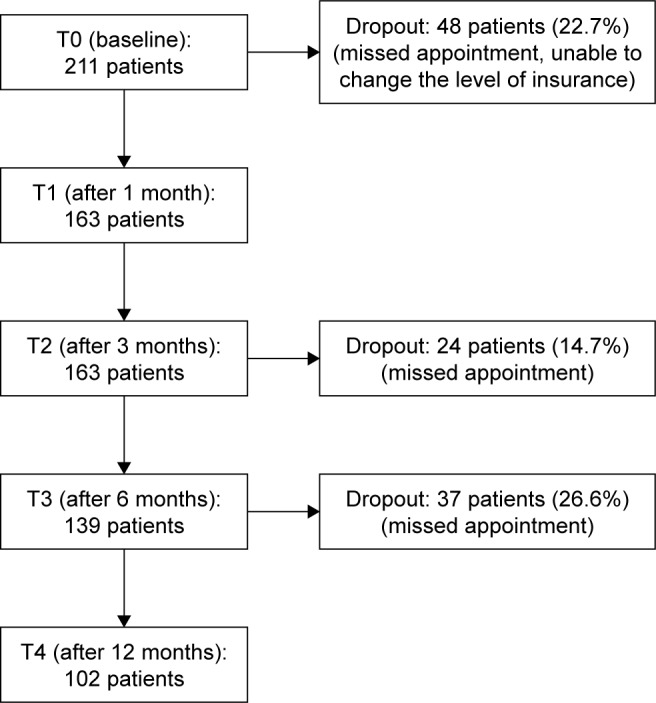
For this pre- and post-intervention study, standardized checklists of correct use of metered-dose inhalers (MDIs) and dry powder inhalers (DPIs) were used to evaluate the inhaler technique. A scoring system (maximum score =8) was applied before and after training to guarantee assessment uniformity among pharmacists. Three methods including "face-to-face training", "teach-back" and "technique reminder label" were used. After the baseline evaluation (T0), the inhaler technique was reassessed after 1 month (T1), 3 months (T2), 6 months (T3) and 12 months (T4).
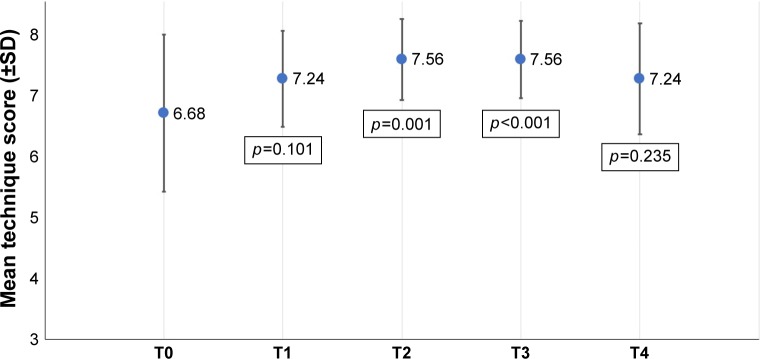
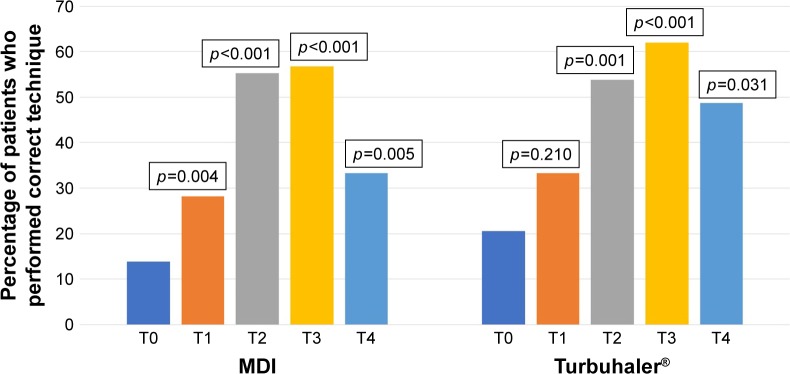
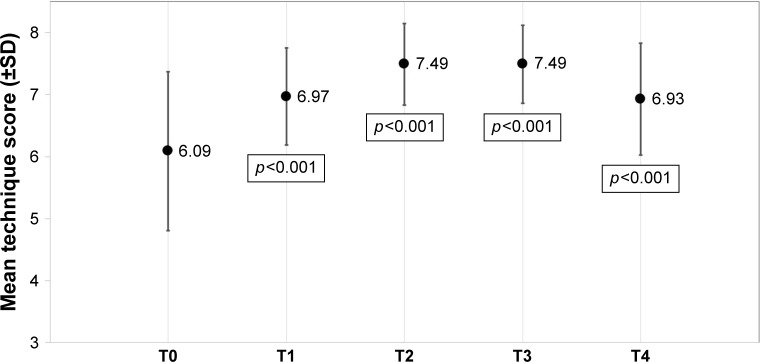
A total of 211 COPD patients participated in the study. Before the training, a high rate of errors was recorded. After the training, the percentage of patients using MDIs and DPIs perfectly increased significantly (<0.05). The mean technique score for MDIs and DPIs improved from 6.0 (T0) to 7.5 (T3) and 6.9 (T4) and 6.7 (T0) to 7.6 (T3) and 7.2 (T4), respectively (<0.05). The average training time was 6 minutes (T0) and 3 minutes (T3), respectively.
Pharmacist-led comprehensive inhaler technique intervention program using an unbiased and simple scoring system can significantly improve the inhaler techniques in COPD patients. Our results indicated a 3-month period as the optimal time period between training and retraining for maintaining the correct inhaler technique. The training would be highly feasible and suitable for implementing in the clinical setting. Our model of pharmacist-led training should be considered as an effective solution for managing COPD patients and better utilization of health care human resources, especially in a developing country like Vietnam.
吸入器使用不当非常普遍,进而导致慢性阻塞性肺疾病(COPD)控制不佳。在医疗保健提供者中,药剂师最有能力指导患者正确使用吸入器装置。
本研究的目的是评估药剂师主导的培训对越南COPD患者吸入器使用技术改善的影响。
在这项干预前后的研究中,使用定量吸入器(MDIs)和干粉吸入器(DPIs)正确使用的标准化检查表来评估吸入器使用技术。在培训前后应用评分系统(最高分=8)以确保药剂师之间评估的一致性。使用了三种方法,包括“面对面培训”、“反馈教学”和“技术提醒标签”。在基线评估(T0)后,在1个月(T1)、3个月(T2)、6个月(T3)和12个月(T4)后重新评估吸入器使用技术。
共有211例COPD患者参与了该研究。培训前,记录到较高的错误率。培训后,正确使用MDIs和DPIs的患者百分比显著增加(<0.05)。MDIs和DPIs的平均技术得分分别从6.0(T0)提高到7.5(T3)和6.9(T4),以及从6.7(T0)提高到7.6(T3)和7.2(T4)(<0.05)。平均培训时间分别为6分钟(T0)和3分钟(T3)。
药剂师主导的、使用无偏且简单评分系统的综合吸入器技术干预方案可显著改善COPD患者的吸入器使用技术。我们的结果表明,培训与再培训之间间隔3个月是维持正确吸入器使用技术的最佳时间段。该培训具有高度可行性,适合在临床环境中实施。我们的药剂师主导培训模式应被视为管理COPD患者以及更好利用医疗保健人力资源的有效解决方案,尤其是在越南这样的发展中国家。