Pharmacy Department, Siriraj Hospital, Bangkok, Thailand.
Division of Respiratory Disease and Tuberculosis, Department of Medicine, Faculty of Medicine Siriraj Hospital, Mahidol University, 2 Wanglang Road, Bangkoknoi, Bangkok, 10700, Thailand.
BMC Pulm Med. 2023 Apr 26;23(1):144. doi: 10.1186/s12890-023-02448-x.
Maintaining correct inhaler technique is crucial in the management of chronic obstructive pulmonary disease (COPD). We aimed to investigate the inhaler technique in patients with COPD, to compare it immediately after and at 1 month after training, and to identify the predictors of incorrect inhaler use at 1 month after training.
This prospective study was conducted at the COPD clinic of Siriraj Hospital (Bangkok, Thailand). Patients demonstrating improper inhaler use were trained face-to-face by pharmacists. Inhaler technique was re-assessed immediately after and at 1 month after training. The Montreal Cognitive Assessment (MoCA) score, pulmonary function tests, 6-min walk distance (6 MWD), modified Medical Research Council scale score, and COPD Assessment Test (CAT) score were evaluated.
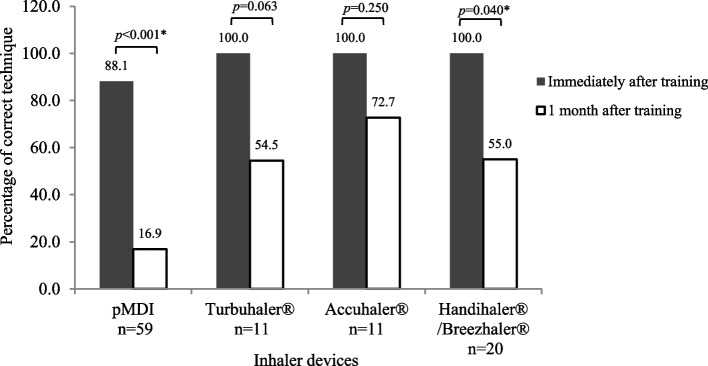
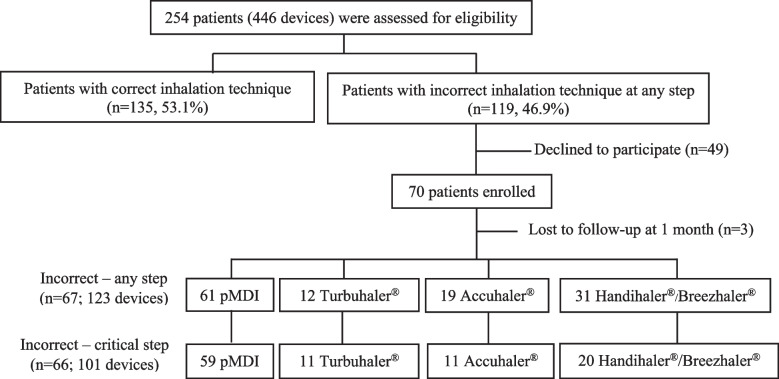
Sixty-six patients with COPD who demonstrated at least one critical error during the use of any controller inhaler were enrolled. The mean age was 73.0 ± 9.0 years, and 75.8% patients had moderate/severe COPD. Immediately after training, all patients used dry powder inhalers correctly and 88.1% used pressurized metered-dose inhalers correctly. At 1 month, the number of patients demonstrating the correct technique decreased across all devices. Multivariable analysis revealed that MoCA score ≤ 16 was independently associated with a critical error at 1 month after training (adjusted odds ratio: 12.7, 95% confidence interval: 1.8-88.2, p = 0.010). At 1 month, CAT score (11.4 ± 8.9 vs. 8.4 ± 5.5, p = 0.018) and 6 MWD (351 ± 93 m vs. 372 ± 92 m, p = 0.009) had significantly improved in patients demonstrating the correct technique, and CAT score met the minimal clinically important difference.
Face-to-face training by pharmacists improved patient performance. However, the number of patients following proper technique had decreased at 1 month after training. Cognitive impairment (MoCA score ≤ 16) independently predicted the ability of COPD patients to maintain proper inhaler technique. Assessment of cognitive function combined with technical re-assessment and repeated training should improve COPD management.
维持正确的吸入器技术对于慢性阻塞性肺疾病(COPD)的管理至关重要。我们旨在调查 COPD 患者的吸入器技术,比较培训后即刻和 1 个月时的技术,并确定培训后 1 个月时不正确使用吸入器的预测因素。
这项前瞻性研究在泰国 Siriraj 医院的 COPD 诊所进行。药师面对面培训显示使用不当的患者。吸入器技术在培训后即刻和 1 个月后进行重新评估。评估蒙特利尔认知评估(MoCA)评分、肺功能测试、6 分钟步行距离(6 MWD)、改良医学研究委员会量表评分和 COPD 评估测试(CAT)评分。
共纳入 66 名在使用任何控制器吸入器时至少出现一个关键错误的 COPD 患者。平均年龄为 73.0±9.0 岁,75.8%的患者患有中重度/重度 COPD。培训后即刻,所有患者正确使用干粉吸入器,88.1%的患者正确使用压力定量气雾剂。1 个月后,所有装置的正确技术使用率均下降。多变量分析显示,MoCA 评分≤16 与培训后 1 个月时的关键错误独立相关(调整后的优势比:12.7,95%置信区间:1.8-88.2,p=0.010)。1 个月时,在正确使用吸入器的患者中,CAT 评分(11.4±8.9 分比 8.4±5.5 分,p=0.018)和 6 MWD(351±93m 比 372±92m,p=0.009)显著改善,CAT 评分达到了最小临床重要差异。
药师的面对面培训提高了患者的表现。然而,培训后 1 个月时,正确使用技术的患者数量有所减少。认知障碍(MoCA 评分≤16)独立预测 COPD 患者维持正确吸入器技术的能力。评估认知功能,结合技术重新评估和重复培训,应改善 COPD 的管理。