Challapalli Amarnath, Edwards Steve M, Abel Paul, Mangar Stephen A
Department of Oncology, Imperial College Healthcare NHS Trust, London, UK.
NIHR Clinical Research Network North West London, Imperial College Healthcare NHS Trust, London, UK.
Clin Transl Radiat Oncol. 2018 Mar 21;10:29-35. doi: 10.1016/j.ctro.2018.03.002. eCollection 2018 Mar.
BACKGROUND & PURPOSE: The impact of vasomotor symptoms (VMS) occurring in prostate cancer (PC) patients whilst on androgen deprivation therapy (ADT) has not been extensively researched. This longitudinal study sought to assess the VMS and identify any predictive factors.
MATERIAL & METHODS: Data from 250 PC patients on ADT were prospectively evaluated between January 10 and August 13 using a physician-directed questionnaire, to assess the impact of VMS. Parameters including height, weight, body surface area (BSA), body mass index (BMI), duration/type of ADT, co-morbidities and ethnicity were recorded.
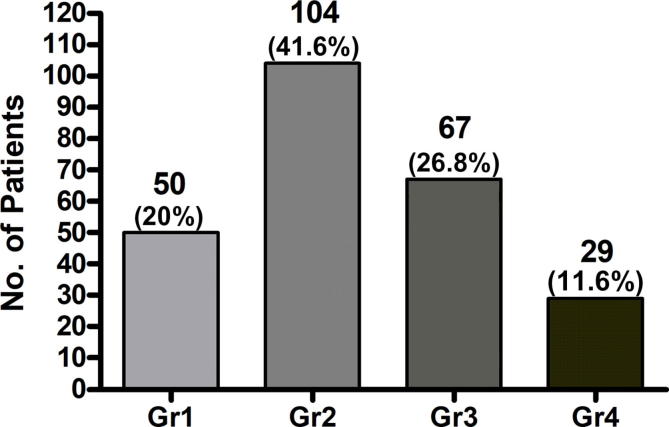
Fifty (20%) men reported no toxicity, whilst 171 (68.4%), and 29 (11.6%) reported mild to moderate and severe symptoms, respectively. Drenching sweats and hot flashes were common, and coexisted with sleep disturbances and fatigue. Patients with severe toxicity were younger (73 vs. 77 yrs; p = 0.04), had higher BMI (28 vs. 26; p = 0.02), and higher BSA (1.99 vs. 1.90; p = 0.04), when compared with those experiencing no toxicity. On multivariate analysis, younger age was predictive of sweats and hot flushes, whilst Afro-Caribbean men were twice as likely to experience sweats (OR 2.03, p = 0.05).
The short-term side-effect profile of ADT for prostate cancer was favourable, though debilitating VMS can occur in a significant minority of cases. Younger age and higher BMI predicted for severe toxicity but not the duration of ADT.
前列腺癌(PC)患者在接受雄激素剥夺治疗(ADT)期间出现血管舒缩症状(VMS)的影响尚未得到广泛研究。这项纵向研究旨在评估VMS并确定任何预测因素。
2010年1月10日至8月13日期间,对250名接受ADT的PC患者的数据进行前瞻性评估,使用医生指导的问卷来评估VMS的影响。记录身高、体重、体表面积(BSA)、体重指数(BMI)、ADT的持续时间/类型、合并症和种族等参数。
50名(20%)男性报告无毒性,而171名(68.4%)和29名(11.6%)分别报告了轻度至中度和重度症状。大汗淋漓和潮热很常见,且与睡眠障碍和疲劳并存。与无毒性的患者相比,重度毒性患者更年轻(73岁对77岁;p = 0.04),BMI更高(28对26;p = 0.02),BSA更高(1.99对1.90;p = 0.04)。多因素分析显示,年龄较小是出汗和潮热的预测因素,而非洲加勒比男性出汗的可能性是其他人的两倍(OR 2.03,p = 0.05)。
前列腺癌ADT的短期副作用表现良好,尽管少数情况下会出现使人衰弱的VMS。年龄较小和BMI较高预示着严重毒性,但与ADT的持续时间无关。