De Brún Aoife, Flynn Darren, Ternent Laura, Price Christopher I, Rodgers Helen, Ford Gary A, Rudd Matthew, Lancsar Emily, Simpson Stephen, Teah John, Thomson Richard G
Institute of Health and Society, Newcastle University, Newcastle upon Tyne, UK.
School of Nursing, Midwifery and Health Systems, University College Dublin, Dublin, Ireland.
BMC Health Serv Res. 2018 Jun 22;18(1):483. doi: 10.1186/s12913-018-3305-5.
A discrete choice experiment (DCE) is a method used to elicit participants' preferences and the relative importance of different attributes and levels within a decision-making process. DCEs have become popular in healthcare; however, approaches to identify the attributes/levels influencing a decision of interest and to selection methods for their inclusion in a DCE are under-reported. Our objectives were: to explore the development process used to select/present attributes/levels from the identified range that may be influential; to describe a systematic and rigorous development process for design of a DCE in the context of thrombolytic therapy for acute stroke; and, to discuss the advantages of our five-stage approach to enhance current guidance for developing DCEs.
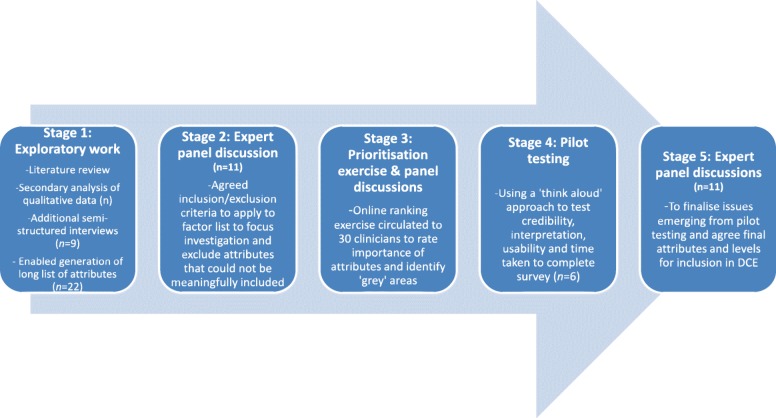
A five-stage DCE development process was undertaken. Methods employed included literature review, qualitative analysis of interview and ethnographic data, expert panel discussions, a quantitative structured prioritisation (ranking) exercise and pilot testing of the DCE using a 'think aloud' approach.
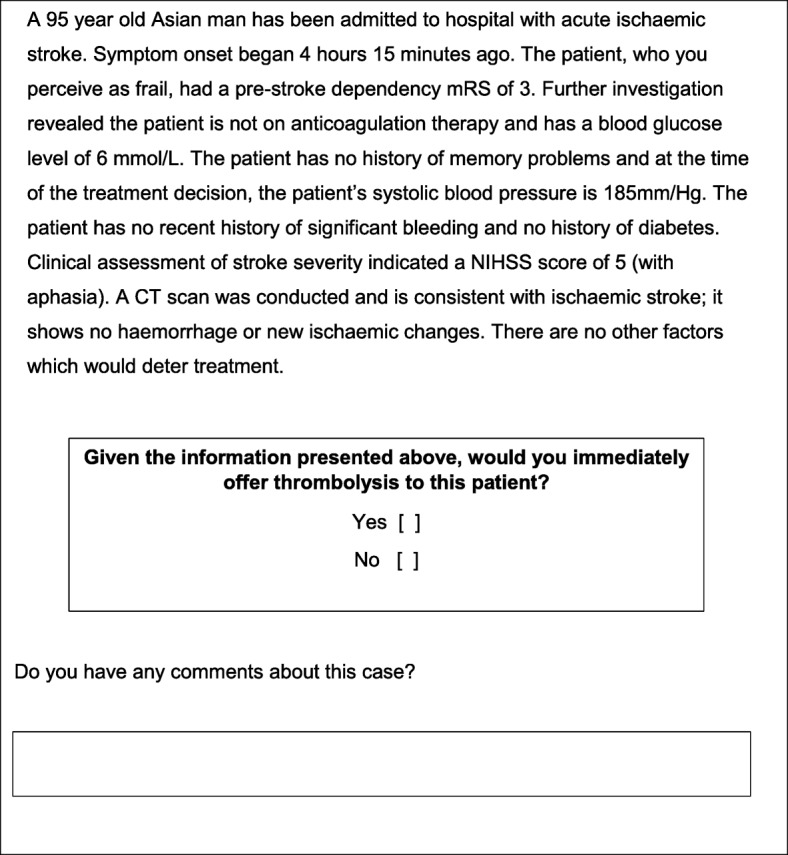
The five-stage process reported helped to reduce the list of 22 initial patient-related factors to a final set of nine variable factors and six fixed factors for inclusion in a testable DCE using a vignette model of presentation.
In order for the data and conclusions generated by DCEs to be deemed valid, it is crucial that the methods of design and development are documented and reported. This paper has detailed a rigorous and systematic approach to DCE development which may be useful to researchers seeking to establish methods for reducing and prioritising attributes for inclusion in future DCEs.
离散选择实验(DCE)是一种用于在决策过程中引出参与者偏好以及不同属性和水平相对重要性的方法。DCE在医疗保健领域已变得很流行;然而,确定影响感兴趣决策的属性/水平的方法以及将其纳入DCE的选择方法却鲜有报道。我们的目标是:探索用于从已确定的可能有影响的范围内选择/呈现属性/水平的开发过程;描述在急性中风溶栓治疗背景下设计DCE的系统且严谨的开发过程;并讨论我们的五阶段方法在加强当前DCE开发指南方面的优势。
采用了五阶段DCE开发过程。所采用的方法包括文献综述、对访谈和人种学数据的定性分析、专家小组讨论、定量结构化优先级排序(排名)练习以及使用“出声思考”方法对DCE进行预测试。
所报告的五阶段过程有助于将22个初始患者相关因素的列表减少到最终的一组九个可变因素和六个固定因素,以便使用 vignette 呈现模型纳入可测试的DCE中。
为了使DCE产生的数据和结论被视为有效,记录和报告设计与开发方法至关重要。本文详细介绍了一种严谨且系统的DCE开发方法,这可能对寻求建立减少和优先考虑纳入未来DCE的属性的方法的研究人员有用。