Rufener Christina, Baur Sarah, Stratmann Ariane, Toscano Michael J
Centre for Proper Housing of Poultry and Rabbits (ZTHZ), Animal Welfare Division, Veterinary Public Health Institute, University of Bern, Zollikofen, Switzerland.
Clinical Radiology, Department of Clinical Veterinary Science, Vetsuisse Faculty, University of Bern, Bern, Switzerland.
Front Vet Sci. 2018 Jun 7;5:124. doi: 10.3389/fvets.2018.00124. eCollection 2018.
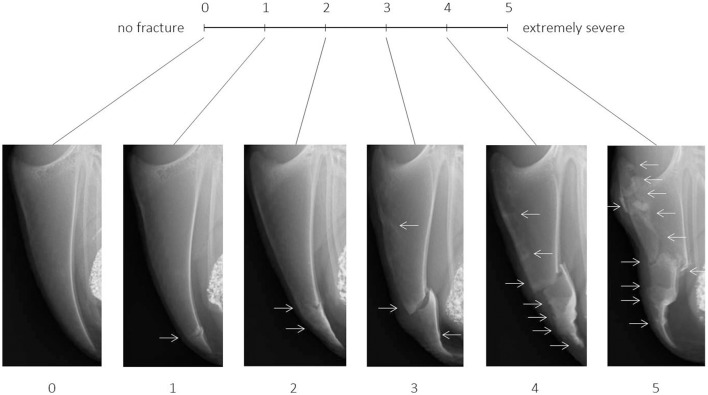
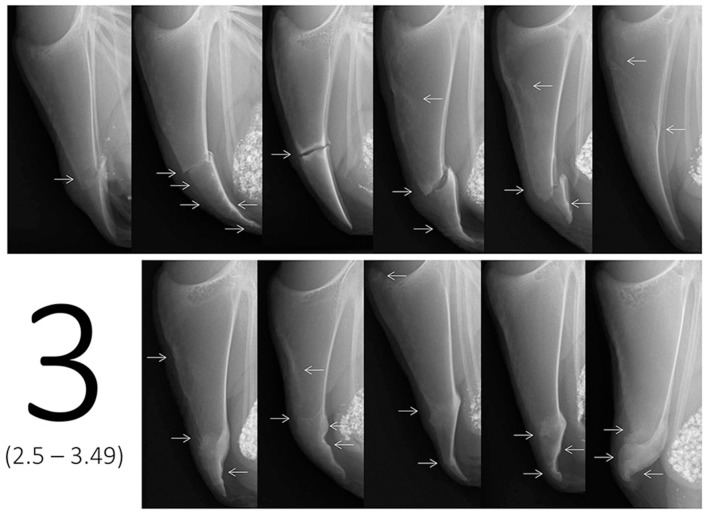
Up to 97% of laying hens housed in aviary systems are affected by keel bone fractures. Due to the scope of the problem, multiple efforts investigating causes and consequences of fractures have been conducted. The most frequently used techniques to detect fractures lack accuracy and provide only vague information (palpation) or cannot be conducted longitudinally (dissection). Radiographic imaging overcomes these weaknesses as it allows longitudinal observations and provides detailed information for individual fractures of which a single keel may have several at different locations and of different origins. However, no standardized system exists to assess fracture severity from radiographs if multiple fractures are present. The aim of this study was therefore to test the reliability of a scoring system assessing the aggregate severity of multiple fractures, taking into account the characteristics of all present fractures (e.g., locations, callus formation, width of fracture gaps). We developed a scoring system based on a tagged visual analogue scale, ranging from score 0 (no fracture) to score 5 (extremely severe) with intermediate tags for scores 1, 2, 3, and 4. A catalog of example scores was provided to describe the range of each score visually. An online tutorial with an introduction, training and scoring session was completed by 14 participants with varying experience involving laying hens and keel bone damage. For inter-observer reliability, we found an Intraclass correlation coefficient (ICC) of 0.985 with a 95% confidence interval of 0.974 < ICC < 0.993 (average-rating, absolute-agreement, two-way random-effects model). Intraclass correlation coefficient for intra-observer reliability was 0.923 with a 95% confidence interval of 0.879 < ICC < 0.951 (single-rating, absolute-agreement, two-way mixed-effects model). Intra-observer reliability ranged from 0.704 to 1.0 indicating excellent agreement and similar ratings across and within participants. Further, high ICCs suggest that the introduction and the training sessions provided were adequate tools to prepare observers for the assessment task despite various backgrounds of the participants. Nonetheless, the validity of this scoring system needs to be investigated further in order to link responses of interest and biological relevance with the specific severity values resulting from our scoring system.
在多层笼养系统中,高达97%的产蛋母鸡受到龙骨骨折的影响。鉴于该问题的范围,人们已经开展了多项研究来探究骨折的原因和后果。检测骨折最常用的技术缺乏准确性,只能提供模糊信息(触诊),或者无法进行纵向观察(解剖)。射线成像克服了这些缺点,因为它可以进行纵向观察,并为单个骨折提供详细信息,一根龙骨可能在不同位置有多处不同成因的骨折。然而,如果存在多处骨折,目前还没有标准化的系统可根据射线照片评估骨折的严重程度。因此,本研究的目的是测试一种评分系统的可靠性,该系统考虑了所有现存骨折的特征(如位置、骨痂形成、骨折间隙宽度)来评估多处骨折的总体严重程度。我们基于标记视觉模拟量表开发了一种评分系统,范围从0分(无骨折)到5分(极其严重),1、2、3、4分有中间标记。提供了示例评分目录以直观描述每个分数的范围。14名涉及产蛋母鸡和龙骨损伤、经验各异的参与者完成了一个包含介绍、培训和评分环节的在线教程。对于观察者间可靠性,我们发现组内相关系数(ICC)为0.985,95%置信区间为0.974 < ICC < 0.993(平均评分、绝对一致性、双向随机效应模型)。观察者内可靠性的组内相关系数为0.923,95%置信区间为0.879 < ICC < 0.951(单评分、绝对一致性、双向混合效应模型)。观察者内可靠性范围为0.704至1.0,表明参与者之间和内部的一致性极佳且评分相似。此外,高ICC值表明,尽管参与者背景各异,但提供的介绍和培训课程是让观察者为评估任务做好准备的充分工具。尽管如此,该评分系统的有效性仍需进一步研究,以便将感兴趣和具有生物学相关性的反应与我们评分系统得出的特定严重程度值联系起来。