Life Sciences, Burnet Institute, Melbourne, VIC, Australia.
Department of Immunology, Monash University, Melbourne, VIC, Australia.
Bioinformatics. 2018 Nov 15;34(22):3942-3944. doi: 10.1093/bioinformatics/bty474.
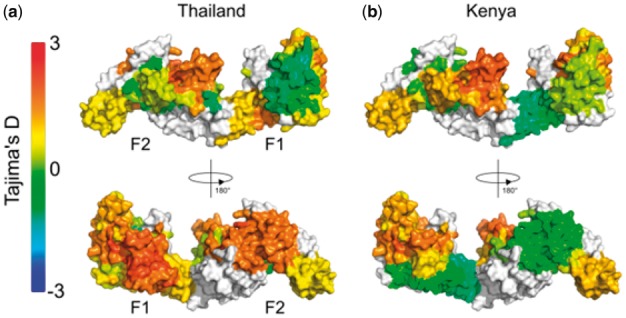
A sliding window analysis over a protein or genomic sequence is commonly performed, and we present a Python tool, BioStructMap, that extends this concept to three-dimensional (3D) space, allowing the application of a 3D sliding window analysis over a protein structure. BioStructMap is easily extensible, allowing the user to apply custom functions to spatially aggregated data. BioStructMap also allows mapping of underlying genomic sequences to protein structures, allowing the user to perform genetic-based analysis over spatially linked codons-this has applications when selection pressures arise at the level of protein structure.
The Python BioStructMap package is available at https://github.com/andrewguy/biostructmap and released under the MIT License. An online server implementing standard functionality is available at https://biostructmap.burnet.edu.au.
Supplementary data are available at Bioinformatics online.
在蛋白质或基因组序列上进行滑动窗口分析是很常见的,我们提出了一个 Python 工具 BioStructMap,它将这个概念扩展到了三维(3D)空间,允许在蛋白质结构上应用 3D 滑动窗口分析。BioStructMap 易于扩展,允许用户对空间聚集的数据应用自定义函数。BioStructMap 还允许将潜在的基因组序列映射到蛋白质结构上,允许用户对空间关联的密码子进行基于遗传的分析——当选择压力出现在蛋白质结构水平时,这具有应用价值。
Python 的 BioStructMap 包可在 https://github.com/andrewguy/biostructmap 获得,并根据 MIT 许可证发布。一个实现标准功能的在线服务器可在 https://biostructmap.burnet.edu.au 获得。
补充数据可在 Bioinformatics 在线获得。