Department of Public Health Sciences and Pediatrics, Università di Torino, Turin, Italy.
Department of Biomedical and Neuromotor Sciences, Alma Mater Studiorum-Università di Bologna, Italy.
PLoS One. 2018 Jun 22;13(6):e0199436. doi: 10.1371/journal.pone.0199436. eCollection 2018.
This study analyzes the trajectories of antibiotic consumption using different indicators of patients' socioeconomic status, category and age-group of physicians.
This study uses a pooled, cross-sectional, time series analysis. The data focus on 22 European countries from 2000 to 2014 and were obtained from the European Center for Disease and Control, Organization for Economic Co-operation and Development, Eurostat and Global Economic Monitor.
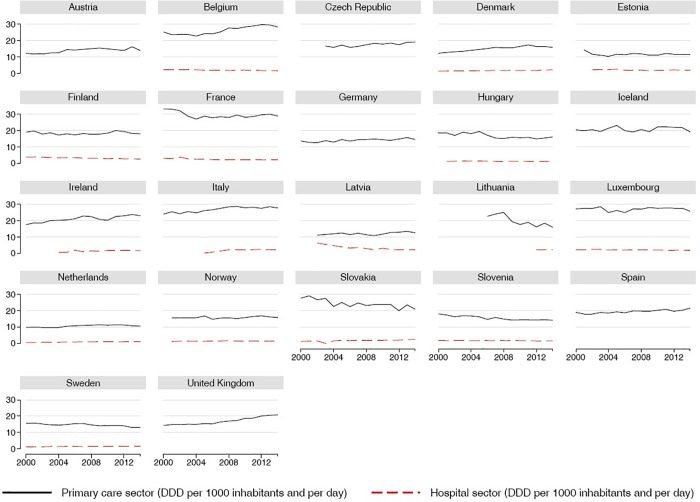
There are large variations in community and hospital use of antibiotics in European countries, and the consumption of antibiotics has remained stable over the years. This applies to the community (b = 0.07, p = 0.267, 95% -0.06, 0.19, b-squared <0.01, p = 0.813, 95% = -0.01, 0.02) as well as the hospital sector (b = -0.02; p = 0.450; CI 95% = -0.06, 0.03; b-squared <0.01; p = 0.396; CI95% = > -0.01, <0.01). Some socioeconomic variables, such as level of education, income, Gini index and unemployment, are not related to the rate of antibiotic use. The age-group of physicians and general practitioners is associated with the use of antibiotics in the hospital. An increase in the proportion of young doctors (<45 years old) leads to a significant increase in antibiotics consumption, and as the percentage of generalist practitioners increases, there use of antibiotics in hospitals decreases by 0.04 DDD/1000 inhabitants.
Understanding that age-groups and categories (general/specialist practitioners) of physicians may predict antibiotic consumption is potentially useful in defining more effective health care policies to reduce the inappropriate antibiotic use while promoting rational use.
本研究使用不同的患者社会经济地位指标、医生类别和年龄组分析抗生素的使用轨迹。
本研究采用了一项汇集的、横截面、时间序列分析。数据聚焦于 2000 年至 2014 年期间的 22 个欧洲国家,数据来源于欧洲疾病预防控制中心、经济合作与发展组织、欧盟统计局和全球经济监测站。
欧洲国家社区和医院抗生素使用存在较大差异,抗生素使用多年来保持稳定。这适用于社区(b = 0.07,p = 0.267,95%CI-0.06,0.19,b 平方<0.01,p = 0.813,95%CI-0.01,0.02)以及医院部门(b =-0.02;p = 0.450;95%CI-0.06,0.03;b 平方<0.01;p = 0.396;95%CI-0.01,<0.01)。一些社会经济变量,如教育水平、收入、基尼指数和失业率,与抗生素使用率无关。医生和全科医生的年龄组与医院抗生素的使用相关。年轻医生(<45 岁)比例的增加会导致抗生素使用显著增加,而随着全科医生比例的增加,医院抗生素的使用量减少 0.04 DDD/1000 居民。
了解医生的年龄组和类别(全科/专科医生)可能预测抗生素的使用情况,这对于制定更有效的医疗保健政策以减少不适当的抗生素使用,同时促进合理使用,可能具有潜在的意义。