Dalen Terje, Øverås Ørjan, van den Tillaar Roland, Welde Boye, von Heimburg Erna Dianne
Department of Physical Education and Sport Science, Nord University, Levanger, Norway.
UiT The Arctic University of Norway, School of Sport Sciences, Alta, Norway.
Open Access J Sports Med. 2018 Jun 13;9:107-114. doi: 10.2147/OAJSM.S167347. eCollection 2018.
The aim of this study was to compare the effect of different soccer-specific maximal actions (Continuous run, Sprint, Sprint with change of direction [Sprint COD], Jump and Shot) upon physiological (oxygen uptake and heart rate) and perceptual (rating of perceived exertion [RPE]) responses and accelerometer load.
Ten moderately to well-trained male soccer players volunteered to serve as subjects in this study. A repeated within-subject design was used in which each subject was tested on five occasions on different days, one test each day, during a period of 2 weeks. Each of the five tests had a distance of 900 m and lasted 5 minutes, thus the mean speed for all five tests was 3 m/s. During the test, oxygen uptake, heart rate and accelerometer load were measured. Immediately after each test, RPE was recorded, and after the test, oxygen uptake was measured for 5 minutes while the subject sat in an upright position on a chair.
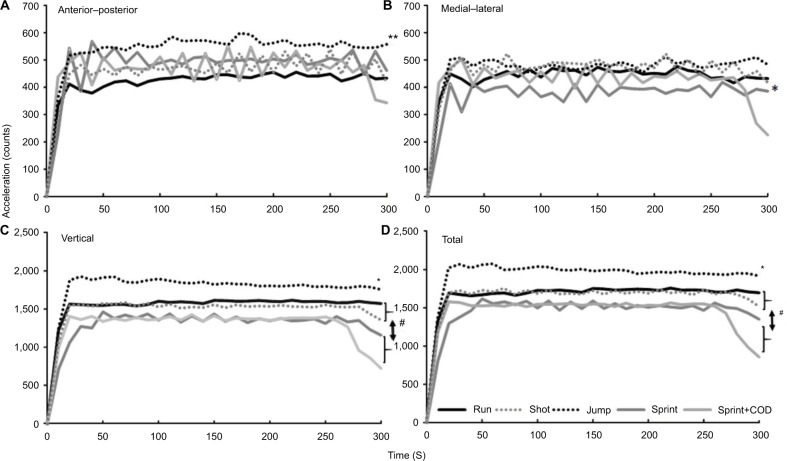
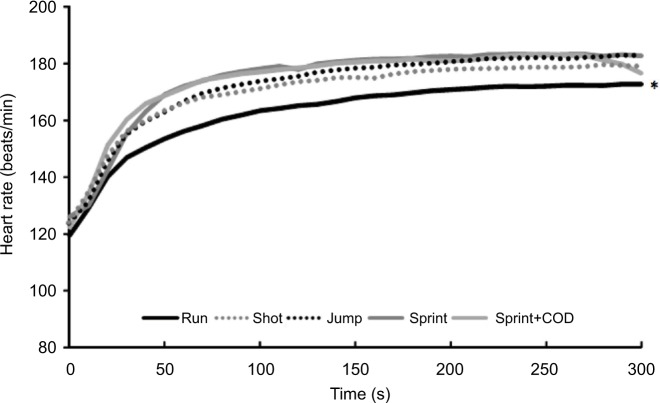
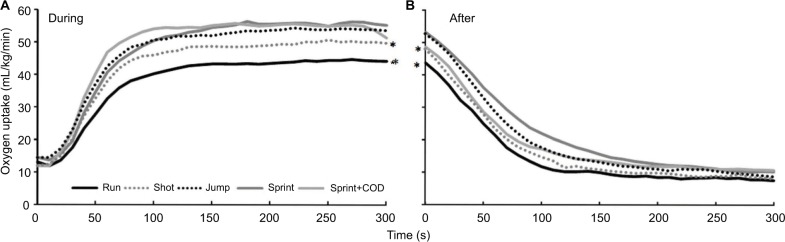
In the comparison of different soccer-specific maximal actions upon physiological and perceptual responses and accelerometer load, this study found that the total accelerometer load was lowest in Sprint and Sprint COD conditions, although the physiological (oxygen uptake and heart rate) and perceptual (RPE) responses were highest in the respective conditions. The Jump condition experienced lower RPE than Sprint and Sprint COD but achieved the highest accelerometer load.
Accelerometer load is not a valid measurement for energy costs or RPE but may function as a complementary tool to investigate the player loads during matches and training.
本研究旨在比较不同足球专项最大动作(持续跑、冲刺跑、变向冲刺跑[Sprint COD]、跳跃和射门)对生理反应(摄氧量和心率)、感知反应(主观用力感觉等级[RPE])以及加速度计负荷的影响。
十名中度至良好训练水平的男性足球运动员自愿作为本研究的受试者。采用重复的受试者内设计,在为期2周的时间内,每个受试者在不同日期接受5次测试,每天进行一次测试。五项测试中的每一项距离均为900米,持续5分钟,因此所有五项测试的平均速度为3米/秒。在测试过程中,测量摄氧量、心率和加速度计负荷。每次测试结束后立即记录RPE,测试结束后,受试者坐在椅子上直立姿势时测量5分钟的摄氧量。
在比较不同足球专项最大动作对生理和感知反应以及加速度计负荷的影响时,本研究发现,尽管在冲刺跑和变向冲刺跑条件下生理反应(摄氧量和心率)和感知反应(RPE)最高,但加速度计总负荷在冲刺跑和变向冲刺跑条件下最低。跳跃条件下的RPE低于冲刺跑和变向冲刺跑,但加速度计负荷最高。
加速度计负荷并非能量消耗或RPE的有效测量指标,但可作为一种补充工具,用于研究比赛和训练期间球员的负荷情况。