Pitt Rachelle, Theodoros Deborah, Hill Anne J, Rodriguez Amy D, Russell Trevor
Centre for Research in Telerehabilitation, University of Queensland, Australia.
School of Health and Rehabilitation Sciences, University of Queensland, Australia.
Digit Health. 2017 Jul 2;3:2055207617718767. doi: 10.1177/2055207617718767. eCollection 2017 Jan-Dec.
This study is designed to determine the feasibility of the provision of an evidenced-based aphasia therapy, constraint-induced language therapy, via telerehabilitation. It describes the computer software that was developed specifically for the delivery of constraint-induced language therapy in the online environment and presents two case studies.
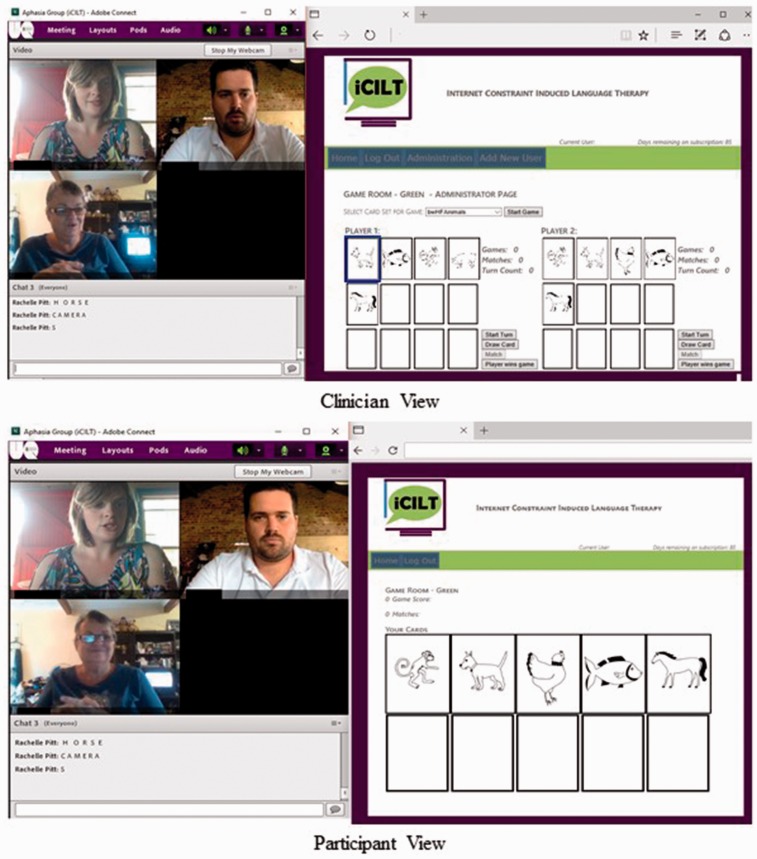
Two participants with chronic aphasia were assessed before and after a two-week intensive treatment block of constraint-induced language therapy delivered via Web-based videoconferencing. The group-based, dual card request game utilized in face-to-face constraint-induced language therapy was transformed into an innovative and user-friendly Web-based game - Internet constraint-induced language therapy (iCILT). Participants accessed iCILT via the Internet from their own home every weekday for two weeks. Language and quality of life measures were administered pre- and post-therapy in order to detect treatment effects. Participant satisfaction information was also recorded.
Online delivery of iCILT was technically feasible and participant satisfaction was high with a number of benefits associated with telerehabilitation identified by participants. Post-treatment performance for language functioning and communication-related quality of life was variable for each participant, however improvements in naming were noted.
Constraint-induced language therapy delivered via telerehabilitation may be a feasible alternative to traditional face-to-face therapy for people with chronic aphasia.
本研究旨在确定通过远程康复提供循证失语症治疗——强制性诱导语言治疗的可行性。它描述了专门为在在线环境中提供强制性诱导语言治疗而开发的计算机软件,并展示了两个案例研究。
两名慢性失语症患者在通过基于网络的视频会议进行为期两周的强制性诱导语言治疗强化治疗阶段前后接受了评估。在面对面的强制性诱导语言治疗中使用的基于小组的双卡请求游戏被转化为一款创新且用户友好的基于网络的游戏——互联网强制性诱导语言治疗(iCILT)。参与者在两周内的每个工作日从自己家中通过互联网访问iCILT。在治疗前和治疗后进行语言和生活质量测量,以检测治疗效果。还记录了参与者的满意度信息。
iCILT的在线交付在技术上是可行的,参与者满意度很高,参与者确定了与远程康复相关的一些益处。每位参与者治疗后的语言功能表现和与沟通相关的生活质量各不相同,不过命名方面有改善。
对于慢性失语症患者,通过远程康复提供的强制性诱导语言治疗可能是传统面对面治疗的一种可行替代方案。