Department of Management and Engineering, University of Padova, Vicenza, Italy.
Department of Neurosciences, Section of Dentistry, University of Padova, Padova, Italy.
PLoS One. 2018 Jun 26;13(6):e0199591. doi: 10.1371/journal.pone.0199591. eCollection 2018.
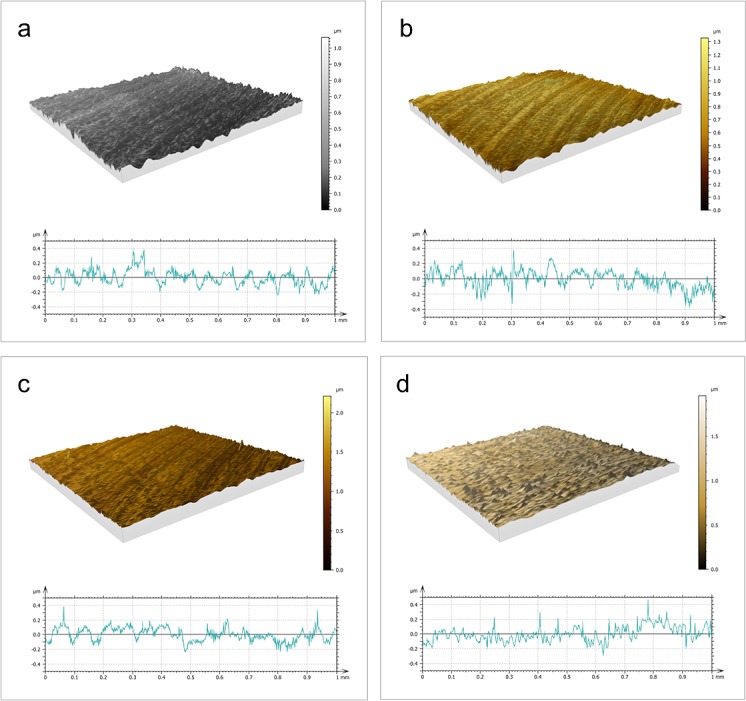
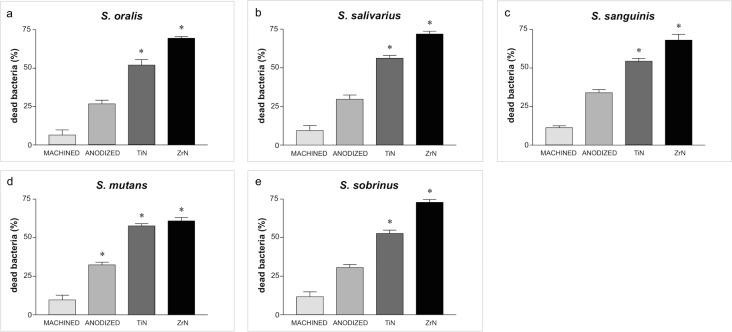
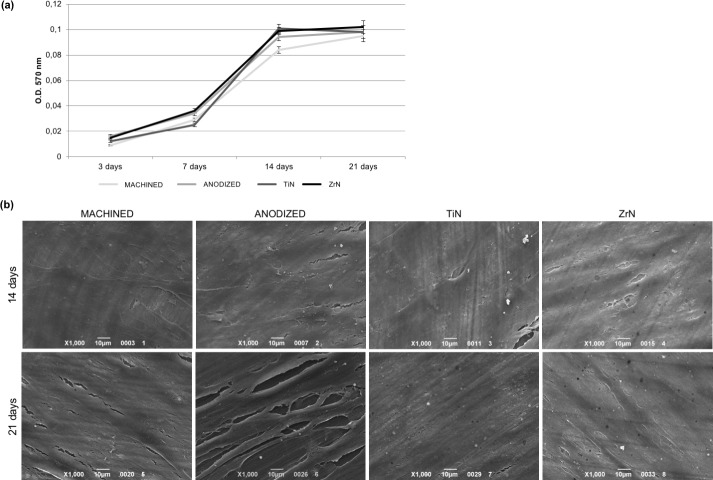
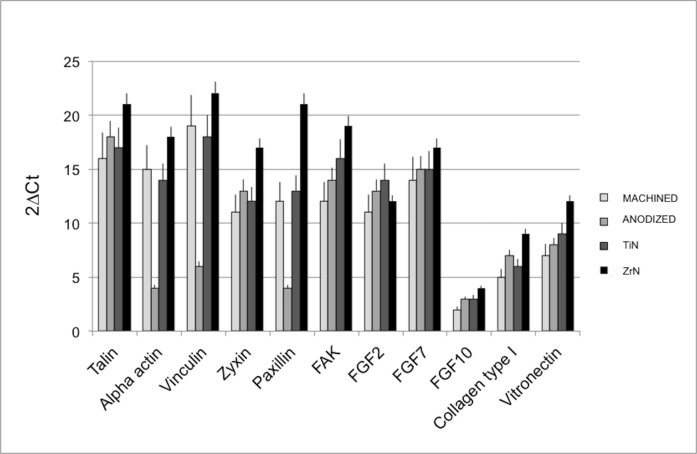
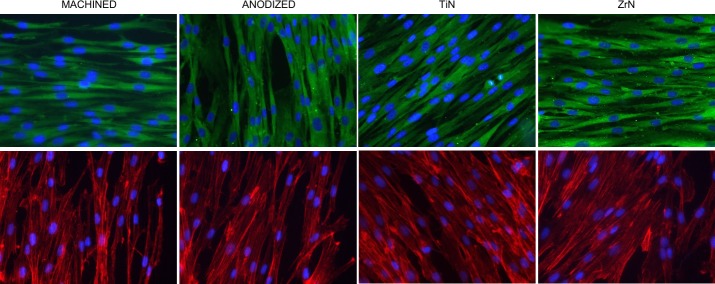
Improving soft tissue attachment and reducing bacterial colonization on titanium abutments are key factors for the long-term maintenance of healthy soft and hard peri-implant tissues. This in vitro study was conducted to compare the biocompatibility and antibacterial activity of four different surfaces: uncoated Ti6Al4V, anodized, and coated with titanium nitride or zirconium nitride. Surface topography was investigated with a high-resolution system for measuring surface finishes. Human gingival fibroblast (HGF) adhesion and proliferation were examined using MTT assay, Scanning Electron Microscopy (SEM) imaging, immunofluorescence analysis and real-time PCR for selected target genes. The hemolysis and AMES tests were performed to assess the chemical compounds' blood compatibility and mutagenic potential, respectively. Antibacterial activity was tested against five bacterial strains isolated from the oral cavity (Streptococcus salivarius, S. sanguinis, S. mutans, S. sobrinus, S. oralis), and the percentage of dead bacteria was calculated. Roughness measurements confirmed a substantial similarity between the surfaces and their compatibility with clinical applications. MTT assay, SEM analysis and immunofluorescence staining showed adhesion and proliferation of HGFs cultured on all the examined surfaces. PCR confirmed that HGFs produced extracellular matrix components efficiently on all the surfaces. No hemolytic activity was detected, and the AMES test confirmed the surfaces' clinical safety. For all tested bacterial strains, biofilms grown on the zirconium nitride surface showed a higher percentage of dead bacteria than on the other disks. The titanium nitride surface inactivated bacterial biofilms, too, but to a lesser extent.
提高钛种植体基台的软组织附着和减少细菌定植是维持健康的软硬种植体周围组织的长期稳定性的关键因素。本体外研究比较了四种不同表面的生物相容性和抗菌活性:未涂层 Ti6Al4V、阳极氧化、氮化钛和氮化锆涂层。使用用于测量表面光洁度的高分辨率系统研究了表面形貌。通过 MTT 测定法、扫描电子显微镜 (SEM) 成像、免疫荧光分析和实时 PCR 检测选定靶基因,研究了人牙龈成纤维细胞 (HGF) 的黏附和增殖。通过溶血和 AMES 试验分别评估化学化合物的血液相容性和致突变潜力。针对从口腔中分离出的五种细菌菌株(唾液链球菌、血链球菌、变形链球菌、远缘链球菌、口腔链球菌)测试了抗菌活性,并计算了死亡细菌的百分比。粗糙度测量结果证实了这些表面与临床应用的高度兼容性。MTT 测定法、SEM 分析和免疫荧光染色显示,HGF 在所有被检测表面上的黏附和增殖。PCR 证实 HGF 在所有表面上都能有效地产生细胞外基质成分。未检测到溶血活性,AMES 试验证实了这些表面的临床安全性。对于所有测试的细菌菌株,在氮化锆表面上形成的生物膜显示出比其他磁盘更高比例的死亡细菌。氮化钛表面也能使细菌生物膜失活,但程度较轻。