University College London, Gower St, London, WC1E 6BT, UK.
Respiratory Medicine, St Mary's Hospital, Paddington, London, W2 1NY, UK.
BMC Med Educ. 2018 Jun 27;18(1):152. doi: 10.1186/s12909-018-1264-5.
Mobile learning (mLearning) devices (such as tablets and smartphones) are increasingly part of the clinical environment but there is a limited and somewhat conflicting literature regarding the impact of such devices in the clinical learning environment. This study aims to: assess the impact of mLearning devices in the clinical learning environment on medical students' studying habits, attitudes towards mobile device supported learning; and the perceived reaction of clinicians and patients to the use of these devices as part of learning in the clinical setting.
Over three consecutive academic years, 18 cohorts of medical students (total n = 275) on a six-week rotation at a large teaching hospital in London were supplied with mLearning devices (iPad mini) to support their placement-based learning. Feedback on their experiences and perceptions was collected via pre- and post-use questionnaires.
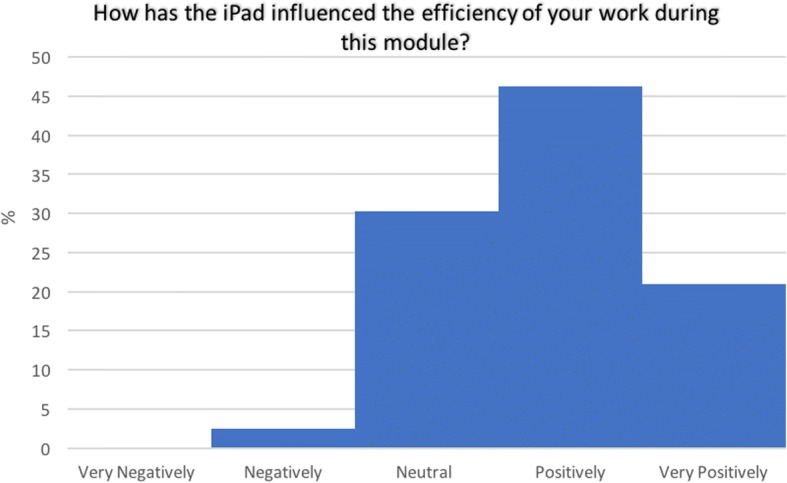
The results suggest mLearning devices have a positive effect on the students' perceived efficiency of working, while experience of usage not only confirmed pre-existing positive opinions about devices but also disputed some expected limitations associated with mLearning devices in the clinical workplace. Students were more likely to use devices in 'down-time' than as part of their clinical learning. As anticipated, both by users and from the literature, universal internet access was a major limitation to device use. The results were inconclusive about the student preference for device provision versus supporting a pre-owned device.
M-learning devices can have a positive impact on the learning experiences medical students during their clinical attachments. The results supported the feasibility of providing mLearning devices to support learning in the clinical environment. However, universal internet is a fundamental limitation to optimal device utilisation.
移动学习(mLearning)设备(如平板电脑和智能手机)越来越多地成为临床环境的一部分,但关于这些设备在临床学习环境中的影响的文献有限且有些相互矛盾。本研究旨在:评估 mLearning 设备在临床学习环境中对医学生学习习惯、对移动设备支持学习的态度的影响;以及临床医生和患者对这些设备在临床环境中作为学习一部分的使用的感知反应。
在连续三个学年中,18 个医学生队列(共 275 名)在伦敦的一家大型教学医院进行了为期六周的轮转,他们配备了 mLearning 设备(iPad mini)来支持他们的基于岗位的学习。通过使用前后的问卷收集他们的经验和看法的反馈。
结果表明,mLearning 设备对学生的工作效率有积极影响,而使用经验不仅证实了他们对设备的先前存在的积极看法,而且还反驳了一些与临床工作场所中的 mLearning 设备相关的预期限制。学生更有可能在“空闲时间”而不是作为临床学习的一部分使用设备。正如预期的那样,用户和文献都认为,普遍的互联网接入是设备使用的主要限制。结果对学生更倾向于使用设备还是支持使用自己的设备没有定论。
mLearning 设备可以对医学生在临床实习期间的学习体验产生积极影响。结果支持在临床环境中提供 mLearning 设备以支持学习的可行性。然而,普遍的互联网是优化设备利用的基本限制。