
平板电脑强化训练提高内科考试成绩。
Tablet computer enhanced training improves internal medicine exam performance.
作者信息
Baumgart Daniel C, Wende Ilja, Grittner Ulrike
机构信息
Department of Gastroenterology and Hepatology, Charité Medical School, Humboldt-University of Berlin, Berlin, Germany.
Department for Biostatistics and Clinical Epidemiology, Charité Medical School, Humboldt-University of Berlin, Berlin, Germany.
出版信息
PLoS One. 2017 Apr 3;12(4):e0172827. doi: 10.1371/journal.pone.0172827. eCollection 2017.
BACKGROUND
Traditional teaching concepts in medical education do not take full advantage of current information technology. We aimed to objectively determine the impact of Tablet PC enhanced training on learning experience and MKSAP® (medical knowledge self-assessment program) exam performance.
METHODS
In this single center, prospective, controlled study final year medical students and medical residents doing an inpatient service rotation were alternatingly assigned to either the active test (Tablet PC with custom multimedia education software package) or traditional education (control) group, respectively. All completed an extensive questionnaire to collect their socio-demographic data, evaluate educational status, computer affinity and skills, problem solving, eLearning knowledge and self-rated medical knowledge. Both groups were MKSAP® tested at the beginning and the end of their rotation. The MKSAP® score at the final exam was the primary endpoint.
RESULTS
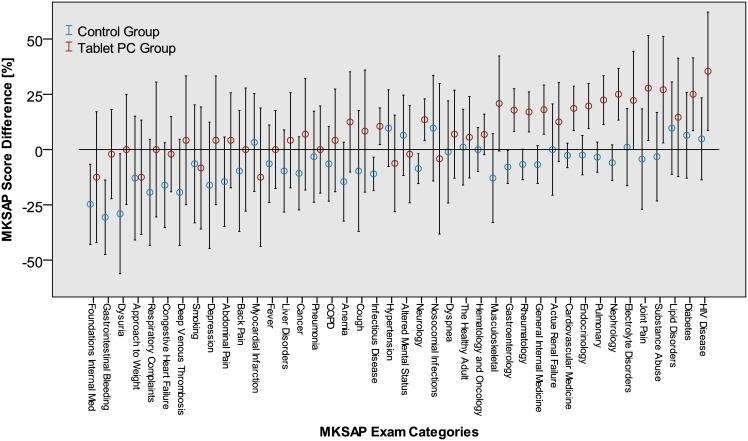
Data of 55 (tablet n = 24, controls n = 31) male 36.4%, median age 28 years, 65.5% students, were evaluable. The mean MKSAP® score improved in the tablet PC (score Δ + 8 SD: 11), but not the control group (score Δ- 7, SD: 11), respectively. After adjustment for baseline score and confounders the Tablet PC group showed on average 11% better MKSAP® test results compared to the control group (p<0.001). The most commonly used resources for medical problem solving were journal articles looked up on PubMed or Google®, and books.
CONCLUSIONS
Our study provides evidence, that tablet computer based integrated training and clinical practice enhances medical education and exam performance. Larger, multicenter trials are required to independently validate our data. Residency and fellowship directors are encouraged to consider adding portable computer devices, multimedia content and introduce blended learning to their respective training programs.
背景
医学教育中的传统教学理念未能充分利用当前的信息技术。我们旨在客观地确定平板电脑强化培训对学习体验和MKSAP®(医学知识自我评估计划)考试成绩的影响。
方法
在这项单中心、前瞻性、对照研究中,将正在进行住院服务轮转的医学专业高年级学生和住院医师分别交替分配到主动测试组(配备定制多媒体教育软件包的平板电脑)或传统教育(对照组)。所有人都完成了一份详尽的问卷,以收集他们的社会人口学数据、评估教育状况、计算机亲和力和技能、解决问题的能力、电子学习知识以及自我评估的医学知识。两组在轮转开始和结束时都进行了MKSAP®测试。期末考试的MKSAP®分数是主要终点。
结果
可评估55名男性(平板电脑组n = 24,对照组n = 31)的数据,占36.4%,中位年龄28岁,学生占65.5%。平板电脑组的平均MKSAP®分数有所提高(分数变化Δ + 8,标准差:11),而对照组则没有提高(分数变化Δ - 7,标准差:11)。在对基线分数和混杂因素进行调整后,与对照组相比,平板电脑组的MKSAP®测试结果平均高出11%(p<0.001)。解决医学问题最常用的资源是在PubMed或谷歌上查阅的期刊文章以及书籍。
结论
我们的研究提供了证据,表明基于平板电脑的综合培训和临床实践可提高医学教育水平和考试成绩。需要进行更大规模的多中心试验来独立验证我们的数据。鼓励住院医师培训项目和专科培训项目的主任考虑在各自的培训项目中增加便携式计算机设备、多媒体内容并引入混合式学习。


 Zotero 插件