Department of Cardiology, Aalborg University Hospital, Aalborg, Denmark
Department of Clinical Medicine, Aalborg University, Aalborg, Denmark.
J Am Heart Assoc. 2018 Jun 26;7(13):e009820. doi: 10.1161/JAHA.118.009820.
We investigated the association between the content of linoleic acid in adipose tissue, a biomarker of long-term intake of linoleic acid, and the risk of ischemic stroke and its subtypes.
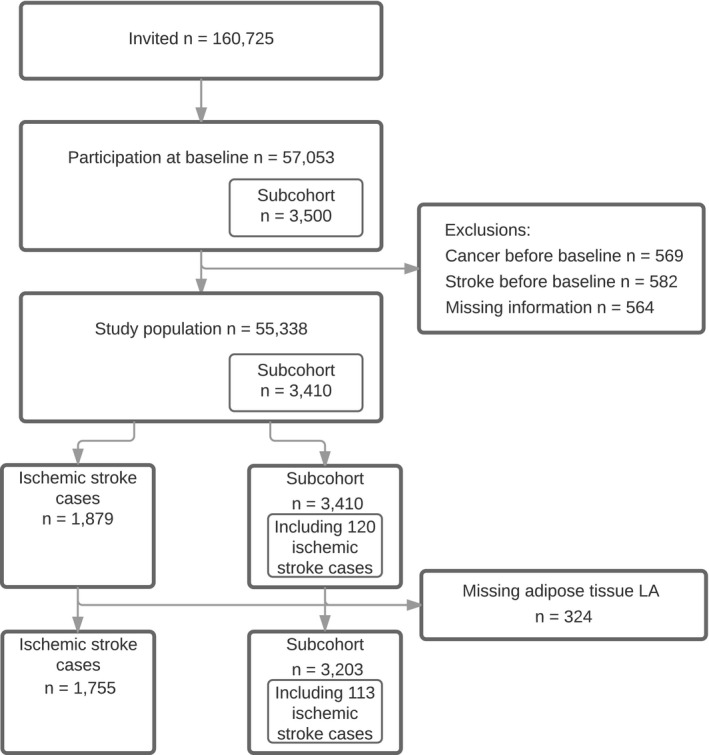
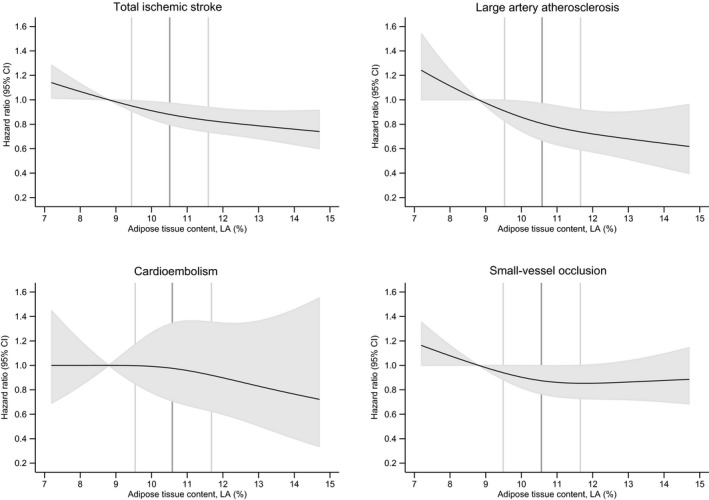
The Danish cohort study Diet, Cancer and Health included 57 053 patients aged 50 to 65 years at enrollment. All participants had an adipose tissue biopsy performed at enrollment, while information on ischemic stroke during follow-up was obtained from the Danish National Patient Register. Stroke diagnoses were all validated and classified according to the Trial of Org 10172 in Acute Stroke Treatment (TOAST) classification. Cases and a randomly drawn subcohort of 3500 patients had their fatty acid composition in adipose tissue determined by gas chromatography. Hazard ratios with 95% confidence intervals were calculated using weighted Cox proportional hazard regression. During 13.5 years of follow-up, 1879 ischemic stroke cases were identified, for which 1755 adipose biopsies were available, while adipose biopsies were available for 3203 participants in the subcohort. When comparing the highest and the lowest quartiles of adipose tissue content of linoleic acid there was a negative association with the rate of total ischemic stroke (hazard ratio, 0.78; 95% confidence interval, 0.65-0.93) and large artery atherosclerosis (hazard ratio, 0.61; 95% confidence interval, 0.43-0.88), while there was an indication of a negative association with small-vessel occlusion (hazard ratio, 0.87; 95% confidence interval, 0.69-1.11). There was no clear association with the rate of cardioembolism.
The content of linoleic acid in adipose tissue was inversely associated with the risk of total ischemic stroke and stroke caused by large artery atherosclerosis.
我们研究了脂肪组织中亚油酸的含量(亚油酸长期摄入的生物标志物)与缺血性中风及其亚型风险之间的关联。
丹麦队列研究 Diet,Cancer and Health 纳入了 57053 名年龄在 50 至 65 岁的患者。所有参与者在入组时均进行了脂肪组织活检,而随访期间缺血性中风的信息则从丹麦国家患者登记处获得。中风诊断均经过验证,并根据急性中风治疗组织 10172 试验(TOAST)分类进行分类。通过气相色谱法确定病例和随机抽取的 3500 名患者亚组的脂肪组织脂肪酸组成。使用加权 Cox 比例风险回归计算风险比及其 95%置信区间。在 13.5 年的随访期间,共确定了 1879 例缺血性中风病例,其中 1755 例可获得脂肪活检,而亚组中 3203 名参与者可获得脂肪活检。比较亚油酸脂肪组织含量最高和最低四分位数时,总缺血性中风(风险比,0.78;95%置信区间,0.65-0.93)和大动脉粥样硬化(风险比,0.61;95%置信区间,0.43-0.88)的发生率呈负相关,而小血管闭塞(风险比,0.87;95%置信区间,0.69-1.11)呈负相关的趋势。与心源性栓塞的发生率无明显关联。
脂肪组织中亚油酸的含量与总缺血性中风和大动脉粥样硬化性中风的风险呈负相关。