RIKEN Center for Biosystems Dynamics Research (RIKEN BDR), 2-2-3 Minatojima-minamimachi, Chuo-ku, Kobe, 650-0047, Japan
The Francis Crick Institute, 1 Midland Road, London NW1 1AT, UK
Development. 2018 Jun 26;145(12):dev164368. doi: 10.1242/dev.164368.
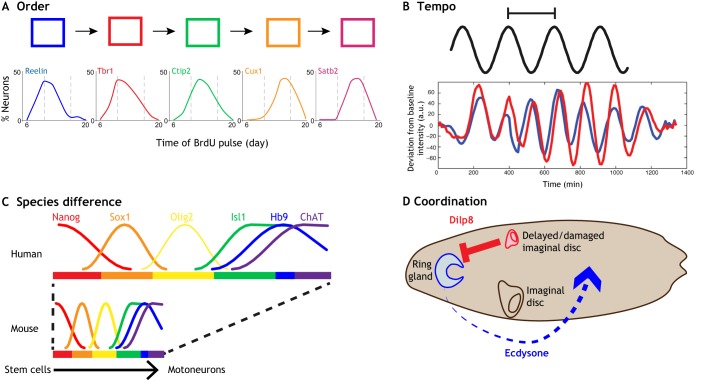
Biology is dynamic. Timescales range from frenetic sub-second ion fluxes and enzymatic reactions to the glacial millions of years of evolutionary change. Falling somewhere in the middle of this range are the processes we usually study in development: cell division and differentiation, gene expression, cell-cell signalling, and morphogenesis. But what sets the tempo and manages the order of developmental events? Are the order and tempo different between species? How is the sequence of multiple events coordinated? Here, we discuss the importance of time for developing embryos, highlighting the necessity for global as well as cell-autonomous control. New reagents and tools in imaging and genomic engineering, combined with culture, are beginning to offer fresh perspectives and molecular insight into the origin and mechanisms of developmental time.
生物学是动态的。时间尺度范围从疯狂的亚秒级离子通量和酶反应到冰河时代的数百万年进化变化。在这个范围的中间是我们通常在发育中研究的过程:细胞分裂和分化、基因表达、细胞间信号传递和形态发生。但是,是什么设定了发育事件的节奏并管理其顺序呢?不同物种之间的顺序和节奏是否不同?如何协调多个事件的序列?在这里,我们讨论了时间对发育中胚胎的重要性,强调了全局和细胞自主控制的必要性。新的成像和基因组工程试剂和工具,结合培养,开始为发育时间的起源和机制提供新的视角和分子见解。