Penninx Brenda W J H, Lange Sjors M M
Department of Psychiatry, VU University Medical Center & GGZ InGeest, Amsterdam, The Netherlands.
Dialogues Clin Neurosci. 2018 Mar;20(1):63-73. doi: 10.31887/DCNS.2018.20.1/bpenninx.
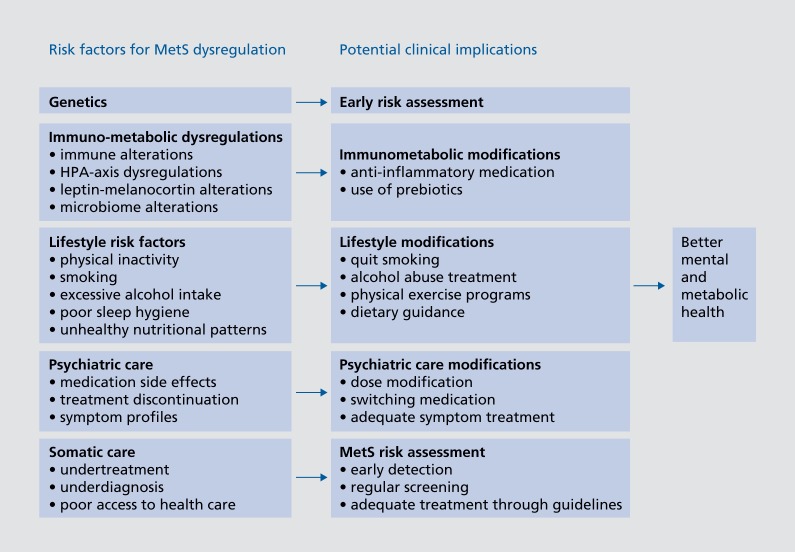
Psychiatric patients have a greater risk of premature mortality, predominantly due to cardiovascular diseases (CVDs). Convincing evidence shows that psychiatric conditions are characterized by an increased risk of metabolic syndrome (MetS), a clustering of cardiovascular risk factors including dyslipidemia, abdominal obesity, hypertension, and hyperglycemia. This increased risk is present for a range of psychiatric conditions, including major depressive disorder (MDD), bipolar disorder (BD), schizophrenia, anxiety disorder, attention-deficit/hyperactivity disorder (ADHD), and posttraumatic stress disorder (PTSD). There is some evidence for a dose-response association with the severity and duration of symptoms and for a bidirectional longitudinal impact between psychiatric disorders and MetS. Associations generally seem stronger with abdominal obesity and dyslipidemia dysregulations than with hypertension. Contributing mechanisms are an unhealthy lifestyle and a poor adherence to medical regimen, which are prevalent among psychiatric patients. Specific psychotropic medications have also shown a profound impact in increasing MetS dysregulations. Finally, pleiotropy in genetic vulnerability and pathophysiological mechanisms, such as those leading to the increased central and peripheral activation of immunometabolic or endocrine systems, plays a role in both MetS and psychiatric disorder development. The excess risk of MetS and its unfavorable somatic health consequences justifies a high priority for future research, prevention, close monitoring, and treatment to reduce MetS in the vulnerable psychiatric patient.
精神疾病患者过早死亡的风险更高,主要原因是心血管疾病(CVDs)。有确凿证据表明,精神疾病的特征是代谢综合征(MetS)风险增加,代谢综合征是包括血脂异常、腹型肥胖、高血压和高血糖在内的心血管危险因素的聚集。一系列精神疾病都存在这种风险增加的情况,包括重度抑郁症(MDD)、双相情感障碍(BD)、精神分裂症、焦虑症、注意力缺陷多动障碍(ADHD)和创伤后应激障碍(PTSD)。有证据表明,症状的严重程度和持续时间与剂量反应相关,并且精神疾病与代谢综合征之间存在双向纵向影响。一般来说,与腹型肥胖和血脂异常失调的关联似乎比与高血压的关联更强。促成机制是不健康的生活方式和对医疗方案的依从性差,这些在精神疾病患者中很普遍。特定的精神药物在增加代谢综合征失调方面也显示出深远影响。最后,遗传易感性和病理生理机制中的多效性,例如那些导致免疫代谢或内分泌系统中枢和外周激活增加的机制,在代谢综合征和精神疾病的发展中都起作用。代谢综合征的额外风险及其对身体健康的不利影响证明,未来在易患精神疾病的患者中开展降低代谢综合征的研究、预防、密切监测和治疗具有高度优先性。