Münger Emmanuelle, Montiel-Castro Augusto J, Langhans Wolfgang, Pacheco-López Gustavo
Department of Environmental Systems Science, Swiss Federal Institute of Technology (ETH) Zurich, Zurich, Switzerland.
Health Sciences Department, Metropolitan Autonomous University (UAM), Lerma, Mexico.
Front Integr Neurosci. 2018 Jun 12;12:21. doi: 10.3389/fnint.2018.00021. eCollection 2018.
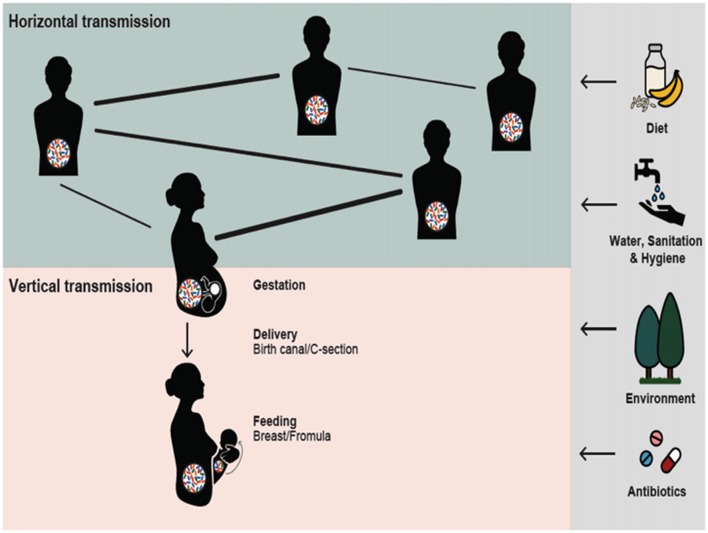
Animals harbor an extensive, dynamic microbial ecosystem in their gut. Gut microbiota (GM) supposedly modulate various host functions including fecundity, metabolism, immunity, cognition and behavior. Starting by analyzing the concept of the holobiont as a unit of selection, we highlight recent findings suggesting an intimate link between GM and animal social behavior. We consider two reciprocal emerging themes: (i) that GM influence host social behavior; and (ii) that social behavior and social structure shape the composition of the GM across individuals. We propose that, throughout a long history of coevolution, GM may have become involved in the modulation of their host's sociality to foster their own transmission, while in turn social organization may have fine-tuned the transmission of beneficial endosymbionts and prevented pathogen infection. We suggest that investigating these reciprocal interactions can advance our understanding of sociality, from healthy and impaired social cognition to the evolution of specific social behaviors and societal structure.
动物的肠道中存在着广泛且动态的微生物生态系统。肠道微生物群(GM)据推测可调节宿主的多种功能,包括繁殖力、新陈代谢、免疫力、认知和行为。我们从分析全生物作为一个选择单位的概念入手,着重介绍了近期表明GM与动物社会行为之间存在密切联系的研究发现。我们考虑两个相互关联且不断涌现的主题:(i)GM影响宿主的社会行为;(ii)社会行为和社会结构塑造个体间GM的组成。我们提出,在漫长的共同进化历史中,GM可能已参与调节其宿主的社会性以促进自身传播,而社会组织则可能对有益共生菌的传播进行了微调并预防病原体感染。我们认为,研究这些相互作用可以增进我们对社会性的理解,从健康和受损的社会认知到特定社会行为和社会结构的演变。