Patel Alok, Matsakas Leonidas, Rova Ulrika, Christakopoulos Paul
Biochemical Process Engineering, Division of Chemical Engineering, Department of Civil, Environmental, and Natural Resources Engineering, Luleå University of Technology, 971 87 Luleå, Sweden.
Biotechnol Biofuels. 2018 Jun 20;11:169. doi: 10.1186/s13068-018-1173-1. eCollection 2018.
The aim of this work was to establish a process for the heterotrophic growth of green microalgae using forest biomass hydrolysates. To provide a carbon source for the growth of the green microalgae, two forest biomasses (Norway spruce and silver birch) were pretreated with a hybrid organosolv-steam explosion method, resulting in inhibitor-free pretreated solids with a high cellulose content of 77.9% w/w (birch) and 72% w/w (spruce). Pretreated solids were hydrolyzed using commercial cellulolytic enzymes to produce hydrolysate for the culture of algae.
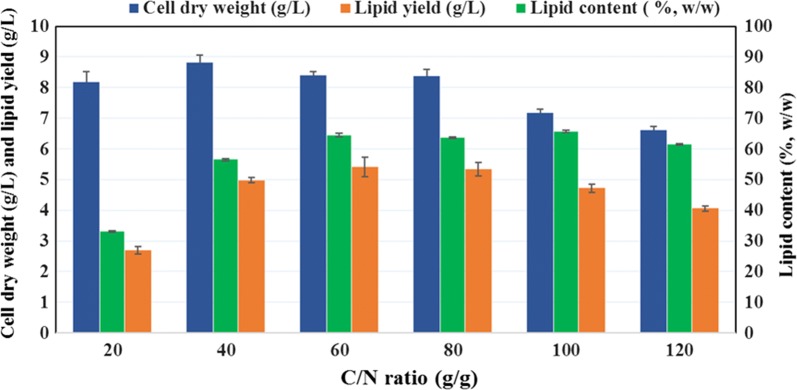
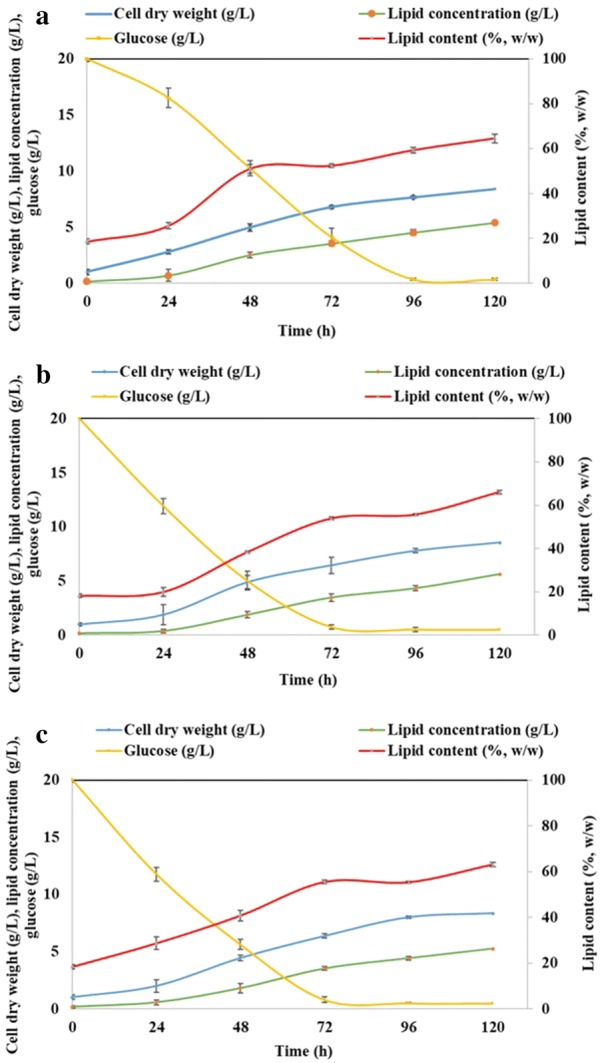
The heterotrophic growth of was assessed using synthetic medium with glucose as carbon source, where the effect of sugar concentration and the carbon-to-nitrogen ratio were optimized, resulting in accumulation of lipids at 5.42 ± 0.32 g/L (64.52 ± 0.53% lipid content) after 5 days of culture on glucose at 20 g/L. The use of birch and spruce hydrolysates was favorable for the growth and lipid accumulation of the algae, resulting in lipid production of 5.65 ± 0.21 g/L (66 ± 0.33% lipid content) and 5.28 ± 0.17 g/L (63.08 ± 0.71% lipid content) when grown on birch and spruce, respectively, after only 120 h of cultivation.
To the best of our knowledge, this is the first report of using organosolv pretreated wood biomass hydrolysates for the growth and lipid production of microalgae in the literature. The pretreatment process used in this study provided high saccharification of biomass without the presence of inhibitors. Moreover, the lipid profile of this microalga showed similar contents to vegetable oils which improve the biodiesel properties.
本研究旨在建立一种利用森林生物质水解产物实现绿色微藻异养生长的方法。为给绿色微藻的生长提供碳源,采用混合有机溶剂 - 蒸汽爆破法对两种森林生物质(挪威云杉和银桦)进行预处理,得到不含抑制剂且纤维素含量高的预处理固体,其中桦木的纤维素含量为77.9% w/w,云杉为72% w/w。使用商业纤维素酶对预处理固体进行水解,以生产用于藻类培养的水解产物。
以葡萄糖为碳源的合成培养基评估了微藻的异养生长,优化了糖浓度和碳氮比的影响,在20 g/L葡萄糖上培养5天后,脂质积累量达到5.42±0.32 g/L(脂质含量为64.52±0.53%)。使用桦木和云杉水解产物有利于藻类的生长和脂质积累,仅培养120小时后,在桦木和云杉上生长时,脂质产量分别为5.65±0.21 g/L(脂质含量为66±0.33%)和5.28±0.17 g/L(脂质含量为63.08±0.71%)。
据我们所知,本文是文献中首次报道使用有机溶剂预处理的木材生物质水解产物用于微藻生长和脂质生产。本研究中使用的预处理工艺在不存在抑制剂的情况下实现了生物质的高糖化。此外,这种微藻的脂质谱显示其含量与植物油相似,改善了生物柴油性能。