Potsdam Institute for Climate Impact Research, Potsdam, Germany.
University of Chicago and ANL Computation Institute, Chicago, Illinois, United States of America.
PLoS One. 2018 Jun 27;13(6):e0198748. doi: 10.1371/journal.pone.0198748. eCollection 2018.
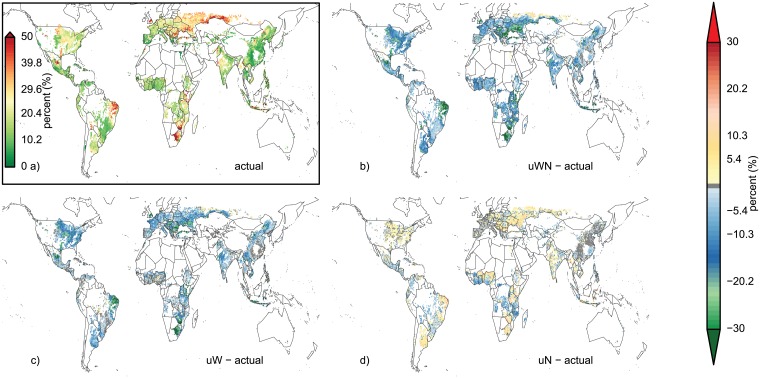
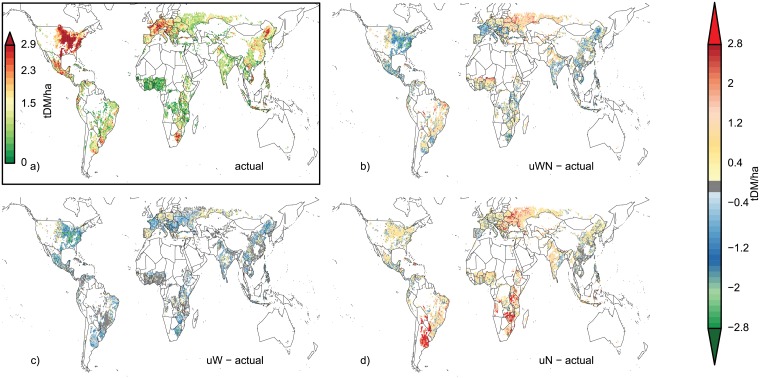
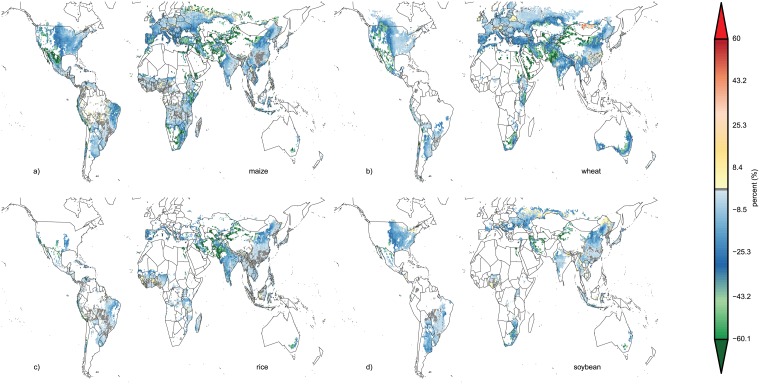
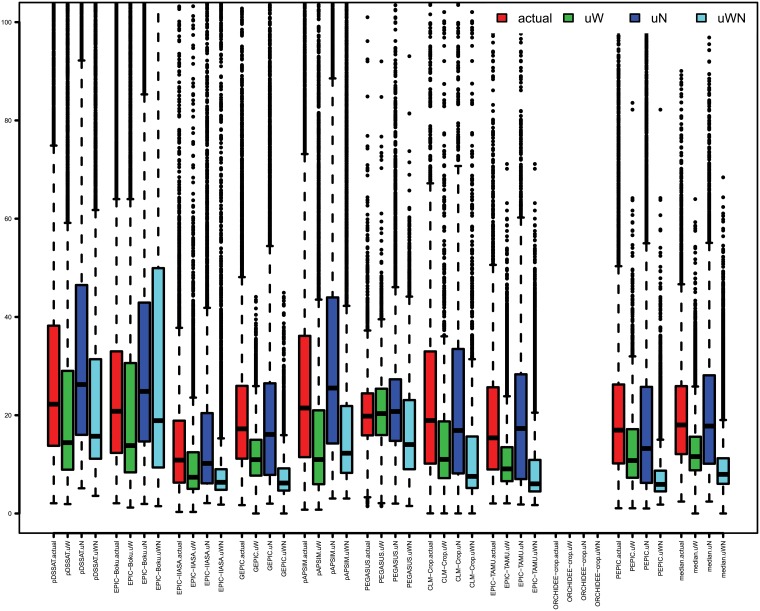
Agricultural production must increase to feed a growing and wealthier population, as well as to satisfy increasing demands for biomaterials and biomass-based energy. At the same time, deforestation and land-use change need to be minimized in order to preserve biodiversity and maintain carbon stores in vegetation and soils. Consequently, agricultural land use needs to be intensified in order to increase food production per unit area of land. Here we use simulations of AgMIP's Global Gridded Crop Model Intercomparison (GGCMI) phase 1 to assess implications of input-driven intensification (water, nutrients) on crop yield and yield stability, which is an important aspect in food security. We find region- and crop-specific responses for the simulated period 1980-2009 with broadly increasing yield variability under additional nitrogen inputs and stabilizing yields under additional water inputs (irrigation), reflecting current patterns of water and nutrient limitation. The different models of the GGCMI ensemble show similar response patterns, but model differences warrant further research on management assumptions, such as variety selection and soil management, and inputs as well as on model implementation of different soil and plant processes, such as on heat stress, and parameters. Higher variability in crop productivity under higher fertilizer input will require adequate buffer mechanisms in trade and distribution/storage networks to avoid food price volatility.
农业生产必须增加,以养活不断增长和更加富裕的人口,满足对生物材料和基于生物质的能源日益增长的需求。与此同时,需要尽量减少森林砍伐和土地利用变化,以保护生物多样性和维持植被及土壤中的碳储量。因此,需要加强农业土地利用,以提高单位土地面积的粮食产量。在这里,我们使用 AgMIP 的全球网格化作物模型比较(GGCMI)第 1 阶段的模拟结果来评估投入驱动强化(水、养分)对作物产量和产量稳定性的影响,这是粮食安全的一个重要方面。我们发现,在模拟的 1980-2009 年期间,不同地区和作物的反应是特定的,随着氮素投入的增加,产量的变异性普遍增加,而在水的投入(灌溉)增加下,产量趋于稳定,反映了当前水和养分限制的模式。GGCMI 集合中的不同模型显示出类似的响应模式,但模型差异需要进一步研究管理假设,如品种选择和土壤管理,以及投入,以及不同土壤和植物过程的模型实现,如热应激和参数。在更高的肥料投入下,作物生产力的更高变异性将需要在贸易和分配/储存网络中建立足够的缓冲机制,以避免粮食价格波动。