Bodirsky Benjamin Leon, Rolinski Susanne, Biewald Anne, Weindl Isabelle, Popp Alexander, Lotze-Campen Hermann
Dept. of Climate Impacts and Vulnerabilites, Potsdam Institute for Climate Impact Research, Potsdam, Germany.
Commonwealth Scientific and Industrial Research Organisation, St. Lucia, Australia.
PLoS One. 2015 Nov 4;10(11):e0139201. doi: 10.1371/journal.pone.0139201. eCollection 2015.
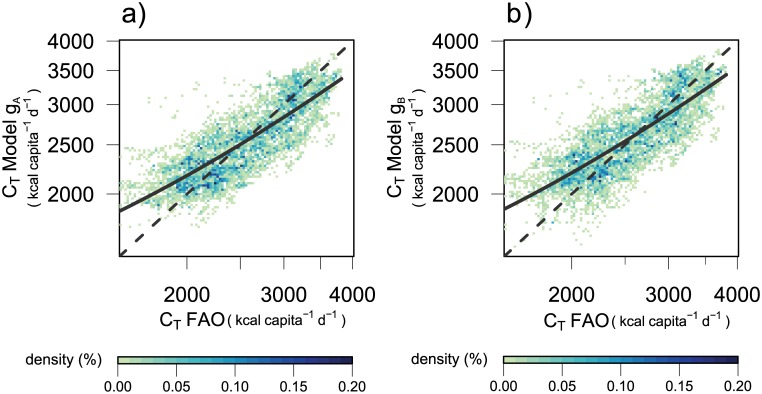
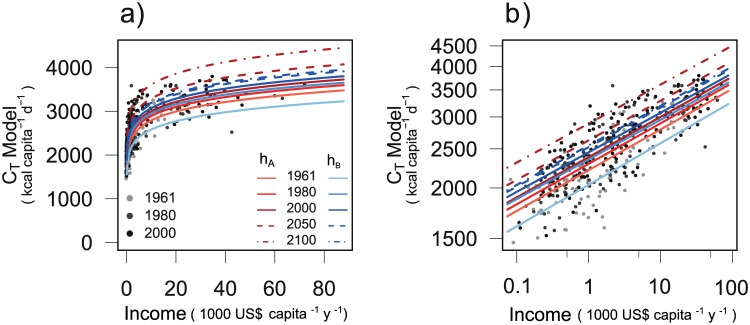
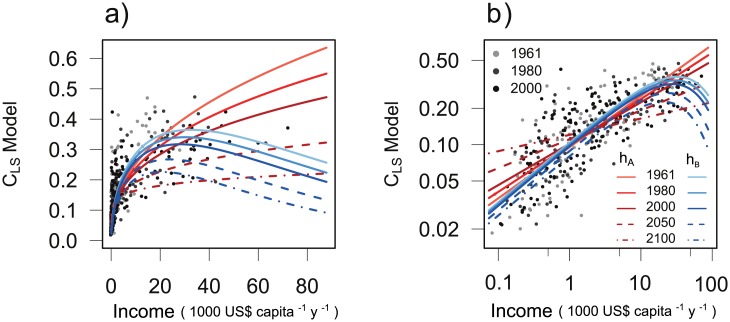
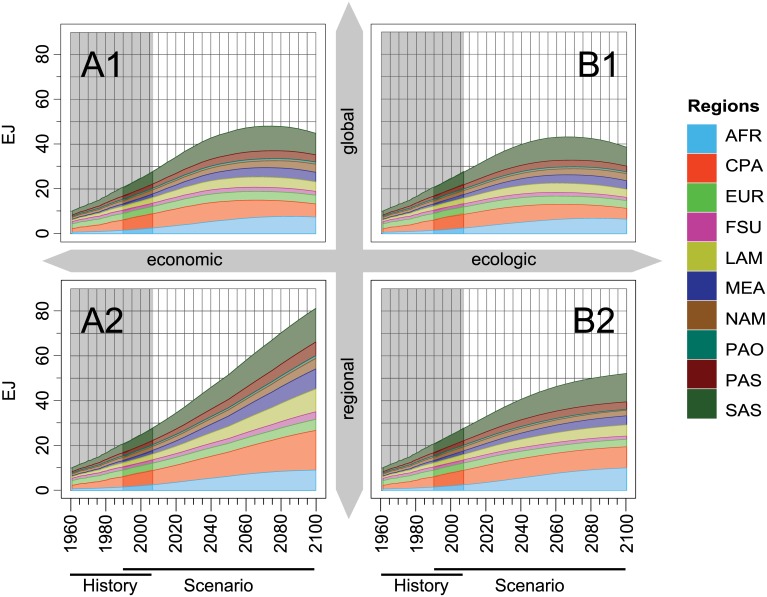
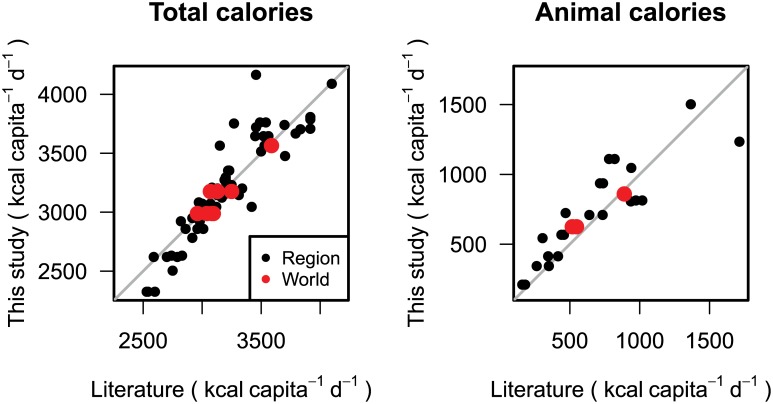
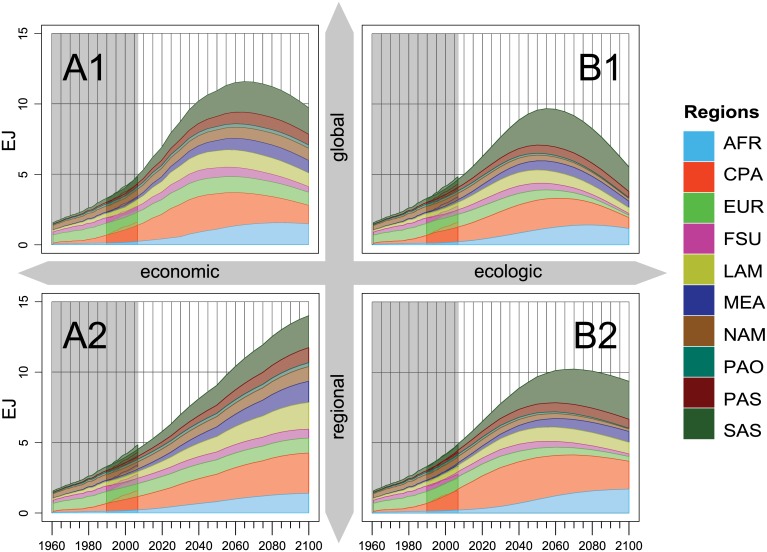
Long-term food demand scenarios are an important tool for studying global food security and for analysing the environmental impacts of agriculture. We provide a simple and transparent method to create scenarios for future plant-based and animal-based calorie demand, using time-dependent regression models between calorie demand and income. The scenarios can be customized to a specific storyline by using different input data for gross domestic product (GDP) and population projections and by assuming different functional forms of the regressions. Our results confirm that total calorie demand increases with income, but we also found a non-income related positive time-trend. The share of animal-based calories is estimated to rise strongly with income for low-income groups. For high income groups, two ambiguous relations between income and the share of animal-based products are consistent with historical data: First, a positive relation with a strong negative time-trend and second a negative relation with a slight negative time-trend. The fits of our regressions are highly significant and our results compare well to other food demand estimates. The method is exemplarily used to construct four food demand scenarios until the year 2100 based on the storylines of the IPCC Special Report on Emissions Scenarios (SRES). We find in all scenarios a strong increase of global food demand until 2050 with an increasing share of animal-based products, especially in developing countries.
长期粮食需求情景是研究全球粮食安全以及分析农业环境影响的重要工具。我们提供了一种简单且透明的方法,利用卡路里需求与收入之间的时间依赖回归模型,来创建未来植物性和动物性卡路里需求的情景。通过使用不同的国内生产总值(GDP)和人口预测输入数据,并假设回归的不同函数形式,这些情景可以根据特定的故事情节进行定制。我们的结果证实,总卡路里需求随收入增加,但我们也发现了一个与收入无关的正向时间趋势。对于低收入群体,动物性卡路里的占比预计会随着收入大幅上升。对于高收入群体,收入与动物性产品占比之间的两种不明确关系与历史数据一致:第一,呈正相关且有强烈的负向时间趋势;第二,呈负相关且有轻微的负向时间趋势。我们回归的拟合度非常显著,并且我们的结果与其他粮食需求估计值相比情况良好。该方法被示例性地用于根据政府间气候变化专门委员会(IPCC)排放情景特别报告(SRES)的故事情节构建到2100年的四种粮食需求情景。我们发现在所有情景中,到2050年全球粮食需求都会大幅增长,动物性产品的占比也会增加,尤其是在发展中国家。