Department of Rehabilitation Medicine, University of Groningen, University Medical Center Groningen, Groningen, The Netherlands.
Center for Rehabilitation, University of Groningen, University Medical Center Groningen, Groningen, The Netherlands.
BMJ Open. 2018 Jun 27;8(6):e020367. doi: 10.1136/bmjopen-2017-020367.
Children with developmental coordination disorder (DCD) are less physically active than their typically developing peers. No substantiated interventions are available to address this issue. Therefore, this study aims to describe the design and rationale of (1) a family-focused intervention to increase motivation for physical activity (PA) and, indirectly, lifestyle PA in children aged 7-12 years with DCD and (2) the methods to examine its preliminary effectiveness and feasibility.
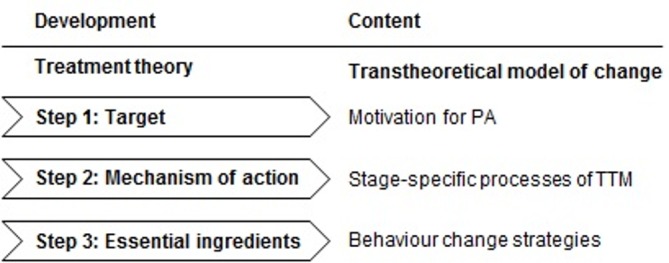
This intervention is the second part of a more comprehensive, multidisciplinary treatment called We12BFit! The intervention was developed using the steps of treatment theory which includes the concept of targets, mechanism of action and essential ingredients. The content of the intervention is based on the transtheoretical model of change (TTM). In the intervention, the motivation for PA will be targeted through application of behaviour change strategies that fit the stages of the TTM. The modes of delivery include: pedometer, poster, parent meeting, booklet and coaching. At least 19 children with DCD, aged 7-12 years, will be included from two schools for special education and two rehabilitation centres. The intervention will be evaluated using a single-arm mixed-method design. Effectiveness will be assessed at three instances by using ActiGraph accelerometers accompanied by an activity log. Feasibility will be assessed using interviews with the participants and coaches. This evaluation may add to our understanding of motivation for PA in children with DCD and may eventually improve the rehabilitation programme of children with DCD.
The study has been approved by the Medical Ethics Committee of the University Medical Center of Groningen (METc 2015.216). We will disseminate the final results to the public through journal publications and presentations for practice providers and scientists. A final study report will also be provided to funding organisations.
4, 12 April 2018.
NTR6334; Pre-results.
患有发育性协调障碍(DCD)的儿童的身体活动量比其典型发育同龄人少。目前尚无经过证实的干预措施可解决此问题。因此,本研究旨在描述(1)以家庭为中心的干预措施的设计和基本原理,该干预措施旨在提高 7-12 岁患有 DCD 的儿童对体育活动(PA)的积极性,并间接地提高其生活方式 PA;(2)检查其初步有效性和可行性的方法。
该干预措施是更全面的多学科治疗方案 We12BFit!的第二部分。该干预措施是使用治疗理论的步骤开发的,该理论包括目标概念,作用机制和基本要素。干预措施的内容基于变化的跨理论模型(TTM)。在干预过程中,将通过应用适合 TTM 阶段的行为改变策略来针对 PA 的动机。交付方式包括:计步器,海报,家长会,手册和辅导。将从两所特殊教育学校和两所康复中心中纳入至少 19 名 7-12 岁患有 DCD 的儿童。将使用单臂混合方法设计评估干预措施。将使用加速度计 ActiGraph 并结合活动日志在三个时间点评估有效性。将通过对参与者和教练的访谈评估可行性。这种评估可能会增加我们对患有 DCD 的儿童对 PA 的动机的理解,并最终改善患有 DCD 的儿童的康复计划。
该研究已获得格罗宁根大学医学中心医学伦理委员会(METc 2015.216)的批准。我们将通过期刊出版物和针对实践提供者和科学家的演讲来向公众传播最终结果。最终研究报告也将提交给资助组织。
4,2018 年 4 月 12 日。
NTR6334;预结果。