Medical Affairs Department, Shionogi & Co., Ltd, Osaka, Japan.
Department of Medical Research and Management for Musculoskeletal Pain, 22nd Century Medical and Research Center, The University of Tokyo, Tokyo, Japan.
BMJ Open. 2018 Jun 27;8(6):e021160. doi: 10.1136/bmjopen-2017-021160.
This study investigated the relationship between presenteeism and health-related quality of life (HRQoL) among Japanese adults with chronic lower back pain (CLBP).
This was a retrospective, cross-sectional study.
Data were collected via a self-administered online survey of the Japanese adult general population.
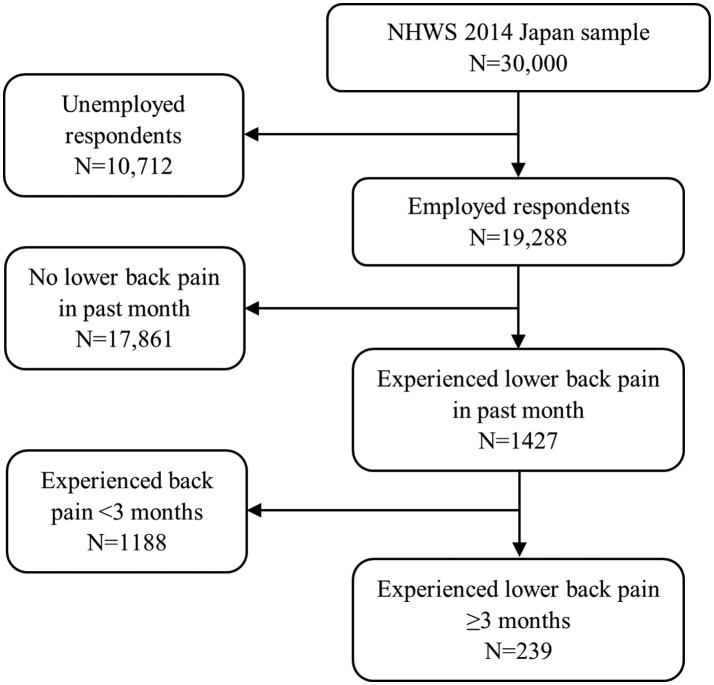
The present study used 2014 Japan National Health and Wellness Survey (NHWS) data (n=30 000). Specifically, data were included from NHWS respondents who self-reported being employed in the past week and having experienced LBP in the past month, with these symptoms lasting for at least 3 months (n=239). 84 (35.1%) participants in this study were female.
Presenteeism and HRQoL were measured using the Work Productivity and Activity Impairment Questionnaire-General Health (categorical (none: 0%, low: 10%-20%, high: ≥30%) and continuous) and Medical Outcomes Study 36-Item Short Form Health Survey, respectively. Covariates included patient demographics, health characteristics, pain characteristics and depression severity (Patient Health Questionnaire).
Presenteeism was reported by 77.4% of respondents. High (vs no) presenteeism related to more severe pain in the prior week (4.9±2.2 vs 3.6±2.1, p=0.001) and currently (5.1±2.1 vs 3.9±3.9, p=0.007), more pain sites (1.9±1.6 vs 1.1±1.4, p=0.004) and greater depression severity (7.5±6.5 vs 3.6±3.6, p<0.001). Adjusting for covariates, high (vs no) presenteeism related to lower mental and physical HRQoL. For low versus no presenteeism, significant HRQoL differences were observed in general health (43.0, 95% CI 40.3 to 45.6 vs 46.9, 95% CI 43.9 to 49.8, p=0.015).
Most respondents experienced presenteeism. Those with high or low presenteeism had poorer HRQoL than respondents with no presenteeism. Monitoring presenteeism rates may help identify workers with an unmet need for better CLBP-related pain management.
本研究旨在探讨日本慢性下腰痛(CLBP)成年患者的出勤与健康相关生活质量(HRQoL)之间的关系。
这是一项回顾性、横断面研究。
通过对日本成年一般人群的在线自我管理调查收集数据。
本研究使用了 2014 年日本国家健康与健康调查(NHWS)的数据(n=30000)。具体来说,数据包括在过去一周内报告就业并在过去一个月内经历过腰痛、且这些症状持续至少 3 个月(n=239)的 NHWS 受访者。本研究中有 84 名(35.1%)参与者为女性。
使用工作生产力和活动障碍问卷-一般健康(分类(无:0%,低:10%-20%,高:≥30%)和连续)和医疗结果研究 36 项简短健康调查分别测量出勤和 HRQoL。协变量包括患者人口统计学特征、健康特征、疼痛特征和抑郁严重程度(患者健康问卷)。
77.4%的受访者报告存在出勤。与无出勤相比,高出勤(vs 无)与过去一周更严重的疼痛(4.9±2.2 vs 3.6±2.1,p=0.001)和当前疼痛(5.1±2.1 vs 3.9±3.9,p=0.007)、更多的疼痛部位(1.9±1.6 vs 1.1±1.4,p=0.004)和更大的抑郁严重程度(7.5±6.5 vs 3.6±3.6,p<0.001)相关。调整协变量后,高(vs 无)出勤与较低的心理和身体 HRQoL 相关。与低出勤相比,在一般健康方面观察到显著的 HRQoL 差异(43.0,95%CI 40.3 至 45.6 vs 46.9,95%CI 43.9 至 49.8,p=0.015)。
大多数受访者经历过出勤。与无出勤相比,高或低出勤的患者 HRQoL 较差。监测出勤率可能有助于识别那些需要更好的 CLBP 相关疼痛管理的工人。