Department of Global Public Health and Primary Care, Centre for International Health, University of Bergen, Bergen, Norway.
School of Pharmacy, Muhimbili University of Health and Allied Sciences, Dar es Salaam, Tanzania.
BMJ Open. 2018 Jun 27;8(6):e021825. doi: 10.1136/bmjopen-2018-021825.
To estimate the economic cost of substandard and falsified human medicines and cosmetics with banned ingredients in Tanzania from 2005 to 2015.
A retrospective review of data.
Tanzania Food and Drugs Authority and premises dealing with importations and distributions of pharmaceuticals.
Confiscation reports of substandard human medicines, falsified human medicines and cosmetics with banned ingredients.
Quantities and costs of pharmaceutical products, costs of transportation, storage, court cases and disposal of products.
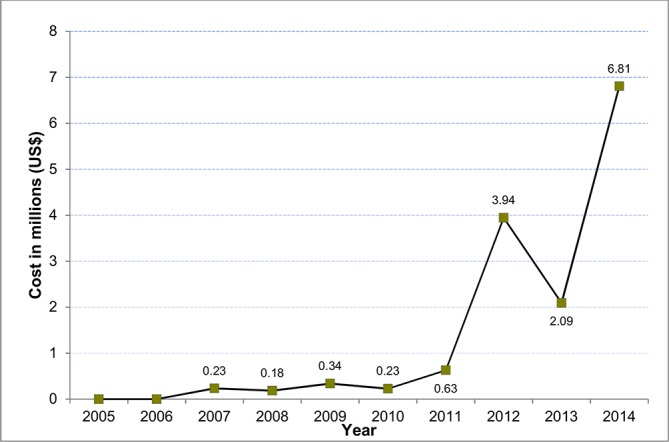
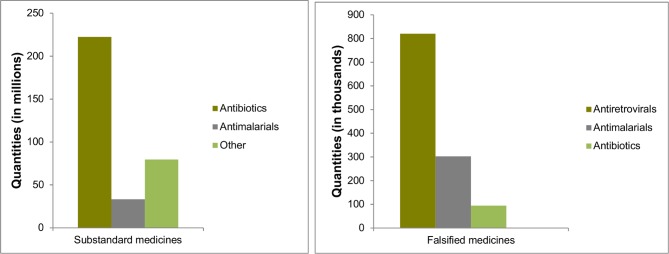
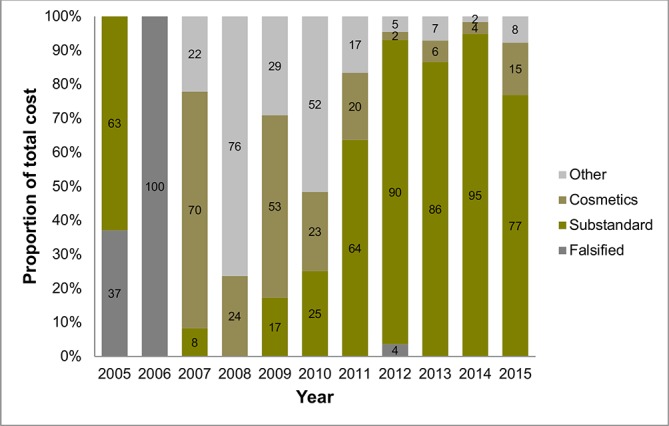
The economic cost of substandard and falsified human medicines and cosmetics with banned ingredients was estimated at US$16.2 million, that is, value of substandard medicines US$13.7 million (84.4%), falsified medicines US$0.1 million (1%), cosmetics with banned ingredients US$1.3 million (8%) and other/operational costs US$1.1 million (6.6%). Some of the identified substandard and falsified human medicines include commonly used antibiotics such as phenoxymethylpenicillin, amoxicillin, cloxacillin and co-trimoxazole; antimalarials such quinine, sulfadoxine-pyrimethamine, sulfamethoxypyrazine-pyrimethamine and artemether-lumefantrine; antiretroviral drugs; antipyretics and vitamins among others.
The economic cost of substandard and falsified human medicines and cosmetics with banned ingredients represent a relatively large loss of scarce resources for a poor country like Tanzania. We believe that the observed increase in the quantities and the economic cost of these products over time could partly be due to the improvement in the regulatory capacity in terms of human resources, infrastructure and frequency of inspections.
估计 2005 年至 2015 年期间坦桑尼亚不合规和假冒人用药品及含禁用成分化妆品的经济成本。
数据回顾性审查。
坦桑尼亚食品和药物管理局及从事药品进出口和分销的场所。
不合规人用药品、假冒人用药品和含禁用成分化妆品的没收报告。
药品数量和成本、运输成本、储存成本、法庭案件和产品处置成本。
不合规和假冒人用药品及含禁用成分化妆品的经济成本估计为 1620 万美元,即不合规药品价值 1370 万美元(84.4%)、假冒药品 10 万美元(1%)、含禁用成分化妆品 130 万美元(8%)和其他/运营成本 110 万美元(6.6%)。一些被识别的不合规和假冒人用药品包括常用抗生素,如苯氧甲基青霉素、阿莫西林、氯唑西林和复方磺胺甲噁唑;抗疟药,如奎宁、磺胺多辛-乙胺嘧啶、磺胺二甲嘧啶-乙胺嘧啶和青蒿琥酯-甲氟喹;抗逆转录病毒药物;解热镇痛药和维生素等。
不合规和假冒人用药品及含禁用成分化妆品的经济成本对坦桑尼亚这样的贫穷国家来说是相当大的稀缺资源损失。我们认为,随着时间的推移,这些产品的数量和经济成本的增加,部分原因可能是监管能力在人力资源、基础设施和检查频率方面有所提高。