Pavanello Sofia, Angelici Laura, Hoxha Mirjam, Cantone Laura, Campisi Manuela, Tirelli Amedea Silvia, Vigna Luisella, Pesatori Angela Cecilia, Bollati Valentina
Medicina del Lavoro, Dipartimento di Scienze Cardiologiche Toraciche e Vascolari, Università di Padova, Padova, Italy.
Azienda Ospedaliera di Padova, Unità di Medicina del Lavoro, Padova, Italy.
Front Endocrinol (Lausanne). 2018 Jun 13;9:309. doi: 10.3389/fendo.2018.00309. eCollection 2018.
BACKGROUND/OBJECTIVES: The pathologic relationship linking obesity and lipid dismetabolism with earlier onset of aging-related disorders, including cardiovascular disease (CVD) and type-2 diabetes (T2D), is not fully elucidate. Chronic inflammatory state, in obese individuals, may accelerate cellular aging. However, leukocyte telomere length (LTL), the cellular biological aging indicator, is elusively linked with obesity. Recent studies indicate that sterol 27-hydroxylase (CYP27A1) is an emerging antiatherogenic enzyme, that, by converting extrahepatic cholesterol to 27-hydroxycholesterol, facilitates cholesterol removal high-density lipoprotein-cholesterol (HDL-C). We tested the hypothesis that obese subjects who carry at least three copies of CYP27A1 low-hydroxylation (LH) activity genome-wide-validated alleles (rs4674345A, rs1554622A, and rs4674338G) present premature aging, as reflected in shorter LTL and higher levels of CVD/T2D risk factors, including reduced HDL-C.
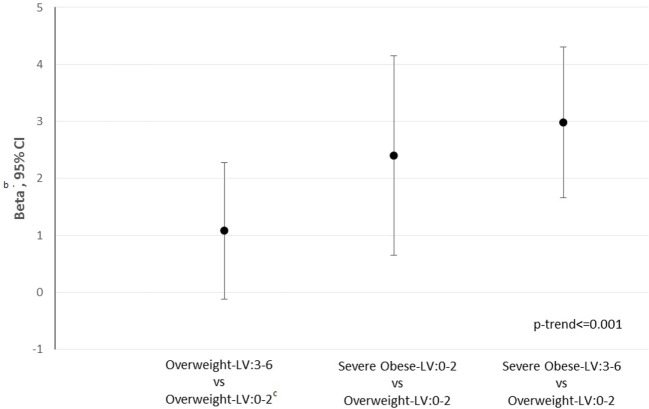
SUBJECTS/METHODS: Obese subjects from SPHERE project { = 1,457; overweight [body mass index (BMI) 25-30 kg/m] 65.8% and severe-obese (BMI > 30 kg/m) 34.2%} were characterized for the presence from 0 to 6 LH-CYP27A1 allele copy number. Univariate and multivariable sex-age-smoking-adjusted linear-regression models were performed to compare CVD/T2D risk factors and biological aging (LTL) in relation to the combined BMI-LH groups: overweight-LH: 0-2, overweight-LH: 3-6, severe-obese-LH: 0-2, and severe-obese-LH: 3-6.
Higher LTL attrition was found in severe-obese than overweight individuals ( < 0.001). Multivariable model reveals that among severe-obese patients those with LH: 3-6 present higher LTL attrition than LH: 0-2 ( < 0.05). Univariate and multivariable models remarkably show that insulin resistance is higher both in overweight-LH: 3-6 vs overweight-LH: 0-2 ( < 0.001) and in severe-obese-LH: 3-6 vs severe-obese-LH: 0-2 ( < 0.0001), and HDL-C is lower in overweight-LH: 3-6 than overweight-LH: 0-2 ( < 0.05 and < 001). Finally, most of the well-known (i.e., blood pressure, heart rate, waist to hip, triglycerides, and HDL-C) and novel CVD risk factors [i.e., inflammation markers (C-reactive protein, leukocytes, and chemoattractant protein-1), fibrinogen, and glucose homeostasis (i.e., insulin resistance, and glycated hemoglobin)] are substantially ( < 0.0001) altered in severe-obese-LH: 0-2 vs overweight-LH: 0-2, pointing to the fact that obesity leads to worsen the CVD/T2D risk factor profile.
Our study supports evidence that CYP27A1 genetic characterization identifies persons at higher risk to develop CVD and T2D, on which better converge preventive measures, and opens new perspectives on mechanisms that link obesity with aging-related disorders.
背景/目的:肥胖和脂质代谢紊乱与包括心血管疾病(CVD)和2型糖尿病(T2D)在内的与衰老相关疾病的早发之间的病理关系尚未完全阐明。肥胖个体的慢性炎症状态可能会加速细胞衰老。然而,白细胞端粒长度(LTL),即细胞生物学衰老指标,与肥胖的关系却难以捉摸。最近的研究表明,固醇27-羟化酶(CYP27A1)是一种新兴的抗动脉粥样硬化酶,它通过将肝外胆固醇转化为27-羟胆固醇,促进胆固醇通过高密度脂蛋白胆固醇(HDL-C)清除。我们检验了这样一个假设,即携带至少三个经全基因组验证的CYP27A1低羟化(LH)活性等位基因(rs4674345A、rs1554622A和rs 4674338G)的肥胖受试者存在早衰现象,表现为较短的LTL和较高水平的CVD/T2D风险因素,包括HDL-C降低。
受试者/方法:来自SPHERE项目的肥胖受试者{=1457;超重[体重指数(BMI)25 - 30kg/m²]占65.8%,重度肥胖(BMI>30kg/m²)占34.2%}根据0至6个LH-CYP27A1等位基因拷贝数的存在情况进行特征分析。进行单变量和多变量性别-年龄-吸烟调整后的线性回归模型,以比较与BMI-LH组合组相关的CVD/T2D风险因素和生物学衰老(LTL):超重-LH:0 - 2、超重-LH:3 - 6、重度肥胖-LH:0 - 2和重度肥胖-LH:3 - 6。
发现重度肥胖个体的LTL损耗高于超重个体(<0.001)。多变量模型显示,在重度肥胖患者中,LH:3 - 6的患者LTL损耗高于LH:0 - 2的患者(<0.05)。单变量和多变量模型显著表明,超重-LH:3 - 6组与超重-LH:0 - 2组相比(<0.001)以及重度肥胖-LH:3 - 6组与重度肥胖-LH:0 - 2组相比(<0.0001),胰岛素抵抗均更高,且超重-LH:3 - 6组的HDL-C低于超重-LH:0 - 2组(<0.05和<0.01)。最后,大多数知名的(即血压、心率、腰臀比、甘油三酯和HDL-C)以及新的CVD风险因素[即炎症标志物(C反应蛋白、白细胞和趋化因子蛋白-1)、纤维蛋白原和葡萄糖稳态(即胰岛素抵抗和糖化血红蛋白)]在重度肥胖-LH:0 - 2组与超重-LH:0 - 2组之间有显著(<0.0001)变化,这表明肥胖会导致CVD/T2D风险因素状况恶化。
我们的研究支持这样的证据,即CYP27A1基因特征可识别出发生CVD和T2D风险较高的人群,在此基础上可以更好地采取预防措施,并为肥胖与衰老相关疾病之间的联系机制开辟了新的视角。