Marolf Vincent, Mirra Alessandro, Fouché Nathalie, Navas de Solis Cristobal
Department of Clinical Veterinary Science, Division of Anaesthesiology and Pain Treatment, Vetsuisse Faculty, University of Bern, Bern, Switzerland.
Swiss Institute of Equine Medicine (ISME), Vetsuisse-Faculty, University of Bern and Agroscope, Bern, Switzerland.
Front Vet Sci. 2018 Jun 8;5:96. doi: 10.3389/fvets.2018.00096. eCollection 2018.
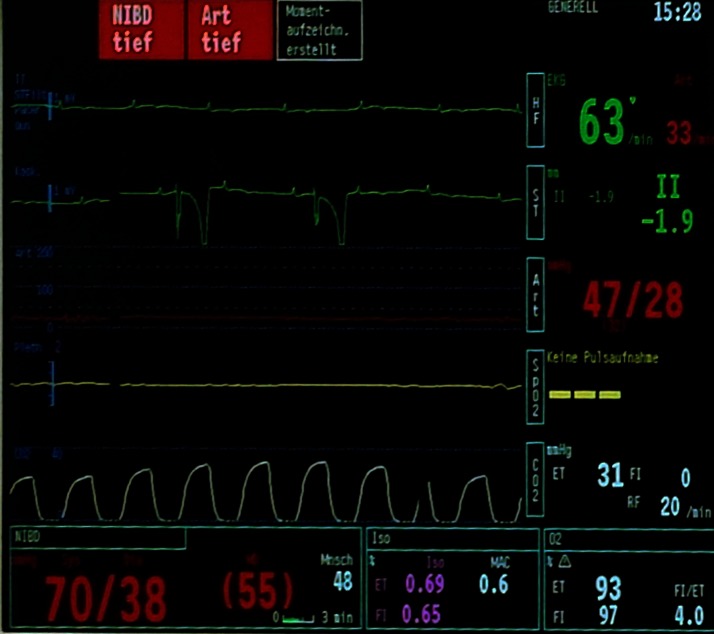
A 3-day-old Swiss Warmblood colt was diagnosed with uroabdomen after urinary bladder rupture. The foal had classical electrolyte abnormalities (hyponatremia, hypochloremia and hyperkalemia) on presentation. The foal was supported prior to surgery with intravenous fluids and the electrolyte abnormalities were treated with physiologic saline, glucose and insulin. Urine could not be drained from the abdomen prior to surgery because the omentum was continuously occluding the drainage cannula and due to progressive abdominal distension, it was decided to pursue surgery without further correction of electrolyte abnormalities. After induction of anaesthesia, signs of hypoxemia were present. Controlled mandatory ventilation using a pressure-controlled ventilation mode with positive end-expiratory pressure was initiated. Urine was drained from the abdomen by free flow. Atrio-ventricular (AV) blocks unresponsive to intravenous antimuscarinic drugs developed. After low dose of epinephrine and cardiac massage, sinus rhythm was restored. Surgery was completed successfully and the foal recovered from anaesthesia. The postoperative period was uneventful and the foal was discharged from the hospital three days later. Based on a clinical case, the purpose of the manuscript is to provide the clinician with potential causes, prevention and treatment of this already known but rarely observed dysrhythmia which could lead to fatal consequences. Definitions of cardiac arrest and asystole are reappraised. We discuss the fact that advanced AV-blocks should be treated as a cardiovascular emergency with advanced life support. The early recognition of advanced AV blocks is the first step to reduce perioperative mortality and morbidity of foal suffering from uroabdomen.
一匹3日龄的瑞士温血马驹因膀胱破裂被诊断为尿腹症。该马驹就诊时出现典型的电解质异常(低钠血症、低氯血症和高钾血症)。在手术前,通过静脉输液对马驹进行支持治疗,并使用生理盐水、葡萄糖和胰岛素治疗电解质异常。由于大网膜持续堵塞引流管,术前无法从腹腔排出尿液,且由于腹部逐渐膨胀,决定在未进一步纠正电解质异常的情况下进行手术。麻醉诱导后,出现低氧血症迹象。开始使用压力控制通气模式并设置呼气末正压进行控制强制通气。尿液通过自由引流从腹腔排出。出现了对静脉注射抗胆碱能药物无反应的房室传导阻滞。在给予小剂量肾上腺素并进行心脏按摩后,恢复了窦性心律。手术成功完成,马驹从麻醉中苏醒。术后恢复顺利,三天后马驹出院。基于一个临床病例,本文的目的是为临床医生提供这种已知但很少观察到的可导致致命后果的心律失常的潜在原因、预防和治疗方法。重新评估了心脏骤停和心搏停止的定义。我们讨论了晚期房室传导阻滞应作为需要高级生命支持的心血管急症进行治疗这一事实。早期识别晚期房室传导阻滞是降低患有尿腹症马驹围手术期死亡率和发病率的第一步。