Bell Lynne, Lamport Daniel J, Field David T, Butler Laurie T, Williams Claire M
School of Psychology and Clinical Language Sciences, University of Reading, Earley Gate, Whiteknights, Reading, UK.
Nutr Healthy Aging. 2018 Jun 15;4(4):309-322. doi: 10.3233/NHA-170038.
There is growing interest in the use of nutrition interventions to improve cognitive function. To determine intervention efficacy, repeated cognitive testing is often required. However, performance on tasks can improve through practice, irrespective of any intervention.
This study investigated practice effects for commonly used cognitive tasks (immediate and delayed recall, serial subtractions, Stroop and the Sternberg task) to identify appropriate methodology for minimising their impact on nutrition intervention outcomes.
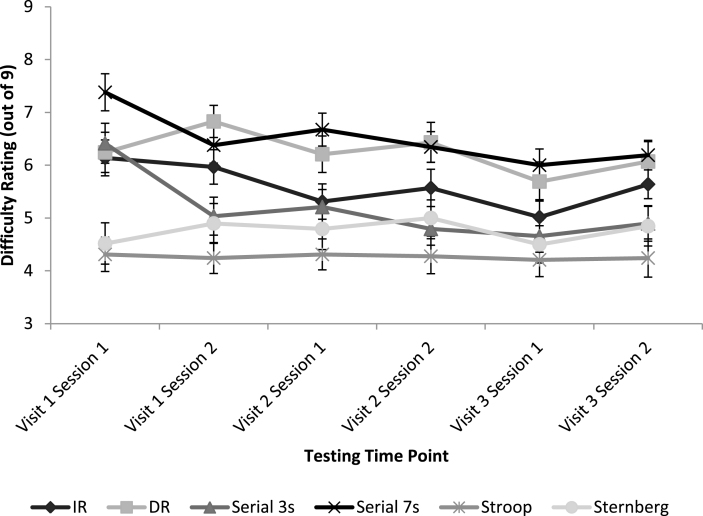
Twenty-nine healthy young adults completed six repetitions of the cognitive battery (two sessions on each of three separate visits). Subjective measures of mood, motivation and task difficulty were also recorded at each repetition.
Significant practice effects were apparent for all tasks investigated and were attenuated, but not fully eliminated, at later visits compared with the earlier visits. Motivation predicted cognitive performance for the tasks rated most difficult by participants (serial 7s, immediate and delayed recall). While increases in mental fatigue and corresponding decreases in positive mood were observed between test sessions occurring on the same day, there were no negative consequences of long term testing on mood across the duration of the study.
Practice effects were evident for all investigated cognitive tasks, with strongest effects apparent between visits one and two. Methodological recommendations to reduce the impact of practice on the statistical power of future intervention studies have been made, including the use of alternate task forms at each repetition and the provision of a familiarisation visit on a separate day prior to data collection.
人们对使用营养干预措施来改善认知功能的兴趣日益浓厚。为了确定干预效果,通常需要进行重复的认知测试。然而,无论是否进行任何干预,任务表现都可以通过练习得到提高。
本研究调查了常用认知任务(即时和延迟回忆、连续减法、斯特鲁普任务和斯特恩伯格任务)的练习效应,以确定适当的方法来最小化其对营养干预结果的影响。
29名健康的年轻成年人完成了认知测试组合的六次重复(在三次单独就诊中的每次就诊进行两部分测试)。每次重复时还记录了情绪、动机和任务难度的主观测量结果。
所有调查任务均出现显著的练习效应,与早期就诊相比,后期就诊时练习效应有所减弱,但未完全消除。动机预测了参与者评定为最难的任务(7的连续减法、即时和延迟回忆)的认知表现。虽然在同一天进行的测试环节之间观察到精神疲劳增加以及积极情绪相应下降,但在整个研究期间,长期测试对情绪没有负面影响。
所有调查的认知任务均存在练习效应,在第一次和第二次就诊之间效应最为明显。已提出方法学建议以减少练习对未来干预研究统计效力的影响,包括每次重复使用不同的任务形式,以及在数据收集前单独安排一天进行熟悉测试。