Allen J, David M, Veerman J L
Queensland Audit of Surgical Mortality, Royal Australasian College of Surgeons Brisbane Queensland Australia.
School of Public Health University of Queensland Brisbane Queensland Australia.
BJS Open. 2018 Apr 14;2(3):81-98. doi: 10.1002/bjs5.45. eCollection 2018 Jun.
Surgical-site infections (SSIs) increase the length of hospital admission and costs. SSI prevention guidelines include preoperative antibiotic prophylaxis. This review assessed the reporting quality and cost-effectiveness of preoperative antibiotics used to prevent SSI.
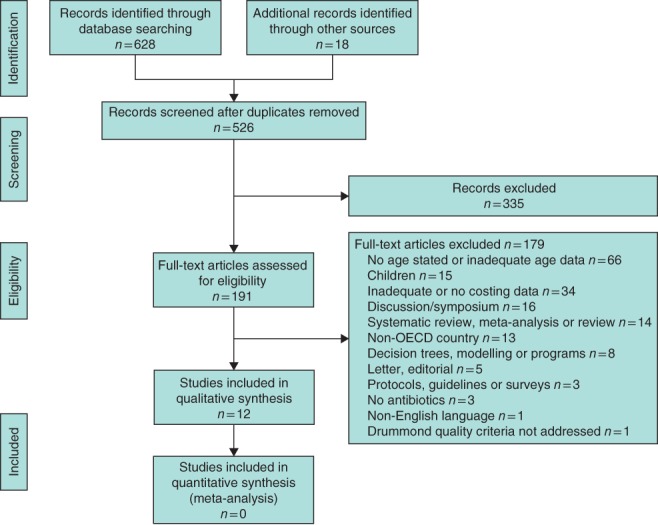
PubMed, Web of Science, Cumulative Index to Nursing and Allied Health Literature, Index of Economic Articles (EconLit), Database of Abstracts of Reviews of Effect (including the National Health Service Economic Evaluation Database) and Cochrane Central databases were searched systematically from 1970 to 2017 for articles that included costs, preoperative antibiotic prophylaxis and SSI. Included were RCTs and quasi-experimental studies conducted in Organisation for Economic Co-operation and Development countries with participants aged at least 18 years and published in English. Two reviewers assessed eligibility, with inter-rater reliability determined by Cohen's κ statistic. The Consolidated Health Economic Evaluation and Reporting Standards (CHEERS) and modified Drummond checklists were used to assess reporting and economic quality. Study outcomes and characteristics were extracted, and incremental cost-effectiveness ratios were calculated, with costs adjusted to euros (2016) (€1 = US $1·25; £1 sterling = €1·28).
Twelve studies published between 1988 and 2014 were included from 646 records identified; nine were RCTs, two were nested within RCTs and one was a retrospective chart review. Study quality was highest in the nested studies. Cephalosporins (first, second and third generation) were the most frequent prophylactic interventions. Eleven studies demonstrated clinically effective interventions; ten were cost-effective (the intervention was dominant); in one the intervention was dominated by the control; and in one the intervention was more effective and more expensive than the control.
Preoperative antibiotic prophylaxis does reduce SSI, costs to hospitals and health providers, but the reporting of economic methods in RCTs is not standardized. Routinely nesting economic methods in RCTs would improve economic evaluations and ensure appropriate selection of prophylactic antibiotics.
手术部位感染(SSIs)会延长住院时间并增加费用。SSI预防指南包括术前抗生素预防。本综述评估了用于预防SSI的术前抗生素的报告质量和成本效益。
系统检索了1970年至2017年期间的PubMed、科学网、护理及相关健康文献累积索引、经济文章索引(EconLit)、效果综述摘要数据库(包括国家卫生服务经济评估数据库)和Cochrane中心数据库,以查找包含成本、术前抗生素预防和SSI的文章。纳入的研究为在经济合作与发展组织国家进行的随机对照试验(RCTs)和准实验研究,参与者年龄至少18岁,且以英文发表。两名评审员评估研究的合格性,通过Cohen's κ统计量确定评分者间信度。使用综合健康经济评估和报告标准(CHEERS)及改良的Drummond清单来评估报告和经济质量。提取研究结果和特征,并计算增量成本效益比,成本换算为2016年欧元(1欧元 = 1.25美元;1英镑 = 1.28欧元)。
从646条记录中纳入了1988年至2014年发表的12项研究;9项为RCTs,2项嵌套于RCTs中,1项为回顾性病历审查。嵌套研究的质量最高。头孢菌素(第一代、第二代和第三代)是最常用的预防性干预措施。11项研究显示干预措施具有临床有效性;10项具有成本效益(干预措施占主导);1项干预措施被对照措施主导;1项干预措施比对照措施更有效但更昂贵。
术前抗生素预防确实能降低SSI、医院和医疗服务提供者的成本,但RCTs中经济方法的报告并不规范。在RCTs中常规嵌套经济方法将改善经济评估,并确保预防性抗生素的合理选择。