Mulder Femke E M, van der Velde Sytske, Pol Fraukje, Bos Marjolein, van Leeuwen Jules Schagen, Dietz Viviane, Hakvoort Robert A, Roovers Jan-Paul W R
Department of Obstetrics and Gynaecology, Academic Medical Centre, Meibergdreef 9 - room H4.240, 1105 AZ, Amsterdam, The Netherlands.
Department of Obstetrics and Gynaecology, Spaarne Gasthuis, Haarlem, The Netherlands.
Int Urogynecol J. 2019 May;30(5):773-778. doi: 10.1007/s00192-018-3700-9. Epub 2018 Jun 27.
Abnormal postvoid residual volumes (PVRV) after delivery are common in daily clinical practice. By using an automatic scanning device, unnecessary catheterizations can be prevented. The aim of this study was to determine the accuracy of PVRV after vaginal delivery measured by an automatic scanning device through a comparison with transurethral catheterization.
This prospective observational equivalence study was performed in patients who delivered vaginally between June 2012 and May 2017 in three teaching hospitals in The Netherlands. After the first spontaneous void after delivery, postvoid residual volume (PVRV) was measured with a portable automatic scanning device (BladderScan® BVI 9400). Directly afterward, it was measured by catheterization. Correlation between measurements was calculated using Spearman's correlation coefficient and agreement plot. The primary outcome was to validate the correlation between the BladderScan® compared with the gold standard of transurethral catheterization.
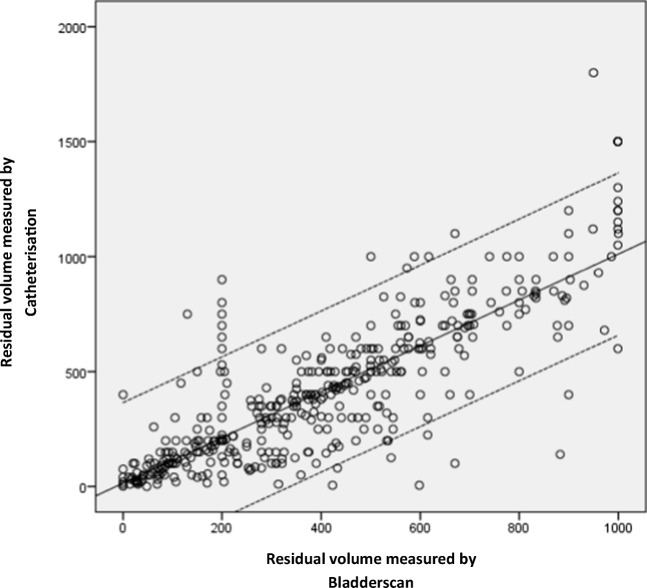
Data of 407 patients was used for final analysis. Median PVRV as measured by BladderScan® was 380 ml (± 261-0-999 ml) and by catheterization was 375 ml (± 315-1800 ml). Mean difference between measurements was -12.9 ml (± 178 ml). There was a very good correlation between methods (Spearman's rho = 0.82, p < 0.001). Using a cut-ff value of >500 ml, specificity and sensitivity were 85.4 and 85.6%, respectively.
The BladderScan® (BVI 9400) measures PVRV precisely and reliably after vaginal delivery and should be preferred over catheterization.
产后残余尿量(PVRV)异常在日常临床实践中很常见。通过使用自动扫描设备,可以避免不必要的导尿。本研究的目的是通过与经尿道导尿法比较,确定自动扫描设备测量阴道分娩后PVRV的准确性。
这项前瞻性观察性等效性研究在2012年6月至2017年5月期间于荷兰三家教学医院经阴道分娩的患者中进行。产后首次自然排尿后,使用便携式自动扫描设备(膀胱扫描仪®BVI 9400)测量残余尿量(PVRV)。随后立即通过导尿法进行测量。使用Spearman相关系数和一致性图计算测量值之间的相关性。主要结果是验证膀胱扫描仪®与经尿道导尿这一金标准之间的相关性。
407例患者的数据用于最终分析。膀胱扫描仪®测量的PVRV中位数为380毫升(±261 - 0 - 999毫升),导尿法测量的为375毫升(±315 - 1800毫升)。测量值之间的平均差异为 - 12.9毫升(±178毫升)。两种方法之间存在非常好的相关性(Spearman相关系数rho = 0.82,p < 0.001)。使用>500毫升的截断值时,特异性和敏感性分别为85.4%和85.6%。
膀胱扫描仪®(BVI 9400)在阴道分娩后能精确且可靠地测量PVRV,应优先于导尿法使用。