Baker Michael K, Peddle-McIntyre Carolyn J, Galvão Daniel A, Hunt Catherine, Spry Nigel, Newton Robert U
1 Australian Catholic University, Strathfield, New South Wales, Australia.
2 Edith Cowan University, Joondalup, Western Australia, Australia.
Integr Cancer Ther. 2018 Sep;17(3):968-978. doi: 10.1177/1534735418781489. Epub 2018 Jun 28.
Women with breast cancer are often prescribed aromatase inhibitors, which can cause rapid loss of bone mass leading to significant potential for morbidity. Vibration training has been shown to be helpful in reducing bone turnover in postmenopausal women without cancer.
To examine the effect of vibration stimulus on markers of bone turnover in breast cancer patients receiving aromatase inhibitors.
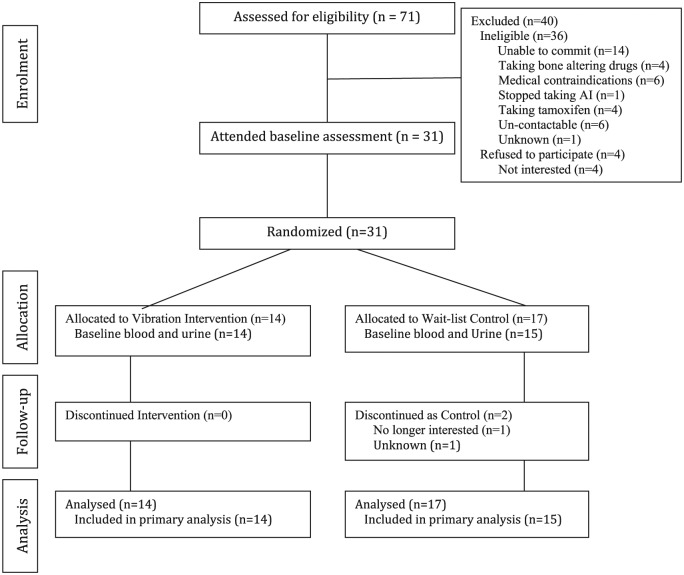
Thirty-one breast cancer survivors undergoing treatment with aromatase inhibitors were randomized to vibration stimulus (n = 14) or usual care control (n = 17). Low-frequency and low-magnitude vibration stimulus (27-32 Hz, 0.3 g) was delivered in supervised sessions via standing on a vibration platform for 20 minutes, 3 times per week for 12 weeks. The primary outcome was blood markers of bone resorption (serum N-telopeptide X/creatine) and formation (serum type 1 procollagen N-terminal propeptide; P1NP). Other study outcomes body composition as well as measures of physical functioning. Outcomes were compared between groups using analysis of covariance adjusted for baseline values as well as time on aromatase inhibitors.
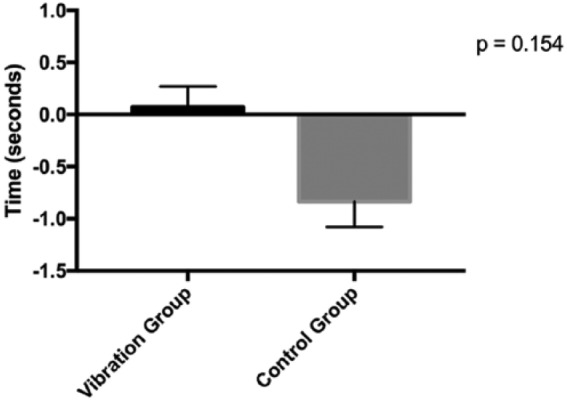
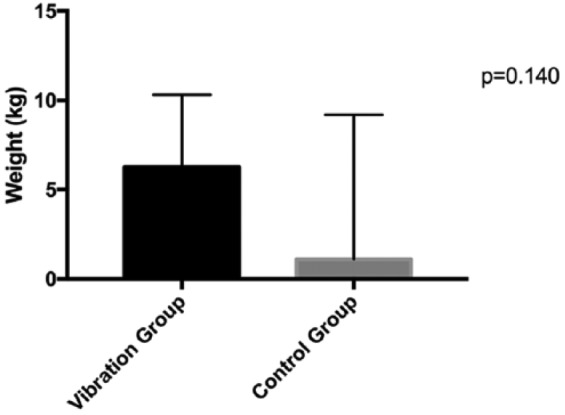
On average, participants were 61.5 years old and overweight (ie, body mass index = 28.5 kg/m). Following vibration training, there was no significant difference between groups for bone resorption (adjusted group difference 0.5, P = .929) or formation (adjusted group difference 5.3, P = .286). There were also no changes in any measure of physical functioning body composition.
Short-term low-magnitude vibration stimulus does not appear to be useful for reducing markers of bone turnover secondary to aromatase inhibitors in breast cancer patients; nor is it useful in improving physical function or symptoms. However, further investigations with larger samples and higher doses of vibration are warranted.
Australian and New Zealand Clinical Trials Registry (ACTRN12611001094965).
乳腺癌女性患者常被开芳香化酶抑制剂,这可能导致骨量迅速流失,引发显著的发病风险。振动训练已被证明有助于减少无癌症的绝经后女性的骨转换。
研究振动刺激对接受芳香化酶抑制剂治疗的乳腺癌患者骨转换标志物的影响。
31名接受芳香化酶抑制剂治疗的乳腺癌幸存者被随机分为振动刺激组(n = 14)或常规护理对照组(n = 17)。通过站立在振动平台上进行20分钟的监督训练,每周3次,共12周,给予低频低强度振动刺激(27 - 32 Hz,0.3 g)。主要结局指标是骨吸收(血清N-端肽交联物/肌酐)和骨形成(血清1型前胶原N端前肽;P1NP)的血液标志物。其他研究结局指标包括身体成分以及身体功能测量。使用协方差分析对组间结局进行比较,并对基线值以及使用芳香化酶抑制剂的时间进行调整。
参与者平均年龄为61.5岁,体重超重(即体重指数 = 28.5 kg/m)。振动训练后,两组在骨吸收(调整后的组间差异为0.5,P = 0.929)或骨形成(调整后的组间差异为5.3,P = 0.286)方面无显著差异。身体功能或身体成分的任何测量指标也没有变化。
短期低强度振动刺激似乎对降低乳腺癌患者因芳香化酶抑制剂导致的骨转换标志物无用;对改善身体功能或症状也无用。然而,有必要进行更大样本量和更高剂量振动的进一步研究。
澳大利亚和新西兰临床试验注册中心(ACTRN12611001094965)