Center for Evolution and Medicine, Arizona State University, Tempe, AZ 85287-4501.
School of Life Sciences, Arizona State University, Tempe, AZ 85287-4501.
CBE Life Sci Educ. 2018 Sep;17(3):es6. doi: 10.1187/cbe.17-12-0287.
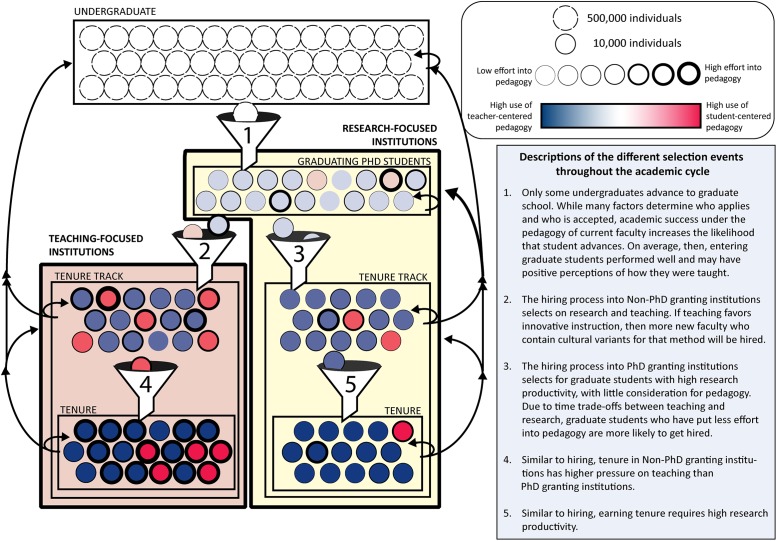
The benefits of student-centered active-learning approaches are well established, but this evidence has not directly translated into instructors adopting these evidence-based methods in higher education. To date, promoting and sustaining pedagogical change through different initiatives has proven difficult, but research on pedagogical change is advancing. To this end, we examine pedagogical behaviors through a cultural evolutionary model that stresses the global nature of the issue, the generational time that change requires, and complications introduced by academic career trajectories. We first provide an introduction to cultural evolutionary theory before describing our model, which focuses on how cultural transmission processes and selection events at different career phases shape not only who teaches in higher education, but also how they choose to teach. We leverage our model to make suggestions for expediting change in higher education. This includes reforming pedagogy in departments that produce PhD students with the greatest chance of obtaining tenure-track positions.
以学生为中心的主动学习方法的好处已得到充分证实,但这一证据并未直接转化为教师在高等教育中采用这些基于证据的方法。迄今为止,通过不同的举措来推动和维持教学法的变革一直很困难,但教学法变革的研究正在取得进展。为此,我们通过强调问题的全球性、变革所需的代际时间以及学术职业轨迹带来的复杂性的文化进化模型来审视教学行为。我们首先介绍文化进化理论,然后描述我们的模型,该模型侧重于文化传播过程以及不同职业阶段的选择事件如何不仅塑造了谁在高等教育中任教,而且还塑造了他们选择的教学方式。我们利用我们的模型为加快高等教育变革提出建议。这包括改革培养最有可能获得终身教职职位的博士生的系所的教育学。