Cooper Katelyn M, Soneral Paula A G, Brownell Sara E
Biology Education Research Lab, School of Life Sciences, Arizona State University, Tempe, AZ 85281.
Biological Sciences, Bethel University, St. Paul, MN 55112.
J Microbiol Biol Educ. 2017 May 26;18(2). doi: 10.1128/jmbe.v18i2.1287. eCollection 2017 Apr.
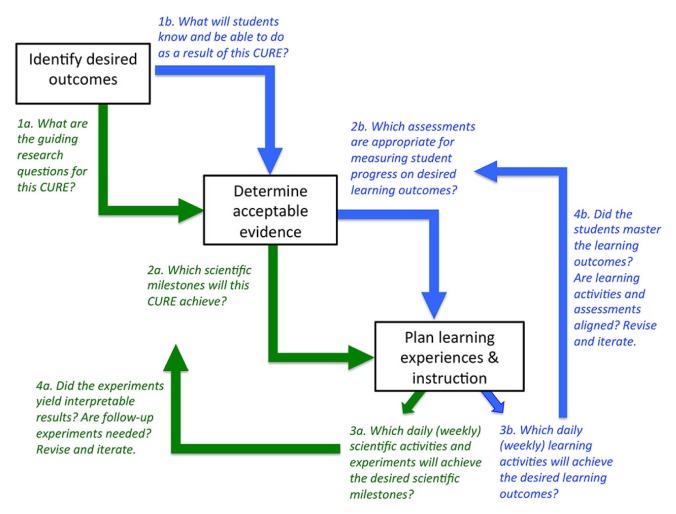
We recommend using backward design to develop course-based undergraduate research experiences (CUREs). The defining hallmark of CUREs is that students in a formal lab course explore research questions with unknown answers that are broadly relevant outside the course. Because CUREs lead to novel research findings, they represent a unique course design challenge, as the dual nature of these courses requires course designers to consider two distinct, but complementary, sets of goals for the CURE: 1) scientific discovery milestones (i.e., research goals) and 2) student learning in cognitive, psychomotor, and affective domains (i.e., pedagogical goals). As more undergraduate laboratory courses are re-imagined as CUREs, how do we thoughtfully design these courses to effectively meet both sets of goals? In this Perspectives article, we explore this question and outline recommendations for using backward design in CURE development.
我们建议采用逆向设计来开发基于课程的本科研究体验(CUREs)。CUREs的标志性特征是,参加正式实验课程的学生探索答案未知且在课程之外具有广泛相关性的研究问题。由于CUREs会产生新的研究成果,它们代表了一种独特的课程设计挑战,因为这些课程的双重性质要求课程设计者为CURE考虑两组不同但互补的目标:1)科学发现里程碑(即研究目标)和2)学生在认知、心理运动和情感领域的学习(即教学目标)。随着越来越多的本科实验课程被重新设计为CUREs,我们如何精心设计这些课程以有效实现这两组目标呢?在这篇观点文章中,我们探讨了这个问题,并概述了在CURE开发中使用逆向设计的建议。