Department of Developmental Psychology and Socialization, University of Padova, Padova, Italy.
Department of General Psychology, University of Padova, Padova, Italy.
PLoS One. 2018 Jun 28;13(6):e0199882. doi: 10.1371/journal.pone.0199882. eCollection 2018.
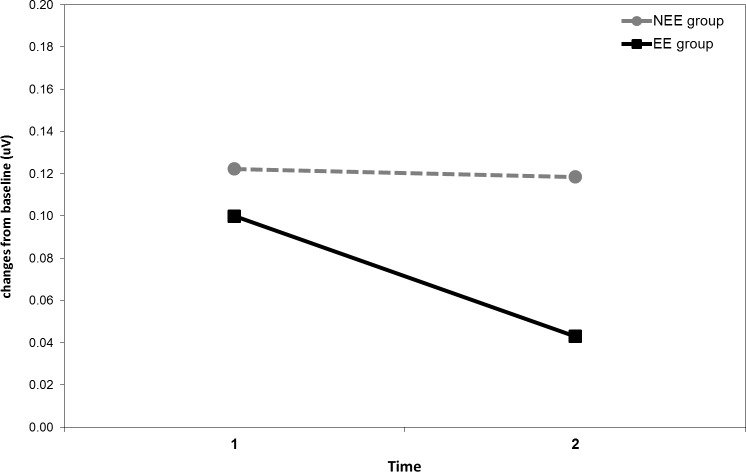
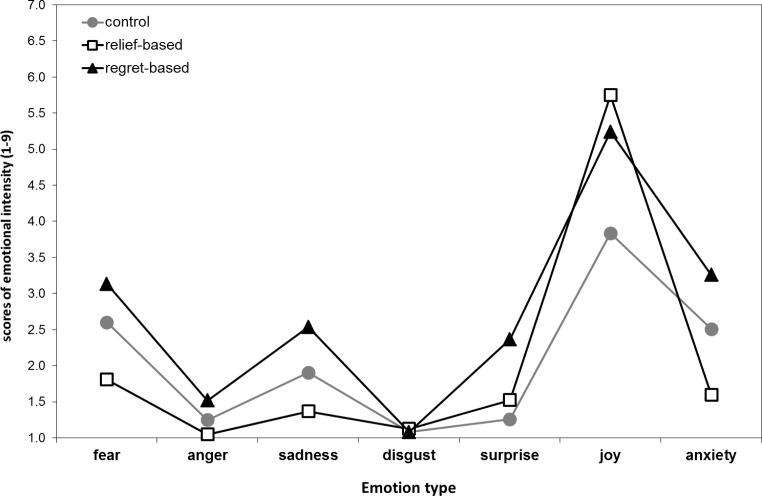
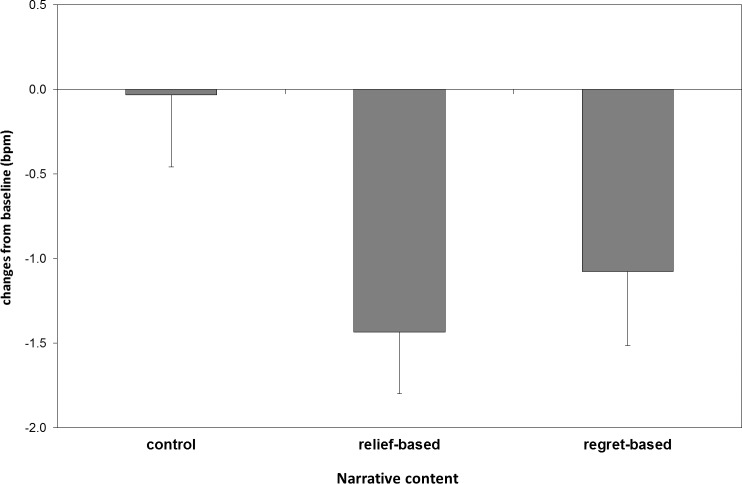
In the context of colorectal cancer screening, we aimed to compare the effectiveness of different emotion-laden narratives, to investigate the specific emotions elicited at both subjective and physiological levels, and to test the effects of emotions explicitly expressed by the narrative character. Study 1 used a between-participants design comparing four conditions: relief-based narrative, regret-based narrative, control (test-uptake only) narrative, and standard invitation material (no-narrative condition). Study 2 used a mixed design, with the narrative content as a within-participants factor and whether emotions were expressed by the narrative character or not as between-participants factor. The main outcome measures were: intention to undergo testing (Studies 1 and 2), knowledge, risk perception, proportion of informed choices (Study 1), subjective emotional responses, changes in skin conductance, heart rate, and corrugator muscle activity (Study 2). In Study 1, relative to the non-narrative condition (51%), only the relief-based narrative significantly increased intention to undergo testing (86%). Relative to the standard invitation material, the narrative conditions did not decrease knowledge, alter risk perception, or decrease the proportion of informed choices. In Study 2, the relief-based narrative elicited the lowest self-reported negative affect, and received greater implicit attention, as suggested by the larger heart rate decrease. Making the emotions experienced by the narrative character explicit decreased negative affect, as indicated by the lower skin conductance and corrugator responses during reading. Our findings provide support for the use of a relief-based narrative with emotions expressed by the character in addition to the standard information material to promote colorectal cancer screening.
在结直肠癌筛查的背景下,我们旨在比较不同情感叙事的有效性,探究在主观和生理层面上引起的具体情感,并检验叙事角色明确表达情感的效果。研究 1 采用了参与者间设计,比较了四种条件:基于缓解的叙事、基于遗憾的叙事、控制(仅测试参与)叙事和标准邀请材料(无叙事条件)。研究 2 采用了混合设计,将叙事内容作为参与者内因素,叙事角色是否表达情感作为参与者间因素。主要的测量指标包括:接受测试的意愿(研究 1 和 2)、知识、风险感知、知情选择的比例(研究 1)、主观情感反应、皮肤电导率、心率和皱眉肌活动的变化(研究 2)。在研究 1 中,与无叙事条件(51%)相比,只有基于缓解的叙事显著提高了接受测试的意愿(86%)。与标准邀请材料相比,叙事条件并未降低知识、改变风险感知,也未降低知情选择的比例。在研究 2 中,基于缓解的叙事引起的自我报告负性情绪最低,并且暗示着更大的心率下降,因此受到了更大的内隐关注。使叙事角色体验到的情感明确化,减少了负性情绪,正如阅读时皮肤电导率和皱眉肌反应较低所表明的那样。我们的研究结果为在标准信息材料之外使用表达情感的缓解叙事来促进结直肠癌筛查提供了支持。