Zebregs Simon, van den Putte Bas, de Graaf Anneke, Lammers Jeroen, Neijens Peter
The Amsterdam School of Communication Research ASCoR, Department of Communication Science, University of Amsterdam, Nieuwe Achtergracht 166, 1018 WV, Amsterdam, The Netherlands.
Trimbos Institute, Netherlands Institute for Mental Health and Addiction, Postbus 725, 3500 AS, Utrecht, The Netherlands.
BMC Public Health. 2015 Oct 23;15:1085. doi: 10.1186/s12889-015-2425-7.
Traditionally most health education materials are written in an expository non-narrative format. Scholars have argued that the effectiveness of materials may increase when these texts are replaced by narrative texts, and that the non-narrative texts should be replaced by narrative texts. However, no previous studies have tested these claims in the context of school health education for low educated adolescents. This study aims to do so for an existing preventive health education intervention about alcohol for low educated adolescents. Based on the empirical findings of previous studies, it is expected that the claims about narratives being more effective than non-narrative texts are not true for effects on knowledge. Instead non-narrative texts are expected to have a stronger impact on this outcome variable. For attitude towards alcohol and intention to drink alcohol the claims are expected to be true, because participants are expected to be less aware of the persuasive intent of the narrative texts, which would make them less resistant. As a result, narrative texts are expected to have a stronger effect on attitude and intention.
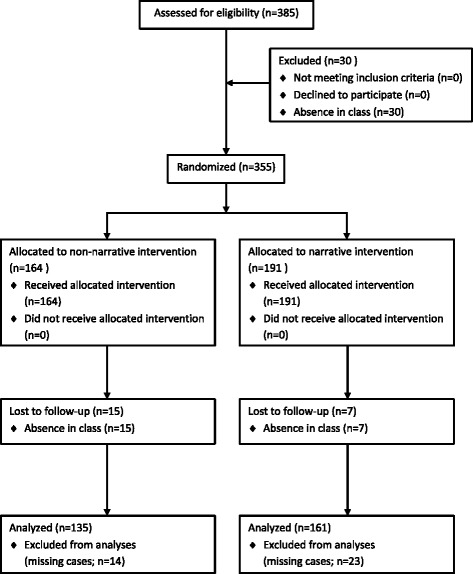
This study compares the effects on knowledge, attitude towards alcohol, and intention to drink alcohol of both information formats in a two-condition (non-narrative vs. narrative information) experiment with repeated measures (pre-measurement, immediate post-measurement, and delayed post-measurement). The experiment was conducted amongst 296 students of the two lowest levels of the Dutch secondary education system.
The results showed immediate effects on knowledge and attitude towards alcohol, which did not differ between conditions and school levels. These effects did not persist over time. There were no effects on intention to drink alcohol.
It is concluded non-narrative and narrative information are equally effective in the context of school health education, suggesting the claims that scholars have made about the superior effects of narrative texts are not true. Given the fact that narrative texts are more expensive to develop, policy makers may not be advised to prefer these types of texts over the traditionally used non-narrative texts.
传统上,大多数健康教育材料是以说明性的非叙事形式编写的。学者们认为,当这些文本被叙事文本取代时,材料的有效性可能会提高,即非叙事文本应由叙事文本取代。然而,以前没有研究在低学历青少年的学校健康教育背景下检验这些说法。本研究旨在针对现有的针对低学历青少年的酒精预防健康教育干预措施进行检验。基于先前研究的实证结果,预计关于叙事比非叙事文本更有效的说法在对知识的影响方面并不成立。相反,非叙事文本预计会对这一结果变量产生更强的影响。对于对酒精的态度和饮酒意图,预计这些说法是成立的,因为预计参与者对叙事文本的说服意图不太敏感,这会使他们的抵触情绪降低。因此,预计叙事文本会对态度和意图产生更强的影响。
本研究在一个两条件(非叙事与叙事信息)的重复测量(预测量、即时后测量和延迟后测量)实验中,比较了两种信息格式对知识、对酒精的态度和饮酒意图的影响。该实验在荷兰中等教育系统两个最低年级的296名学生中进行。
结果显示对知识和对酒精的态度有即时影响,各条件和学校年级之间没有差异。这些影响没有随时间持续。对饮酒意图没有影响。
得出的结论是,在学校健康教育背景下,非叙事和叙事信息同样有效,这表明学者们关于叙事文本具有更优效果的说法不成立。鉴于叙事文本的开发成本更高,建议政策制定者在传统使用的非叙事文本和这些类型的文本之间,不要偏向于选择这些类型的文本。