Liu Hui, Yang Xiao-Chuan, Liu Ding-Cheng, Tong Chao, Wen Wen, Chen Ri-Hui
Department of Interventional Radiology, Xiangya School of Medicine Affiliated Haikou Hospital, Central South University, Haikou, Hainan, China.
Department of Hepatobiliary Surgery, Xiangya School of Medicine Affiliated Haikou Hospital, Central South University, Haikou, Hainan, China.
Front Nutr. 2023 Apr 11;10:1156006. doi: 10.3389/fnut.2023.1156006. eCollection 2023.
The clinical value of the controlling nutritional status (CONUT) score has been widely reported in multiple malignancies. The aim of this study is to investigate the association between the CONUT score and clinical outcomes in patients with gastric cancer.
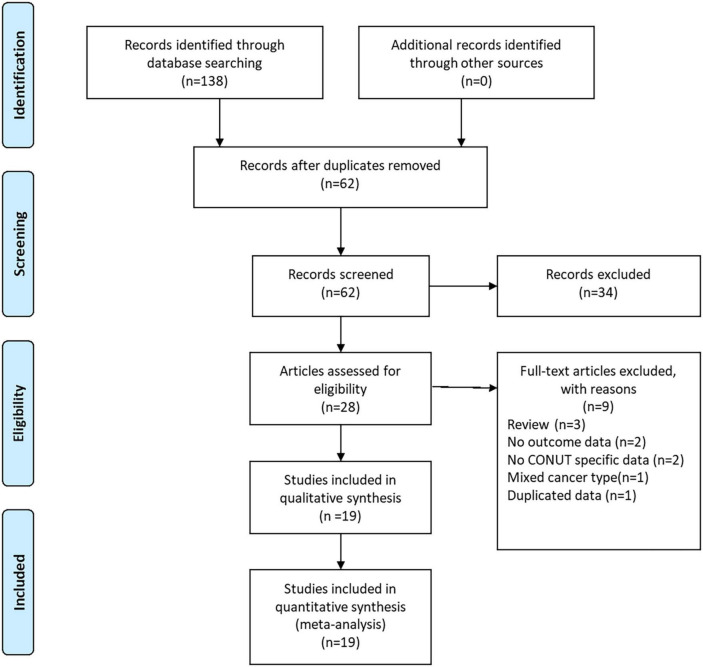
A comprehensive literature search of electronic databases including PubMed, Embase, and Web of Science was performed up to December 2022. The primary endpoints were survival outcomes and postoperative complications. Subgroup analysis and sensitivity analysis were performed during the pooled analysis.
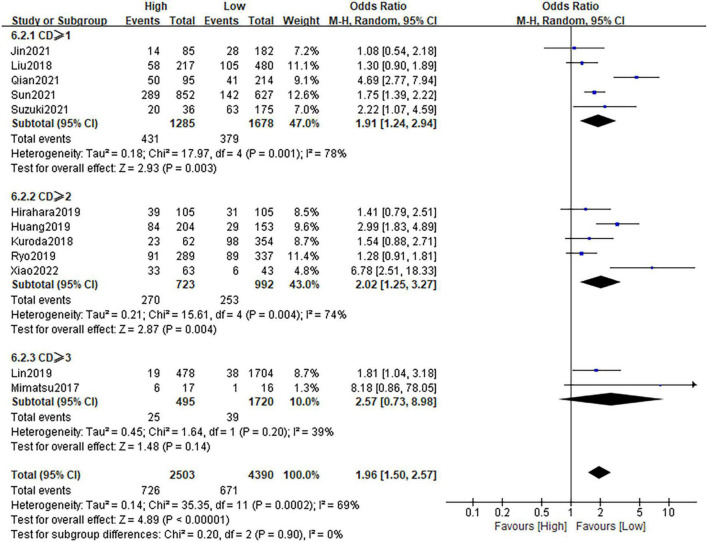
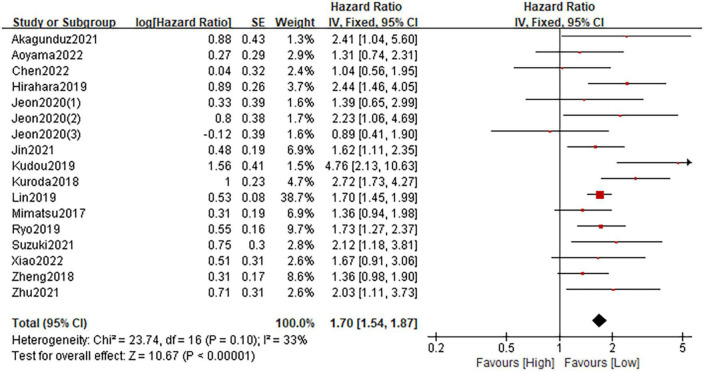
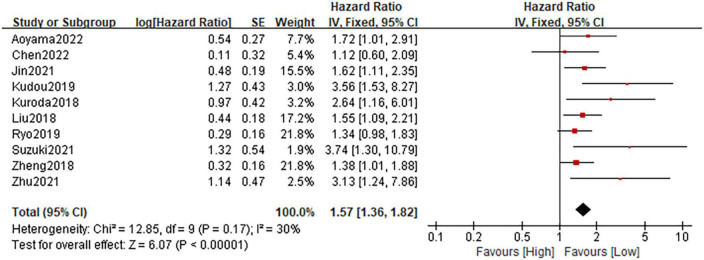
Nineteen studies including 9,764 patients were included. The pooled results indicated that patients in the high CONUT group had a worse overall survival (HR = 1.70 95%CI: 1.54-1.87; < 0.0001; = 33%) and recurrence-free survival (HR = 1.57; 95%CI: 1.36-1.82; < 0.0001; = 30%), and a higher risk of complications (OR = 1.96; 95%CI: 1.50-2.57; < 0.0001; = 69%). In addition, a high CONUT score was significantly associated with larger tumor size, higher percentage of microvascular invasion, later TNM stage and fewer patients receiving adjuvant chemotherapy, but not with tumor differentiation.
Based on existing evidence, the CONUT score could act as a valuable biomarker to predict clinical outcomes in patients with gastric cancer. Clinicians could use this useful indicator to stratify patients and formulate individual treatment plans.
控制营养状况(CONUT)评分的临床价值已在多种恶性肿瘤中得到广泛报道。本研究旨在探讨CONUT评分与胃癌患者临床结局之间的关联。
截至2022年12月,对包括PubMed、Embase和Web of Science在内的电子数据库进行了全面的文献检索。主要终点为生存结局和术后并发症。在汇总分析过程中进行了亚组分析和敏感性分析。
纳入了19项研究,共9764例患者。汇总结果表明,高CONUT评分组患者的总生存期较差(HR = 1.70,95%CI:1.54 - 1.87;P < 0.0001;I² = 33%),无复发生存期也较差(HR = 1.57;95%CI:1.36 - 1.82;P < 0.0001;I² = 30%),且并发症风险更高(OR = 1.96;95%CI:1.50 - 2.57;P < 0.0001;I² = 69%)。此外,高CONUT评分与肿瘤体积较大、微血管侵犯百分比更高、TNM分期较晚以及接受辅助化疗的患者较少显著相关,但与肿瘤分化无关。
基于现有证据,CONUT评分可作为预测胃癌患者临床结局的有价值生物标志物。临床医生可使用这一有用指标对患者进行分层并制定个体化治疗方案。