State Key Laboratory of Oncology in South China; Collaborative Innovation Center for Cancer Medicine, Sun Yat-sen University Cancer Center, Guangzhou, 510060, China.
Department of Gastric Surgery, Sun Yat-sen University Cancer Center, 651# East Dongfeng road Guangzhou, 510060, Guangdong Province, People's Republic of China.
BMC Cancer. 2018 Jun 28;18(1):699. doi: 10.1186/s12885-018-4616-y.
The prognostic value of preoperative controlling nutritional status (CONUT) has been reported in many malignancies. In present study, we aimed to clarify the prognostic impact of CONUT in gastric cancer (GC) receiving curative resection and adjuvant chemotherapy.
We retrospectively reviewed 697 consecutive patients undergoing curative surgery followed by adjuvant chemotherapy for Stage II-III GC between November 2000 and September 2012. Patients were classified into high (≥3) and low (≤2) CONUT groups according to the receiver operating characteristic (ROC) analysis.
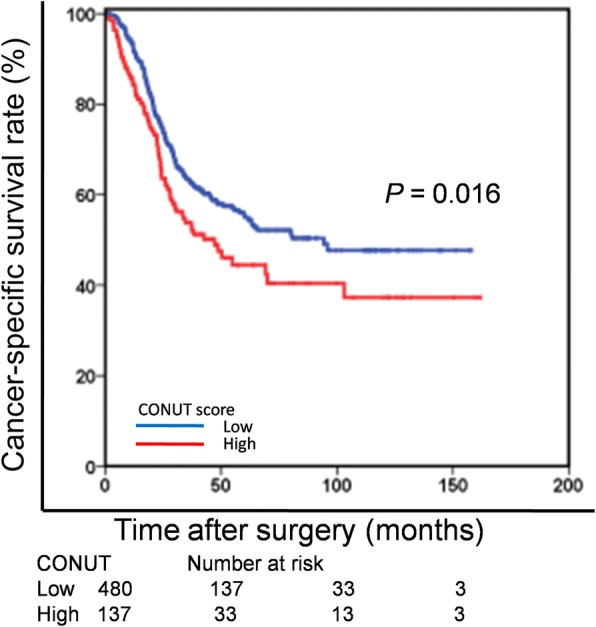
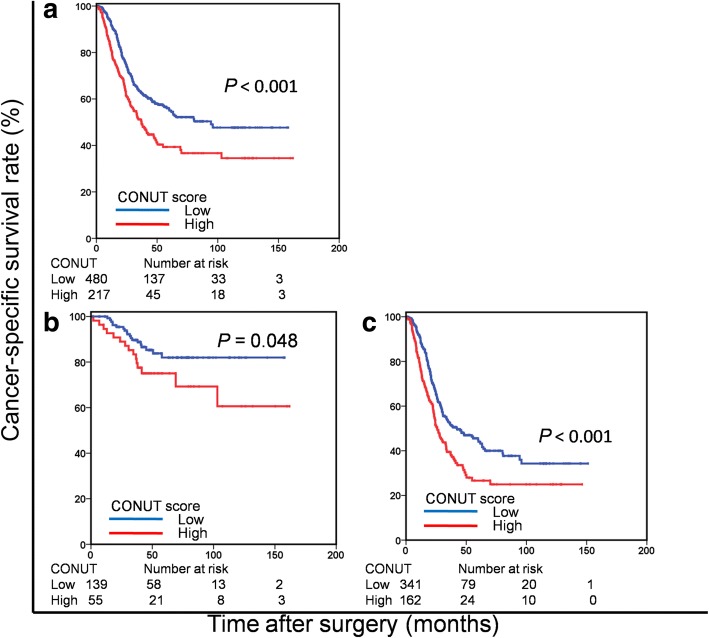
Of the included patients, 217 (31.1%) belonged to the high CONUT group. The high CONUT group had a significantly lower 5-year cancer-specific survival (CSS) rate than the low CONUT group (39.3 vs. 55.5%, P < 0.001). High CONUT score was significantly associated with larger tumor size, more lymph node metastasis, and poorer nutritional status, including lower body mass index (BMI), higher prognostic nutritional index (PNI) and the presence of preoperative anemia (all P < 0.05). Multivariate analysis revealed that CONUT score was an independent prognostic factor (HR: 1.553; 95% CI: 1.080-2.232; P = 0.017). Of note, in the low PNI group, CONUT score still effectively stratified CSS (P = 0.016). Furthermore, the prognostic significance of CONUT score was also maintained when stratified by TNM stage (all P < 0.05).
CONUT score is considered a useful nutritional marker for predicting prognosis in stage II-III GC patients undergoing curative resection and adjuvant chemotherapy, and may help to facilitate the planning of preoperative nutritional interventions.
术前控制营养状况(CONUT)的预后价值已在许多恶性肿瘤中得到报道。本研究旨在阐明 CONUT 在接受根治性切除术和辅助化疗的胃癌(GC)患者中的预后影响。
我们回顾性分析了 2000 年 11 月至 2012 年 9 月期间接受根治性手术和辅助化疗的 II 期-III 期 GC 连续 697 例患者。根据接受者操作特征(ROC)分析,患者被分为高(≥3)和低(≤2)CONUT 组。
纳入的患者中有 217 例(31.1%)属于高 CONUT 组。高 CONUT 组的 5 年癌症特异性生存率(CSS)明显低于低 CONUT 组(39.3%比 55.5%,P<0.001)。高 CONUT 评分与肿瘤较大、淋巴结转移较多和较差的营养状况显著相关,包括较低的体重指数(BMI)、较高的预后营养指数(PNI)和术前贫血的存在(均 P<0.05)。多因素分析显示,CONUT 评分是独立的预后因素(HR:1.553;95%CI:1.080-2.232;P=0.017)。值得注意的是,在低 PNI 组中,CONUT 评分仍然有效地分层 CSS(P=0.016)。此外,CONUT 评分的预后意义在 TNM 分期分层时仍然保持(均 P<0.05)。
CONUT 评分被认为是预测接受根治性切除术和辅助化疗的 II 期-III 期 GC 患者预后的有用营养标志物,并可能有助于促进术前营养干预的规划。