Uehara Ikuno, Tanaka Nobuyuki
Department of Molecular Oncology, Institute for Advanced Medical Sciences, Nippon Medical School, 1-396 Kosugi-cho, Nakahara-ku, Kawasaki 211-8533, Japan.
Cancers (Basel). 2018 Jun 27;10(7):219. doi: 10.3390/cancers10070219.
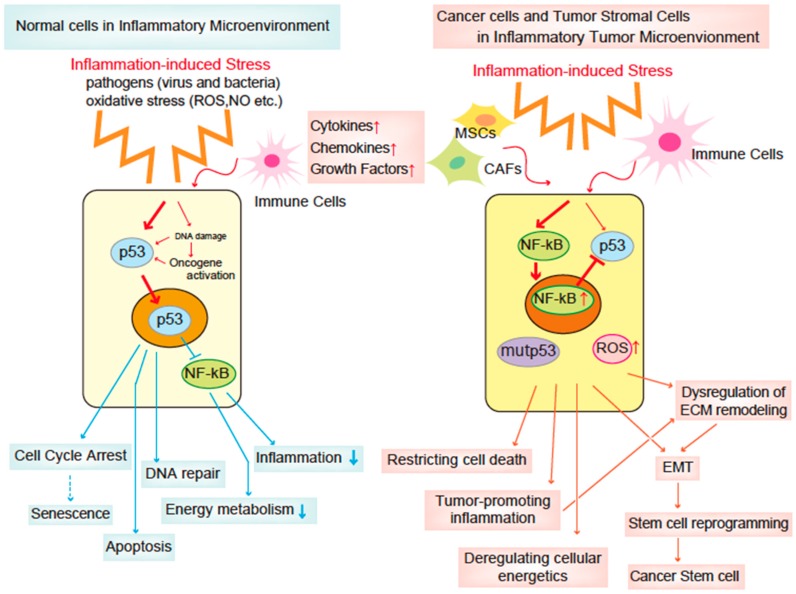
p53 has functional roles in tumor suppression as a guardian of the genome, surveillant of oncogenic cell transformation, and as recently demonstrated, a regulator of intracellular metabolism. Accumulating evidence has shown that the tumor microenvironment, accompanied by inflammation and tissue remodeling, is important for cancer proliferation, metastasis, and maintenance of cancer stem cells (CSCs) that self-renew and generate the diverse cells comprising the tumor. Furthermore, p53 has been demonstrated to inhibit inflammatory responses, and functional loss of p53 causes excessive inflammatory reactions. Moreover, the generation and maintenance of CSCs are supported by the inflammatory tumor microenvironment. Considering that the functions of p53 inhibit reprogramming of somatic cells to stem cells, p53 may have a major role in the inflammatory microenvironment as a tumor suppressor. Here, we review our current understanding of the mechanisms underlying the roles of p53 in regulation of the inflammatory microenvironment, tumor microenvironment, and tumor suppression.
p53作为基因组的守护者、致癌细胞转化的监测者以及最近所证实的细胞内代谢的调节者,在肿瘤抑制中发挥着功能性作用。越来越多的证据表明,伴有炎症和组织重塑的肿瘤微环境对于癌症增殖、转移以及自我更新并产生构成肿瘤的多种细胞的癌症干细胞(CSCs)的维持非常重要。此外,p53已被证明可抑制炎症反应,p53的功能丧失会导致过度的炎症反应。而且,炎症性肿瘤微环境支持CSCs的产生和维持。鉴于p53的功能可抑制体细胞重编程为干细胞,p53可能在炎症微环境中作为肿瘤抑制因子发挥主要作用。在此,我们综述了目前对p53在调节炎症微环境、肿瘤微环境及肿瘤抑制中所起作用的潜在机制的理解。