Wang Yin-Ling, Ge Xin-Xin, Wang Yi, Xu Meng-Dan, Gong Fei-Ran, Tao Min, Wang Wen-Jie, Shou Liu-Mei, Chen Kai, Wu Meng-Yao, Li Wei
Department of Oncology, the First Affiliated Hospital of Soochow University, Suzhou, 215006, China.
Department of Hematology, the First Affiliated Hospital of Soochow University, Suzhou, 215006, China.
BMC Gastroenterol. 2018 Jun 28;18(1):99. doi: 10.1186/s12876-018-0812-0.
The classifications and counts of white blood cells (WBCs) have been proved to be able to be used as prognostic markers in cancer cases. The present study investigated the potential values of the classifications and counts of WBC, including lymphocyte (LY), monocyte (MO), neutrophil (NE), eosinophil (EO), and basophil (BA) in the prognosis of resectable gastric cancers (GCs).
This retrospective study recruited 104 resectable GC cases which were pathologically confirmed. The patients were divided into two groups according to the median pre-treatment values. To evaluate the changes in WBC counts and classification after treatment, we introduced the concept of post/pre-treatment ratios (≤ 1 indicated count was not increased after therapy, while > 1 suggested increased count).
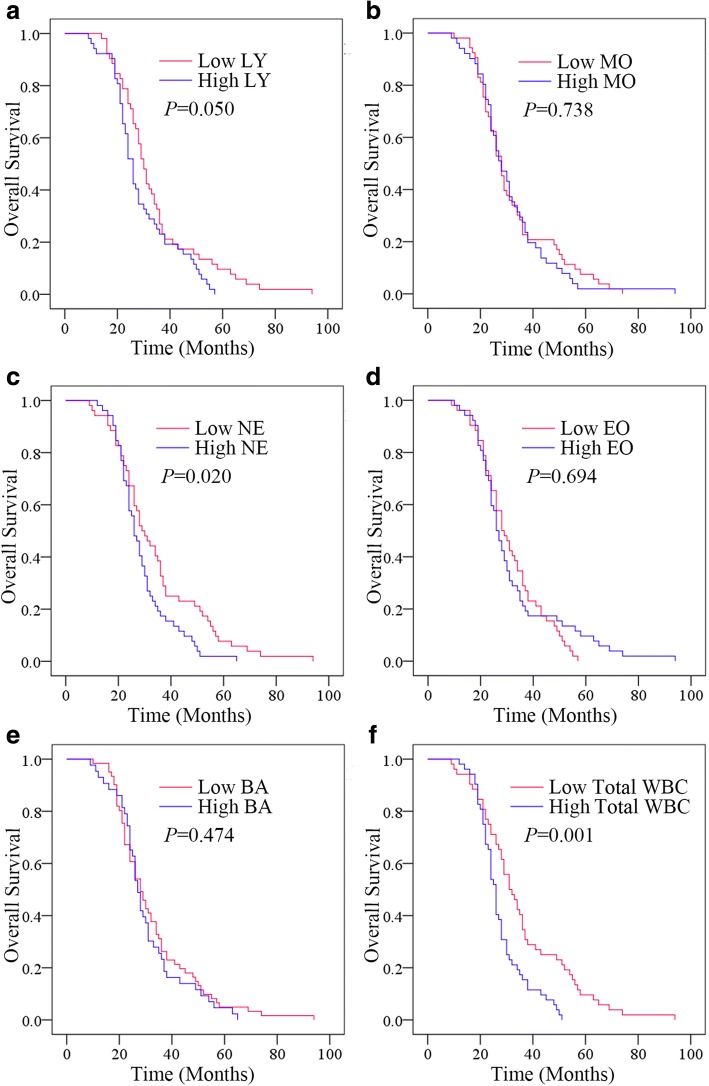
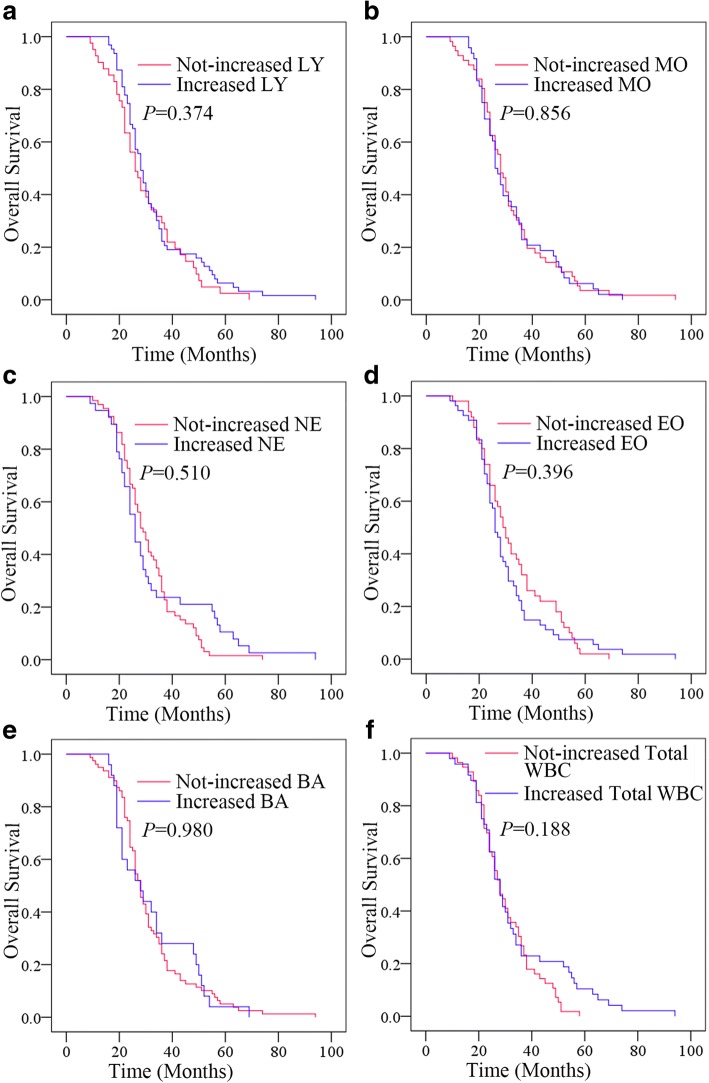
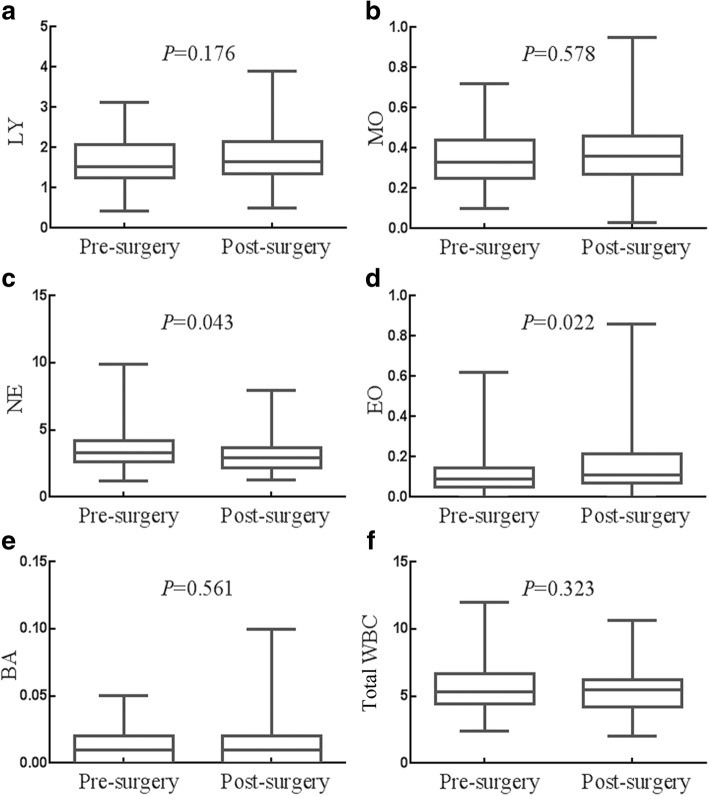
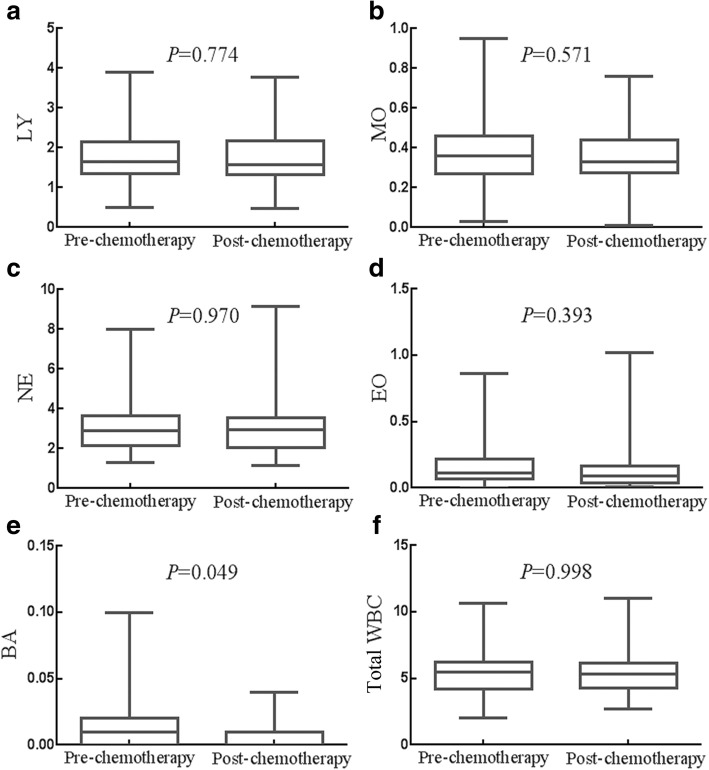
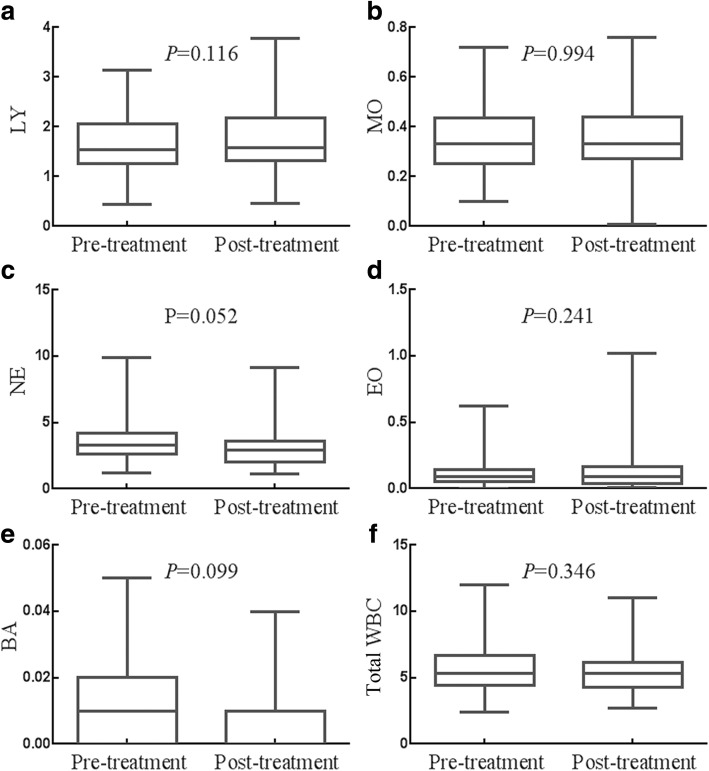
Pre-treatment NE and total WBC counts were negatively correlated with overall survival (OS). Surgery significantly decreased the level of NE count, but increased the level of EO, whereas had no effect on the levels of LY, MO, BAor total WBC. Adjuvant chemotherapy significantly decreased the level of BA. Whole course of treatment (surgery combined with adjuvant chemotherapy) had no significant effect on the counts of LY, MO, NE, EO, BA or total WBC. Post/pre-treatment ratios of LY, MO NE, EO, BA and total WBC levels had no effects on OS. Univariate analysis indicated that AJCC stage (III) and higher level of pre-treatment total WBC count were prognostic factors affecting OS. Multivariate Cox regression analysis revealed that AJCC stage (III) and higher level of pre-treatment total WBC count were independent prognostic factors.
Pre-treatment NE count and pre-treatment total WBC count may be potential prognostic factors for the prognostic evaluation of GCs.
白细胞(WBC)分类计数已被证明可作为癌症病例的预后标志物。本研究探讨了白细胞分类计数,包括淋巴细胞(LY)、单核细胞(MO)、中性粒细胞(NE)、嗜酸性粒细胞(EO)和嗜碱性粒细胞(BA)在可切除胃癌(GC)预后中的潜在价值。
本回顾性研究纳入了104例经病理证实的可切除GC病例。根据治疗前中位数将患者分为两组。为评估治疗后白细胞计数和分类的变化,我们引入了治疗后/治疗前比值的概念(≤1表示治疗后计数未增加,而>1表示计数增加)。
治疗前NE和白细胞总数与总生存期(OS)呈负相关。手术显著降低了NE计数水平,但提高了EO水平,而对LY、MO、BA或白细胞总数水平无影响。辅助化疗显著降低了BA水平。全程治疗(手术联合辅助化疗)对LY、MO、NE、EO、BA或白细胞总数无显著影响。LY、MO、NE、EO、BA和白细胞总数水平的治疗后/治疗前比值对OS无影响。单因素分析表明,美国癌症联合委员会(AJCC)分期(III期)和治疗前白细胞总数较高是影响OS的预后因素。多因素Cox回归分析显示,AJCC分期(III期)和治疗前白细胞总数较高是独立的预后因素。
治疗前NE计数和治疗前白细胞总数可能是GC预后评估的潜在预后因素。