Patel Yash R, Robbins Jeremy M, Kurgansky Katherine E, Imran Tasnim, Orkaby Ariela R, McLean Robert R, Ho Yuk-Lam, Cho Kelly, Michael Gaziano J, Djousse Luc, Gagnon David R, Joseph Jacob
Massachusetts Veterans Epidemiology and Research Information Center (MAVERIC), Veterans Affairs Boston Healthcare System, Boston, MA, USA.
Mount Sinai St Luke's & Mount Sinai West Hospitals, New York, NY, USA.
BMC Cardiovasc Disord. 2018 Jun 28;18(1):128. doi: 10.1186/s12872-018-0866-5.
Heart failure (HF) with preserved ejection fraction (HFpEF) comprises nearly half of prevalent HF, yet is challenging to curate in a large database of electronic medical records (EMR) since it requires both accurate HF diagnosis and left ventricular ejection fraction (EF) values to be consistently ≥50%.
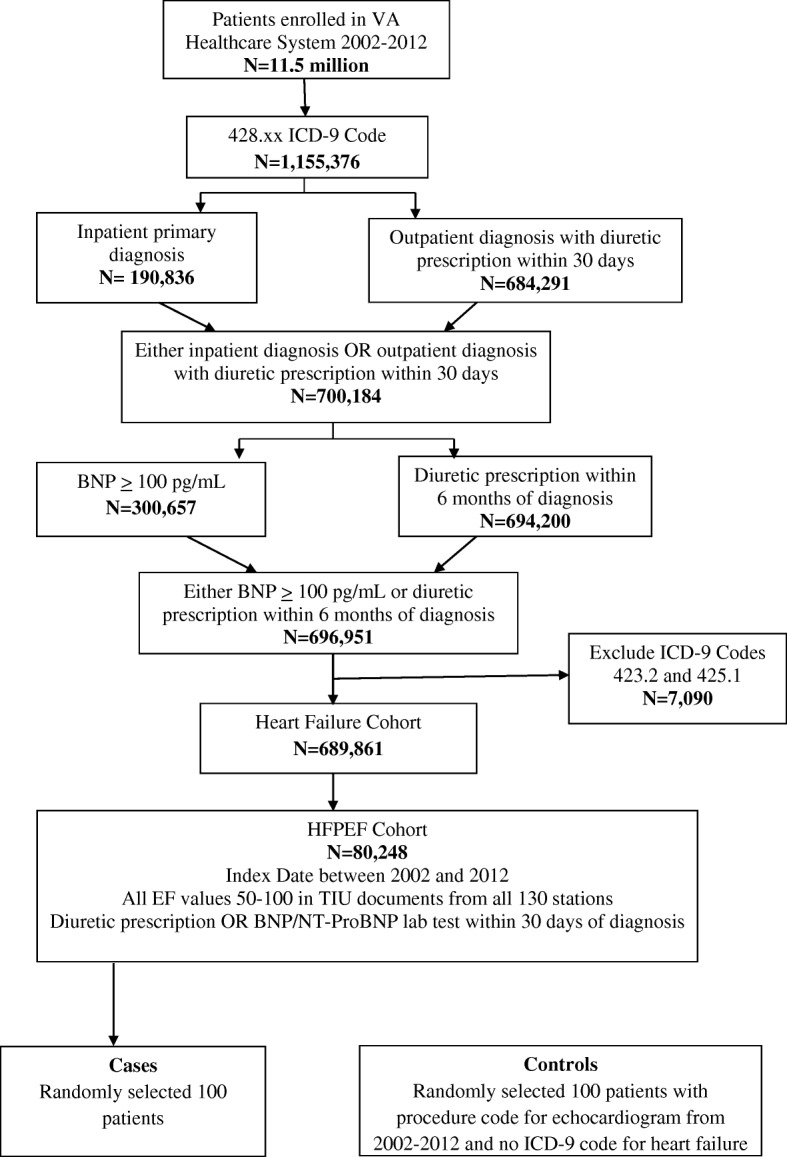
We used the national Veterans Affairs EMR to curate a cohort of HFpEF patients from 2002 to 2014. EF values were extracted from clinical documents utilizing natural language processing and an iterative approach was used to refine the algorithm for verification of clinical HFpEF. The final algorithm utilized the following inclusion criteria: any International Classification of Diseases-9 (ICD-9) code of HF (428.xx); all recorded EF ≥50%; and either B-type natriuretic peptide (BNP) or aminoterminal pro-BNP (NT-proBNP) values recorded OR diuretic use within one month of diagnosis of HF. Validation of the algorithm was performed by 3 independent reviewers doing manual chart review of 100 HFpEF cases and 100 controls.
We established a HFpEF cohort of 80,248 patients (out of a total 1,155,376 patients with the ICD-9 diagnosis of HF). Mean age was 72 years; 96% were males and 12% were African-Americans. Validation analysis of the HFpEF algorithm had a sensitivity of 88%, specificity of 96%, positive predictive value of 96%, and a negative predictive value of 87% to identify HFpEF cases.
We developed a sensitive, highly specific algorithm for detecting HFpEF in a large national database. This approach may be applicable to other large EMR databases to identify HFpEF patients.
射血分数保留的心力衰竭(HFpEF)占所有心力衰竭患者的近一半,但在大型电子病历(EMR)数据库中筛选此类患者具有挑战性,因为这需要准确的心力衰竭诊断以及左心室射血分数(EF)值持续≥50%。
我们利用美国退伍军人事务部的全国电子病历系统,筛选出2002年至2014年期间的HFpEF患者队列。利用自然语言处理技术从临床文档中提取EF值,并采用迭代方法优化算法,以验证临床HFpEF。最终算法采用以下纳入标准:任何国际疾病分类第九版(ICD-9)中的心力衰竭编码(428.xx);所有记录的EF≥50%;以及记录有B型利钠肽(BNP)或氨基末端脑钠肽前体(NT-proBNP)值,或在心力衰竭诊断后一个月内使用过利尿剂。由3名独立审阅者对100例HFpEF病例和100例对照进行人工病历审查,对算法进行验证。
我们建立了一个包含80248例患者的HFpEF队列(在总共1155376例ICD-9诊断为心力衰竭的患者中)。平均年龄为72岁;96%为男性,12%为非裔美国人。HFpEF算法的验证分析在识别HFpEF病例方面,灵敏度为88%,特异度为96%,阳性预测值为96%,阴性预测值为87%。
我们开发了一种灵敏、高特异度的算法,用于在大型国家数据库中检测HFpEF。这种方法可能适用于其他大型电子病历数据库,以识别HFpEF患者。