Faculty of Natural Sciences, Vytautas Magnus University, Vileikos 8, LT-44404, Kaunas, Lithuania.
Laboratory of Mammalian Ecology, Nature Research Centre, Akademijos st. 2, LT-08412, Vilnius, Lithuania.
Parasit Vectors. 2018 Jun 28;11(1):375. doi: 10.1186/s13071-018-2947-9.
Rickettsiae are emerging pathogens causing public health problems in many countries around the world. Rickettsia spp. are found in association with a wide range of arthropods which feed on different species of animals. However, the distribution and natural cycle of Rickettsia species and their association with different arthropod vectors are not fully established. The aim of this study was to investigate the presence and prevalence of Rickettsia spp. in ticks, mites and fleas parasitizing different species of small mammals in Lithuania and to molecularly characterize the Rickettsia spp. obtained from different ectoparasites.
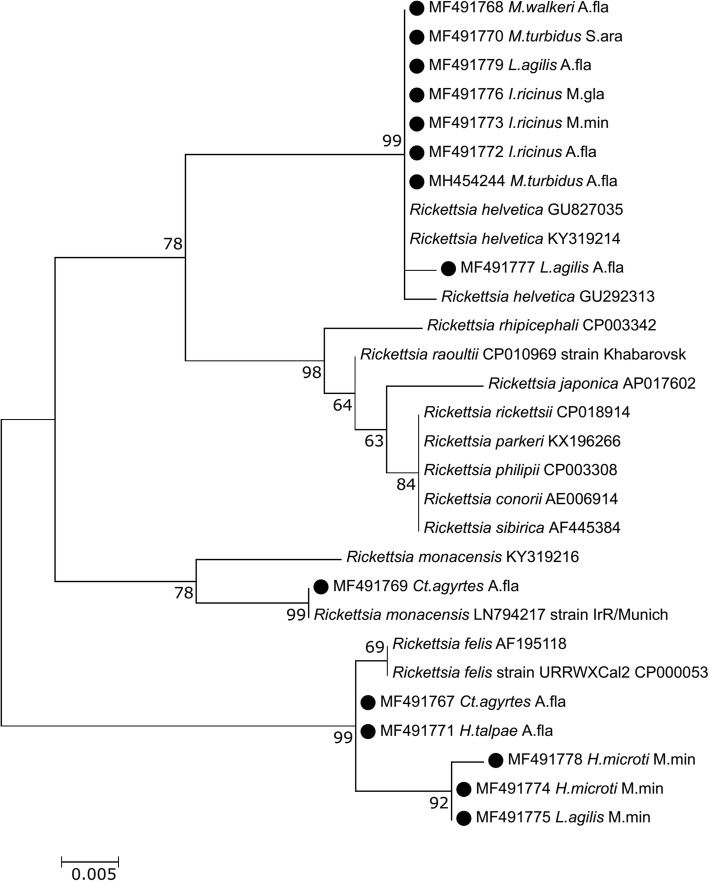
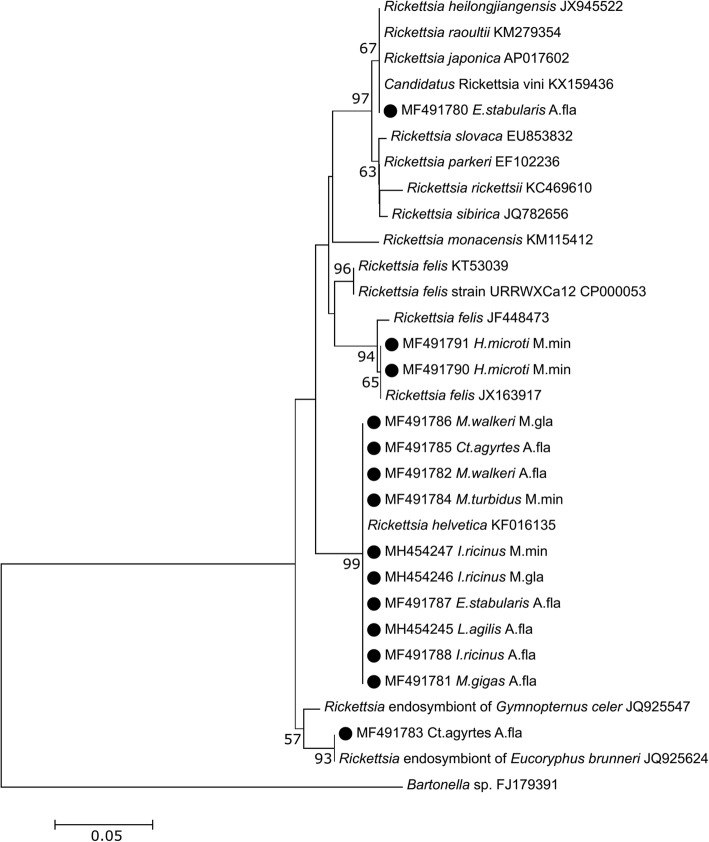
A total of 1261 ectoparasites (596 Ixodes ricinus ticks, 550 mites of five species and 115 fleas of eight species) collected from 238 rodents in Lithuania during 2013-2014 were investigated for the presence of Rickettsia pathogens. Infection rates were calculated as the maximum likelihood estimation (MLE) with 95% confidence intervals (CI). The infection rate varied among ectoparasites and was found highest in fleas 43.5%, followed by I. ricinus ticks (MLE = 26.5%; 95% CI: 22.2-31.3%) and then mites (MLE = 9.3%; 95% CI: 7.0-12.2%). Sequence analysis of partial gltA and 17kDa genes revealed the presence of Rickettsia helvetica, R. felis, R. monacensis, Rickettsia sp. and rickettsial endosymbionts. Four Rickettsia spp. were identified in fleas, while three Rickettsia spp. were identified in Laelapidae mites and only one (R. helvetica) in I. ricinus ticks.
To our knowledge, this is the first report of the occurrence and molecular characterization of Rickettsia spp. in 11 species of ectoparasites of small rodents in Lithuania. The present data extend the knowledge on the distribution of Rickettsia spp. and their association with different arthropod vectors. Prior to our study, R. felis had never been identified in Lithuania. To our knowledge, this is also the first report of R. felis in L. agilis and H. microti mites and in Ct. agyrtes and H. talpae fleas, as well as the first detection of R. monacensis in Ct. agyrtes fleas.
立克次体是一种新兴的病原体,在世界许多国家造成了公共卫生问题。立克次氏体与广泛的节肢动物有关,这些节肢动物以不同种类的动物为食。然而,立克次体的分布和自然循环及其与不同节肢动物媒介的关系尚未完全确定。本研究的目的是调查立陶宛不同小型哺乳动物的蜱、螨和蚤中是否存在立克次体,并对从不同外寄生虫中获得的立克次体进行分子特征分析。
2013-2014 年期间,从立陶宛 238 只啮齿动物中采集了 1261 只外寄生虫(596 只硬蜱、550 只 5 种螨和 115 只 8 种蚤),以检测立克次体病原体的存在。感染率采用最大似然估计(MLE)和 95%置信区间(CI)计算。外寄生虫之间的感染率不同,跳蚤最高为 43.5%,其次是硬蜱(MLE=26.5%;95%CI:22.2-31.3%),然后是螨(MLE=9.3%;95%CI:7.0-12.2%)。部分 gltA 和 17kDa 基因序列分析显示存在嗜吞噬细胞无形体、猫立克次体、蒙氏立克次体、立克次体和立克次体内共生体。在跳蚤中发现了 4 种立克次体,在 Laelapidae 螨中发现了 3 种立克次体,在硬蜱中仅发现了 1 种(嗜吞噬细胞无形体)。
据我们所知,这是立陶宛首次报道在 11 种小型啮齿动物的外寄生虫中发现立克次体的发生和分子特征。本研究数据扩展了对立克次体的分布及其与不同节肢动物媒介的关系的认识。在我们的研究之前,猫立克次体从未在立陶宛被发现。据我们所知,这也是猫立克次体首次在 L. agilis 和 H. microti 螨和 Ct. agyrtes 和 H. talpae 蚤中被发现,也是蒙氏立克次体首次在 Ct. agyrtes 跳蚤中被发现。