Minichová Lenka, Hamšíková Zuzana, Mahríková Lenka, Slovák Mirko, Kocianová Elena, Kazimírová Mária, Škultéty Ľudovít, Štefanidesová Katarína, Špitalská Eva
Institute of Virology, Biomedical Research Center, Slovak Academy of Sciences, Dúbravská cesta 9, 845 05, Bratislava, Slovakia.
Institute of Zoology, Slovak Academy of Sciences, Dúbravská cesta 9, 845 06, Bratislava, Slovakia.
Parasit Vectors. 2017 Mar 24;10(1):158. doi: 10.1186/s13071-017-2094-8.
Natural foci of tick-borne spotted fever group (SFG) rickettsiae of public health concern have been found in Slovakia, but the role of rodents in their circulation is unclear. Ticks (Ixodes ricinus, Ixodes trianguliceps, Dermacentor marginatus, Dermacentor reticulatus, Haemaphysalis concinna and Haemaphysalis inermis) and tissues of rodents (Apodemus flavicollis, Apodemus sylvaticus, Myodes glareolus, Microtus arvalis, Microtus subterraneus and Micromys minutus) were examined for the presence of SFG rickettsiae and Coxiella burnetii by molecular methods. Suburban, natural and rural habitats were monitored to acquire information on the role of ticks and rodents in the agents' maintenance in various habitat types of Slovakia.
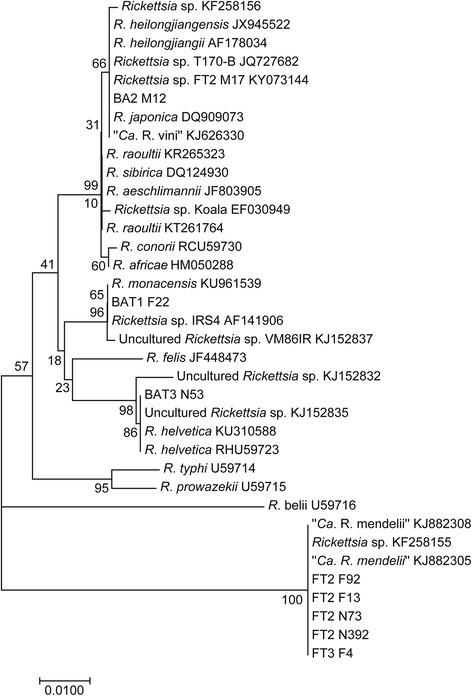
The overall prevalence of rickettsial infection in questing I. ricinus and D. marginatus was 6.6% and 21.4%, respectively. Rickettsia helvetica, R. monacensis and non-identified rickettsial species were detected in I. ricinus, whereas R. slovaca and R. raoultii were identified in D. marginatus. Rickettsia spp.-infected I. ricinus occurred during the whole tick questing period. Rickettsia helvetica dominated (80.5%) followed by R. monacensis (6.5%). The species were present in all studied habitats. Rickettsia slovaca (66.7%) and R. raoultii (33.3%) were identified in D. marginatus from the rural habitat. Apodemus flavicollis was the most infested rodent species with I. ricinus, but My. glareolus carried the highest proportion of Rickettsia-positive I. ricinus larvae. Only 0.5% of rodents (A. flavicollis) and 5.2% of engorged I. ricinus removed from My. glareolus, A. flavicollis and M. arvalis were R. helvetica- and R. monacensis-positive. Coxiella burnetii was not detected in any of the tested samples. We hypothesize that rodents could play a role as carriers of infected ticks and contribute to the maintenance of rickettsial pathogens in natural foci.
Long-term presence of SFG Rickettsia spp. was confirmed in questing ticks from different habitat types of Slovakia. The results suggest a human risk for infection with the pathogenic R. helvetica, R. monacensis, R. slovaca and R. raoultii.
斯洛伐克已发现存在对公共卫生有影响的蜱传斑点热群(SFG)立克次体自然疫源地,但啮齿动物在其传播中的作用尚不清楚。通过分子方法检测了蜱(蓖麻硬蜱、三角硬蜱、边缘革蜱、网纹革蜱、康氏血蜱和无盾血蜱)和啮齿动物(黄颈姬鼠、小林姬鼠、林姬鼠、普通田鼠、地下田鼠和巢鼠)组织中SFG立克次体和伯氏考克斯体的存在情况。对郊区、自然和农村栖息地进行了监测,以获取有关蜱和啮齿动物在斯洛伐克不同栖息地类型中病原体维持方面作用的信息。
在采集的蓖麻硬蜱和边缘革蜱中,立克次体感染的总体患病率分别为6.6%和21.4%。在蓖麻硬蜱中检测到瑞士立克次体、蒙纳立克次体和未鉴定的立克次体物种,而在边缘革蜱中鉴定出斯洛伐克立克次体和拉乌尔立克次体。感染立克次体的蓖麻硬蜱在整个蜱采集期均有出现。瑞士立克次体占主导(80.5%),其次是蒙纳立克次体(6.5%)。这些物种存在于所有研究的栖息地中。在农村栖息地的边缘革蜱中鉴定出斯洛伐克立克次体(66.7%)和拉乌尔立克次体(33.3%)。黄颈姬鼠是蓖麻硬蜱寄生最多的啮齿动物物种,但林姬鼠携带立克次体阳性蓖麻硬蜱幼虫的比例最高。仅0.5%的啮齿动物(黄颈姬鼠)和从林姬鼠、黄颈姬鼠和普通田鼠身上采集的5.2%饱血蓖麻硬蜱对瑞士立克次体和蒙纳立克次体呈阳性。在任何测试样本中均未检测到伯氏考克斯体。我们推测啮齿动物可能作为感染蜱的携带者发挥作用,并有助于自然疫源地中立克次体病原体的维持。
在斯洛伐克不同栖息地类型采集的蜱中证实了SFG立克次体物种的长期存在。结果表明人类有感染致病性瑞士立克次体、蒙纳立克次体、斯洛伐克立克次体和拉乌尔立克次体的风险。