Clinica Universidad de Navarra, Centro Investigación Medica Aplicada (CIMA), El Instituto de Investigación Sanitaria de Navarra (IDISNA), Centro de Investigación Biomédica en Red de Cáncer (CIBERONC), Pamplona, Spain
Hospital Universitario Donostia, San Sebastián, Spain.
Haematologica. 2018 Sep;103(9):1518-1526. doi: 10.3324/haematol.2017.185991. Epub 2018 Jun 28.
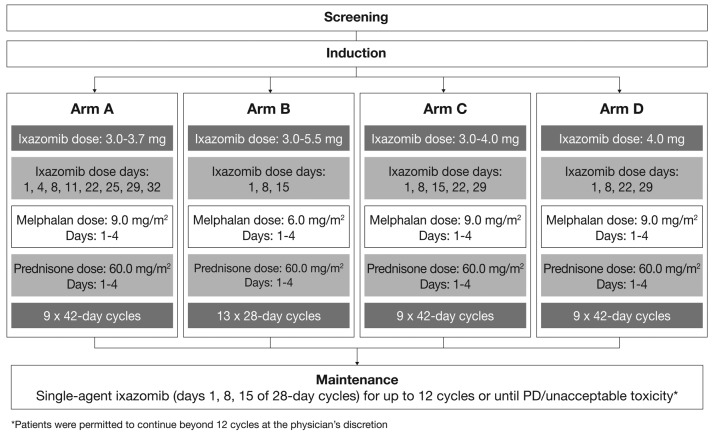
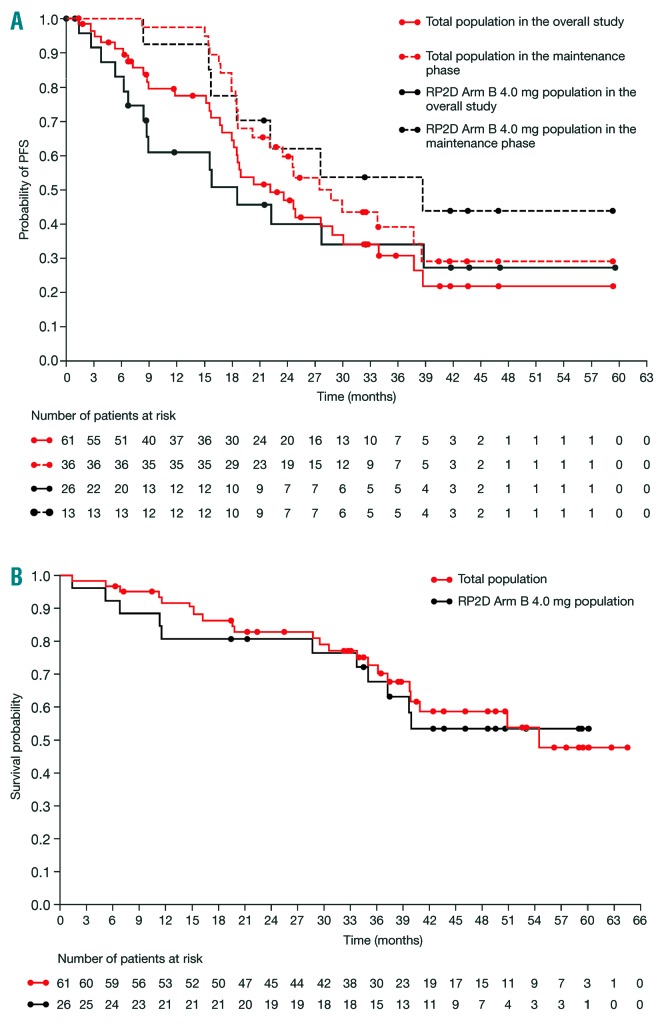
This phase I/II dose-escalation study investigated the all-oral ixazomib-melphalan-prednisone regimen, followed by single-agent ixazomib maintenance, in elderly, transplant-ineligible patients with newly diagnosed multiple myeloma. Primary phase I objectives were to determine the safety and recommended phase II dose of ixazomib-melphalan-prednisone. The primary phase II objective was to determine the complete plus very good partial response rate. In phase I, patients were enrolled to 4 arms investigating weekly or twice-weekly ixazomib (13 28-day cycles or nine 42-day cycles) plus melphalan-prednisone. In phase II, an expansion cohort was enrolled at the recommended phase II ixazomib dose. Of the 61 patients enrolled, 26 received the recommended phase II dose (ixazomib 4.0 mg [days 1, 8, 15] plus melphalan-prednisone 60 mg/m [days 1-4], 28-day cycles). Of the 61 enrolled patients, 36 (13 of 26 in the recommended phase II dose cohort) received single-agent ixazomib maintenance (days 1, 8, 15; 28-day cycles). In phase I, 10/38 patients reported dose-limiting toxicities in cycle 1, including grade 3 and/or 4 neutropenia (n=6) and thrombocytopenia (n=4). Complete plus very good partial response rate was 48% (48% at recommended phase II dose), including 28% (22%) complete response or better; responses deepened during maintenance in 34% (33%) of evaluable patients. After median follow up of 43.6 months, median progression-free survival was 22.1 months. Adverse events were mainly hematologic events, gastrointestinal events, and peripheral neuropathy. This study demonstrates the feasibility, tolerability, and activity of ixazomib-melphalan-prednisone induction and single-agent ixazomib maintenance in transplant-ineligible newly diagnosed multiple myeloma patients. .
这项 I/II 期剂量递增研究调查了新诊断多发性骨髓瘤的老年、不适合移植患者的全口服伊沙佐米-美法仑-泼尼松方案,随后进行单药伊沙佐米维持治疗。主要的 I 期目标是确定伊沙佐米-美法仑-泼尼松的安全性和推荐的 II 期剂量。主要的 II 期目标是确定完全缓解加非常好的部分缓解率。在 I 期,患者被纳入 4 个研究组,分别接受每周或每两周一次的伊沙佐米(13 个 28 天周期或 9 个 42 天周期)联合美法仑-泼尼松。在 II 期,推荐的 II 期伊沙佐米剂量扩展队列被纳入。在 61 名入组患者中,26 名患者接受了推荐的 II 期剂量(伊沙佐米 4.0mg[第 1、8、15 天]联合美法仑-泼尼松 60mg/m[第 1-4 天],28 天周期)。在 61 名入组患者中,36 名(推荐的 II 期剂量组的 13 名)接受了单药伊沙佐米维持治疗(第 1、8、15 天;28 天周期)。在 I 期,10/38 名患者在第 1 周期报告了剂量限制性毒性,包括 3 级和/或 4 级中性粒细胞减少症(n=6)和血小板减少症(n=4)。完全缓解加非常好的部分缓解率为 48%(在推荐的 II 期剂量下为 48%),包括 28%(22%)完全缓解或更好;在可评估患者中,34%(33%)的患者在维持治疗期间反应加深。中位随访 43.6 个月后,中位无进展生存期为 22.1 个月。不良事件主要为血液学事件、胃肠道事件和周围神经病。这项研究表明,在不适合移植的新诊断多发性骨髓瘤患者中,伊沙佐米-美法仑-泼尼松诱导和单药伊沙佐米维持治疗是可行、耐受和有效的。