Institute of Medical Epidemiology, Biostatistics and Informatics, Martin-Luther University Halle-Wittenberg, 06112, Halle, Germany.
Clinic of Psychiatry, Psychotherapy, and Psychosomatic, Martin-Luther University Halle-Wittenberg, 06112, Halle, Germany.
Sci Rep. 2018 Jun 28;8(1):9810. doi: 10.1038/s41598-018-27958-1.
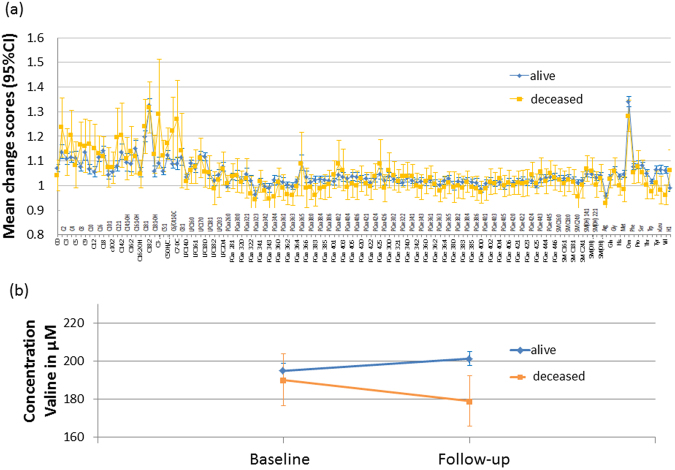
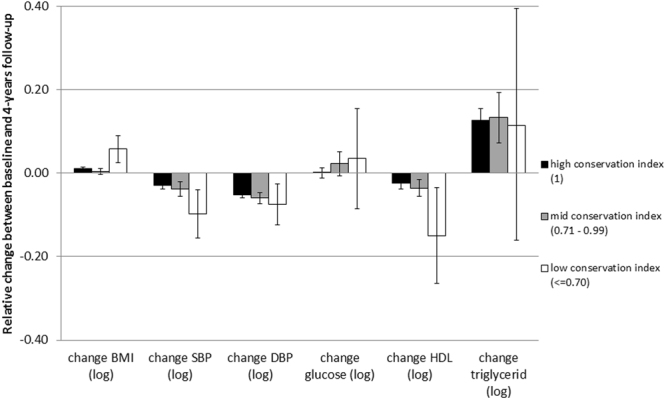
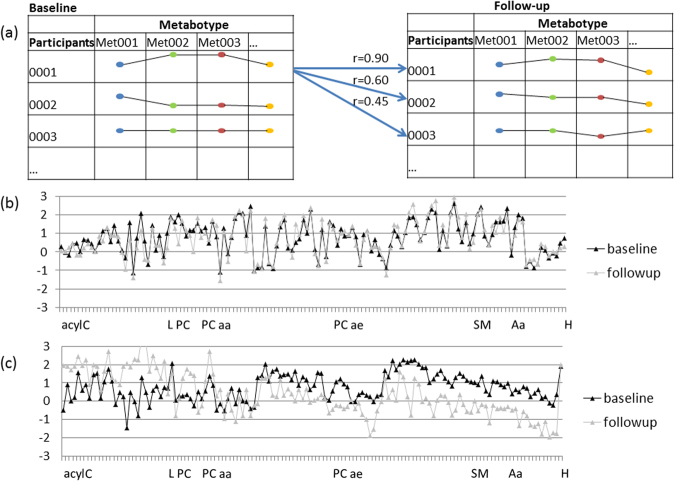
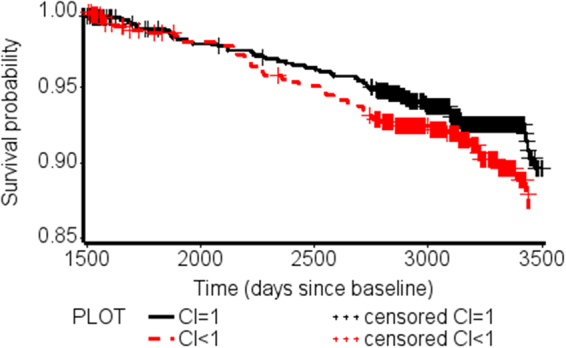
Disruption of metabolic homeostasis is an important factor in many diseases. Various metabolites have been linked to higher risk of morbidity and all-cause mortality using metabolomics in large population-based cohorts. In these studies, baseline metabolite levels were compared across subjects to identify associations with health outcomes, implying the existence of 'healthy' concentration ranges that are equally applicable to all individuals. Here, we focused on intra-individual changes in metabolite levels over time and their link to mortality, potentially allowing more personalized risk assessment. We analysed targeted metabolomics data for 134 blood metabolites from 1409 participants in the population-based CARLA cohort at baseline and after four years. Metabotypes of the majority of participants (59%) were extremely stable over time indicated by high correlation between the subjects' metabolite profiles at the two time points. Metabotype instability and, in particular, decrease of valine were associated with higher risk of all-cause mortality in 7.9 years of follow-up (hazard ratio (HR) = 1.5(95%CI = 1.0-2.3) and 0.2(95%CI = 0.1-0.3)) after multifactorial adjustment. Excluding deaths that occurred in the first year after metabolite profiling showed similar results (HR = 1.8(95%CI = 1.1-2.8)). Lower metabotype stability was also associated with incident cardiovascular disease (OR = 1.2(95%CI = 1.0-1.3)). Therefore, changes in the personal metabotype might be a valuable indicator of pre-clinical disease.
代谢稳态的破坏是许多疾病的一个重要因素。利用代谢组学在大型基于人群的队列中,各种代谢物与较高的发病率和全因死亡率相关。在这些研究中,通过比较研究对象之间的基线代谢物水平来识别与健康结果的关联,这意味着存在“健康”的浓度范围,对所有个体同样适用。在这里,我们关注的是个体随时间推移的代谢物水平的个体内变化及其与死亡率的联系,这可能允许更个性化的风险评估。我们分析了基于人群的 CARLA 队列中 1409 名参与者的 134 种血液代谢物的靶向代谢组学数据,包括基线和四年后的水平。大多数参与者(59%)的代谢类型非常稳定,这表明在两个时间点上受试者的代谢物图谱之间具有很高的相关性。代谢类型的不稳定性,特别是缬氨酸的减少,与 7.9 年的全因死亡率风险增加相关(风险比(HR)=1.5(95%CI=1.0-2.3)和 0.2(95%CI=0.1-0.3)),经过多因素调整后。排除代谢物图谱分析后第一年发生的死亡,结果相似(HR=1.8(95%CI=1.1-2.8))。较低的代谢类型稳定性也与心血管疾病的发生相关(OR=1.2(95%CI=1.0-1.3))。因此,个人代谢类型的变化可能是临床前疾病的一个有价值的指标。